When people talk about progress, their minds often go to skyscrapers, innovations, and white-collar meetings. But beneath every invention and every company logo stands a quiet force, the blue collar staff. They don’t often make headlines or appear on company social media feeds, yet without them, no city, service, or system would function for even a day.
Understanding who the blue collar staff is is not only about recognizing their work; it’s about realizing how modern life depends on their skills, consistency, and pride in craft.
The Real Meaning Behind “Blue Collar”
The phrase “blue collar” first appeared in the early 20th century. Workers who performed manual or technical labor often wore durable blue uniforms with shades that concealed dust and grease. Over time, this gave rise to the modern blue collar meaning, which refers to workers whose roles involve physical skill, technical execution, or hands-on operations.
The formal blue collar definition has expanded beyond factories and workshops. Today, blue collar staff form the operational backbone of cities, industries, and supply chains. Electricians, plumbers, drivers, technicians, nursing aides, and construction crews all fall under the umbrella of blue collar employees, even when their tools are digital or their environments are highly regulated.
If someone asks what is a blue collar worker is, the simplest answer is this: a professional whose work centers on building, maintaining, repairing, operating, or transporting the physical systems society relies on.
They build, they repair, they maintain and they do so with precision earned through time, not textbooks.
The Skills That Keep the World Running
While discussions often overvalue degrees, behind-the-scenes industries tell another story. Many blue collar employees master complex, specialized skills through years of experience. Their learning happens on the job by handling tools, reading materials, or assessing problems most people overlook.
A senior welder can visualize stress points in steel as if reading a story. A mechanic can listen to an engine and know exactly where the problem lies. A line technician ensures production never stops. Their intelligence is physical, careful, lived-in.
This is why the blue collar employees definition cannot be reduced to “manual labor.” These roles demand judgment, safety awareness, and problem-solving under real-world constraints. Quality blue collar staff are often far more irreplaceable than organizations realize.
Here are a few areas where their skills directly shape everyday comfort:
- Construction that brings safety and shelter
- Transportation that moves goods and people
- Maintenance services that keep environments clean and functional
- Manufacturing that transforms ideas into tangible products
The quiet precision of their work holds more impact than any projection or plan.
The Human Fabric of Blue Collar Work
Every blue collar staff member carries a personal story intertwined with society’s heartbeat. These are people who learn early to respect work itself, not just its rewards. Their day begins before dawn and ends after others sleep. Their satisfaction often doesn’t come from applause or recognition; it comes from completion, from knowing something tangible was made or fixed today.
In an age dominated by screens, blue collar workers keep us connected to the physical world. They represent reliability in a society overwhelmed by unpredictability.
It takes endurance, not just physical, but emotional. Repetition, deadlines, weather, and unpredictability test them daily. Yet resilience forms the foundation of their character. It’s why many industries trust blue collar staff more than anyone else when timelines are tough or margins are thin.
More Than Labor: The Discipline Behind Expertise
There’s often a silent misunderstanding that blue collar staff simply “do” while others “think.” But the truth is different. Skilled labor combines intelligence with precision; it’s practical decision-making in real time.
When a technician handles wiring or a machinist measures cuts to the millimeter, they apply focus sharper than theory can define. Their problem-solving happens by touch, sight, and deep familiarity with materials. The feedback isn’t a chart, but it’s immediate, physical proof of success or error.
This connection between the hand and the mind defines craftsmanship. It is why blue collar employees often develop a deep respect for process, safety, and accountability that carries into every task they perform.
Economic Value That Never Sleeps
The contribution of blue collar staff to national economies is immense but often invisible. They support infrastructure, sustain logistics, and uphold manufacturing standards that ripple through entire industries.
Even in countries driven by information technology or services, economies still rest on physical labor.
- Without transport staff, supply chains stall.
- Without utilities teams, cities freeze or darken.
- Without maintenance professionals, industries crumble, literally.
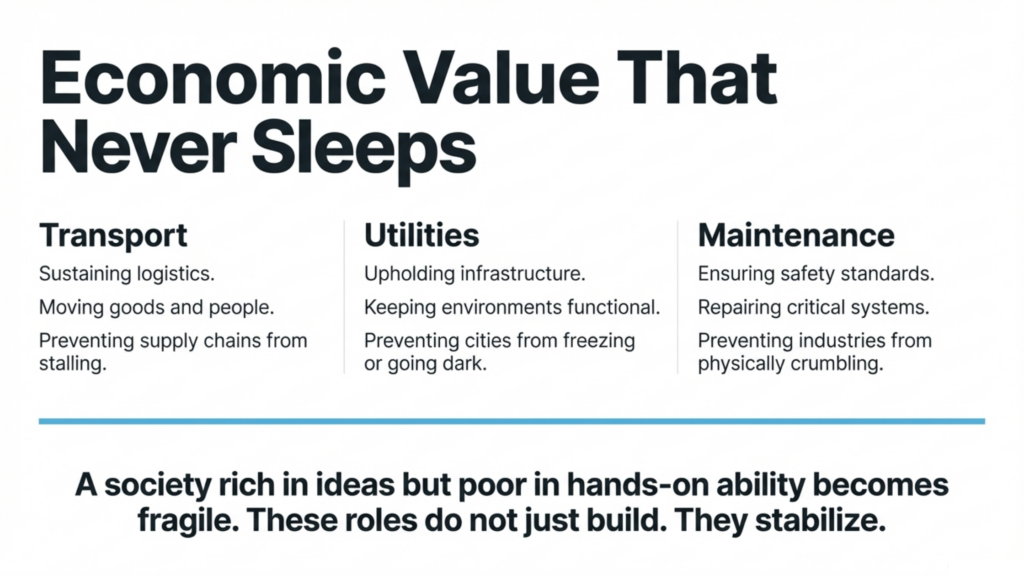
The world of work cannot separate physical creation from economic creation. A society rich in ideas but poor in hands-on ability becomes fragile. Blue collar roles don’t just build; they stabilize.
The Changing Face of Blue Collar Work
Automation and technology have changed the nature of work everywhere. Yet, contrary to popular belief, these advances have not erased blue collar staff. They’ve transformed their skill sets.
Today’s blue collar worker often uses digital tools, automated equipment, and precision software. Instead of replacing them, technology now extends their capabilities.
A factory technician reads sensor data while standing on the assembly floor. A construction engineer uses digital mapping on-site. A machine operator learns computer-aided design. These are not old-fashioned jobs; they are evolving professions that blend strength with tech literacy.
Examples of Blue Collar Jobs
Blue collar jobs encompass a diverse range of professions requiring manual labor and specialized skills. These roles are foundational to the economy and play a crucial part in various industries. Here are several examples illustrating the breadth of blue collar work:
- Construction Workers: Responsible for building, repairing, and maintaining structures. Roles can vary significantly, from skilled tradespeople like electricians and plumbers to general laborers.
- Manufacturing Technicians: Found in factories, these workers operate machinery, oversee production processes, and ensure quality control standards are met.
- Automotive Mechanics: Diagnose and repair vehicles, requiring both technical knowledge and hands-on experience, adapting to the rise of electric vehicles.
- HVAC Technicians: Install and maintain climate control systems, crucial for comfort and energy conservation.
- Welders: Join metal parts by applying heat, integral to manufacturing and construction, often working in challenging conditions.
Understanding these examples not only highlights the scope of blue collar occupations but also underscores their vital contributions. As industries evolve, so too do the opportunities and skill requirements associated with blue collar roles, emphasizing the need for ongoing training and development.
Dignity and Misconceptions
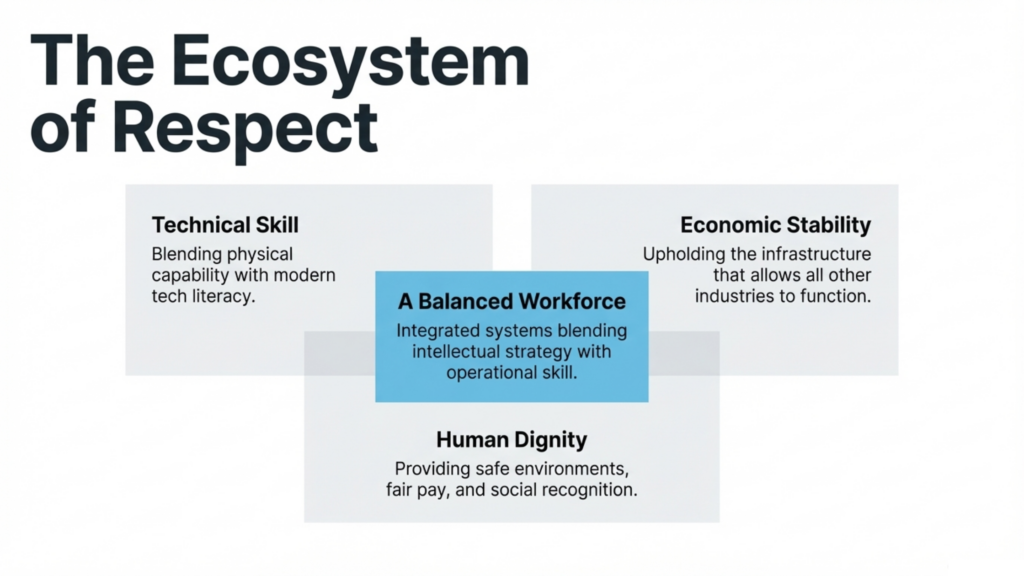
Despite their visible contribution, blue collar staff face persistent stereotypes that their jobs are less “prestigious” or less “educated.” But this division is outdated. Every industry depends on both thinkers and doers, planners and performers. Remove one side, and the other collapses.
It’s time societies redefine aspiration. Respect cannot rest solely on academic achievement. Respect should follow work that improves lives.
The dignity of the blue collar employee lies not in their title but in their reliability. They show commitment when conditions are least forgiving. And unlike many corporate roles, their results can be touched and measured: streets repaired, houses built, systems powered.
Blue Collar Staff in the Modern Workforce
Companies now recognize that a balanced workforce, one that honours the blue-collar staff, is essential for growth. Industries are moving toward integrated systems blending intellectual strategy with operational skill.
Manufacturing industries, logistics companies, and even tech organizations now create internal development programs for skill training. Governments, too, are investing in vocational education, understanding that economies thrive not only on innovation but on execution.
There is also a renewed focus on safety, fair pay, and proper working environments. The emphasis on “human-centered work design” in factories and on worksites shows an important cultural shift: blue collar workers are no longer unseen; they’re essential contributors to inclusive growth.
How to Get a Blue Collor Work?
To get a blue collar work, focus on skills, local networks, and simple applications.
Start by choosing a trade or role you like: construction, electrician, driver, warehouse, mechanic, security, cleaner, or factory work. Then check what that job needs in your area: licenses (like a driving license), basic training, or safety certificates.
Next steps that work in real life:
- Look for apprenticeships or entry-level openings through local contractors, unions, or trade schools. Many trades accept helpers with little experience if you show a willingness to learn.
- Use local, simple channels: nearby agencies, WhatsApp/Facebook job groups, community boards, and worker-first sites that allow easy, mobile applications without long resumes.
- Visit workplaces in person when possible (garages, workshops, construction sites, warehouses) and ask if they are hiring helpers or trainees. Many blue collar employers still prefer direct, face-to-face contact and short on-site interviews.
Once you get an opportunity, show up on time, follow safety rules, and keep a respectful attitude on site. Good workers get referred to better-paying roles and recommended to other employers, which is still one of the strongest ways to grow in blue collar careers.
Challenges That Still Need Attention
Despite progress, blue collar staff worldwide still face barriers, including inconsistent wages, limited social recognition, and uncertainty during economic fluctuations. Globalization offers opportunities but also risks, as cheaper labor demands can undercut fair standards.
Addressing these challenges means adopting new systems that prioritize skill development, upskilling, and financial security. The solution lies in long-term respect: providing education pathways for technical trades, improved healthcare access, and recognition that industrial expertise deserves the same weight as academic degrees.
Reforming this ecosystem would create a workforce that can confidently coexist with automation rather than fear it.
The Emotional Side of Blue Collar Life
Beyond policy, the everyday reality of blue collar staff involves subtle emotional battles. Physical exhaustion, unstable work hours, or undervalued recognition can corrode motivation over time. Many workers build not just products but entire lives around routines that demand quiet resilience.
Companies that truly value their blue collar teams invest in care time off, communication, and training. These aren’t just benefits; they’re signs of mutual respect. A motivated blue collar staff community doesn’t simply deliver results; they build a legacy.
Closing Perspective: Work That Holds the World Together
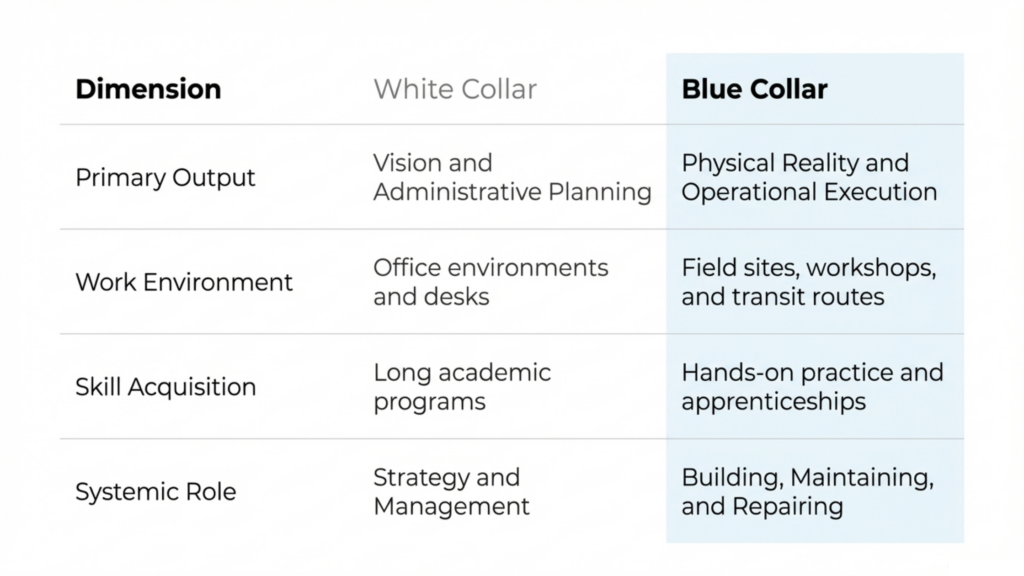
If white collar work represents vision, then blue collar staff represent reality, the translation of plans into structures that stand, roads that connect, and power that flows.
Behind every skyline is a crew that erected it. Behind every smooth system is a worker who fine-tuned it in silence. In an age obsessed with digital progress, it’s humbling to remember that the future still relies on hands that hold steady tools and minds trained in precision.
The blue collar staff doesn’t ask for applause. They ask for recognition that their work matters as much as any strategic roadmap or policy. Every economy that forgets this truth begins to weaken; every society that remembers it becomes stronger and more grounded.
Because real progress doesn’t begin at the top floor of a corporate tower, it begins at sunrise, with those who build the foundation.
Frequently Asked Questions
What does blue collar staff mean?
Blue collar staff are workers who do hands-on, physical, or skilled trade jobs rather than office or management work. Examples include electricians, plumbers, factory workers, drivers, construction workers, mechanics, and warehouse staff.
What jobs are considered blue collar?
Common blue collar jobs include construction worker, carpenter, electrician, plumber, machine operator, welder, truck driver, cleaner, security guard, warehouse associate, and maintenance technician. Many of these roles require physical work and practical skills.
What is the difference between blue collar and white collar staff?
Blue collar staff usually work in manual or operational roles (construction, manufacturing, repairs), often in uniforms or safety gear. White collar staff typically work in offices, doing administrative or managerial tasks, often in business attire and using computers most of the day.
Do blue collar staff need formal education?
Many blue collar roles do not require a university degree but often need a high school diploma plus vocational training, apprenticeships, or trade certifications. Skills are built through hands-on practice and on-the-job learning rather than long academic programs.
Can blue collar staff earn high salaries?
Yes. Skilled blue collar workers like electricians, plumbers, welders, and heavy equipment operators can earn strong incomes, especially with overtime, night shifts, or specialized certifications. In some regions, experienced tradespeople earn as much or more than many office workers.