If you’ve ever wondered why some employees stay and thrive while others quietly disengage or why a “great hire” still leaves within a year, the answer isn’t in a job title or paycheck alone. It’s in the employee lifecycle, a framework that captures the entire journey a person takes from the moment they first hear about your company to the day they walk out the door and sometimes beyond.
Understanding the employee lifecycle isn’t just an HR textbook exercise. It’s a practical roadmap that can help leaders reduce turnover, boost productivity, improve culture, and build a workforce that actually sticks.
In this post, we’ll explore:
- What the employee lifecycle really means in today’s world
- Real examples of where it succeeds or fails
- How organizations are using data and experience design to transform it
- Practical ways you can apply these ideas in your own workplace
And yes, we’ll use the keyword employee lifecycle exactly six times as promised.
What Is the Employee Lifecycle (And Why Most People Misunderstand It)
So, what is employee lifecycle? The employee lifecycle is the structured yet evolving journey of an employee’s experience, performance, and relationship with an organization from first contact to post-exit connection.
At first glance, the employee lifecycle might seem like a simple HR checklist: attraction, hiring, onboarding, development, performance, retention, separation.
But that’s the old view: static, transactional, and disconnected.
Today’s workforce is more dynamic. People don’t just move from one stage to the next like steps on a ladder. Their personal lives, learning journeys, and work identities intersect with their roles in unpredictable ways. This means that lifecycle management has to respond to psychological, social, and even physiological shifts, not just administrative ones.
For example:
- A new parent returning from leave doesn’t just “resume stage 4.” Their priorities, stress points, and motivations have shifted.
- A mid-career professional may need very different development support than an entry-level hire.
- A boomerang hire is someone returning to the company who carries institutional memory, relationships, and cultural familiarity that traditional onboarding models don’t account for.
This is why modern lifecycles are described as adaptive, data-driven, and person-centred rather than linear and static.
Why Early Experiences Set the Tone (And How Many Companies Get This Wrong)
Many organizations still treat onboarding as a checklist: paperwork, orientation sessions, and a few introductions. But studies show this early stage carries disproportionate weight.
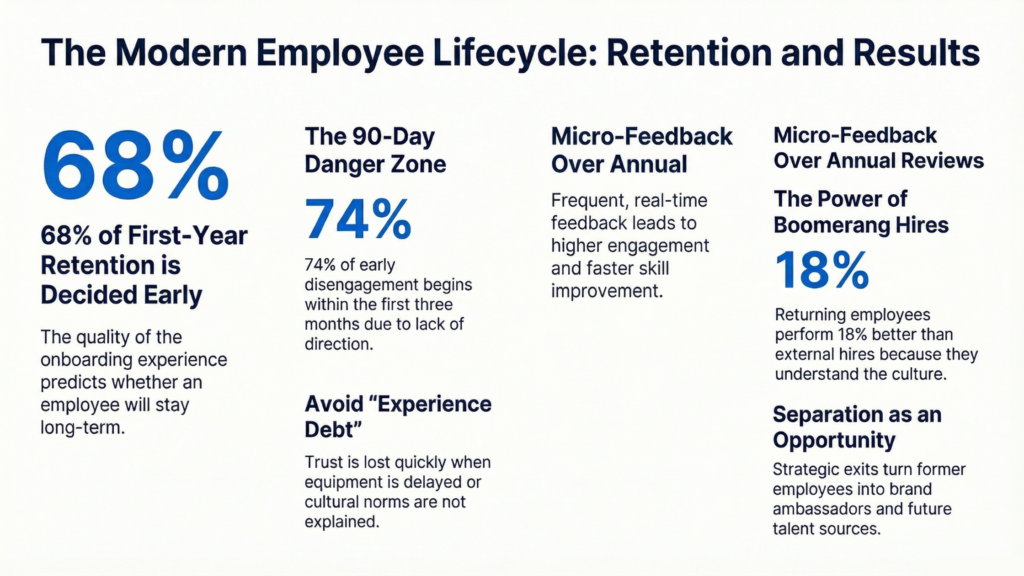
A 2025 review found that the quality of employee experience (EX) during onboarding predicts as much as 68% of first-year retention variance. This means your onboarding experience almost determines whether someone will stay or leave, not just in the first year, but in how they approach work long term.
People care about:
- Clarity of expectations
- Meaningful early work assignments
- Timely equipment and access
- Psychological safety and support networks
- Consistency between what was promised and what actually happens
When these factors fail, “EX debt” accrues, a concept HR leaders now use to describe the cumulative loss of trust caused by early missteps.
Here’s what often goes wrong early:
- Delayed equipment or workspace setup
- Managers who haven’t been trained on effective onboarding
- New hires are lacking clarity on early success indicators
- Cultural norms that aren’t explained or modelled
This is why senior HR leaders now treat onboarding as a strategic investment, not an administrative task.
Real Employee Lifecycle Challenges (And Real Examples)
To make all of this concrete, consider these workplace scenarios that most readers will instantly recognize:
Scenario: Quiet Quitting by Month Three
An employee joins and is given basic orientation, but no clear roadmap for growth. Their work feels repetitive. Their manager is infrequent. Feedback rarely comes.
Result? By day 90, they’re disengaged not because they lack ability, but because they lack direction and connection. Recent research identified that 74% of early disengagement begins in the first 90 days, often tied to a lack of psychological safety and unclear pathways forward.
This is a lifecycle problem, not a people problem.
Scenario: High Performer Leaves After a Year
A technically strong employee excels early, but yearly reviews focus only on numbers and not on development. They feel boxed into routine tasks with no new challenges.
Even though they perform well, they leave because they didn’t see growth opportunities.
This points to a lifecycle gap between performance management and career development, which is a common disconnect in many organizations.
Scenario: Returning Alums Outperform New Hires
Companies that re-hire former employees, often called “boomerang hires,” see measurable gains. Boomerang hires performed 18% better than those filled by external newcomers.
Why? Because these returning employees already understand the company’s culture, rhythm, expectations, and relationships. Their reintegration is faster and less disruptive, producing higher productivity sooner.
This insight has inspired formal alumni reconnection programs at major firms, turning separation into a strategic talent channel.
How Technology Is Reshaping the Employee Lifecycle
Today’s employee lifecycle isn’t powered by gut instinct; it’s powered by data.
Gone are the days of paper reviews and annual feedback. Now, HR teams use tools that:
- Track onboarding milestones and time to productivity
- Analyze feedback patterns in real time
- Map skills gaps and recommend personalized learning
- Correlate performance scores with retention risk
- Use AI to surface development opportunities
Technology now allows companies to detect lifecycle risks earlier. For example, identifying onboarding delays, stalled skill growth, or declining engagement signals before turnover occurs sometimes occurs up to 52% faster in technical roles.
Though still early, even neuroscience tools (like wearables or attentional tracking in virtual sessions) are being tested to measure engagement and cognitive load, signaling a shift toward predictive experience optimization.
These technologies help companies not just react to employee behaviour, but anticipate it.
Employee Lifecycle in the Real World: What Works (And Why)
Here’s where theory turns into everyday practice.
Structured Onboarding That Feels Personal
Good onboarding has:
- A clear roadmap for the first 30, 60, and 90 days
- Regular check-ins with managers and peers
- Early achievement milestones
- Training tied directly to job tasks
Employees who experience this feel grounded, capable, and connected early.
Continuous Feedback Instead of Annual Reviews
People want feedback now, not in 12 months.
Organizations that embed micro-feedback into daily work see:
- Higher engagement
- Faster skill improvement
- Reduced cycle time for course correction
This aligns with research showing that quick, actionable feedback reinforces learning far better than delayed performance reviews.
360-Degree Input for Holistic Growth
Including feedback from peers, customers, and cross-functional partners gives a more complete picture of performance, especially for roles heavy in collaboration or influence.
When done right (anonymized and calibrated), it enhances fairness and insight.
Lifecycle Analytics for Business Impact
Leading companies connect lifecycle data (onboarding success, performance trends, engagement scores, turnover patterns) into a unified dashboard. This reveals early warning signals and helps HR intervene before problems escalate.
For example:
- Onboarding dropoff patterns may predict first-year turnover
- Low pulse survey scores may predict engagement dips months in advance
This data turns lifecycle management into strategic foresight.
Why Separation Matters (Even If They Leave)
The end of the employee lifecycle isn’t an exit interview and a goodbye email. It’s an opportunity.
Exit interviews, especially if processed with sentiment analysis, can reveal systemic issues seldom captured in regular reviews, such as unresolved conflict, unclear leadership expectations, or cultural blind spots.
Moreover, if former employees leave with goodwill, they become:
- Alumni ambassadors
- Referral sources
- Future boomerang hires
Treating separation as a stage, not a loss, creates a learning loop that strengthens the entire lifecycle.
Employee Lifecycle Challenges You Should Know About
Even forward-thinking organizations face roadblocks.
1. Lifecycle Silos
Often, recruitment, onboarding, performance, and separation are run by different teams with different data systems. This breaks continuity.
Solution: Create unified data models and shared governance across stages.
2. Psychological Safety Gaps
Workplaces focus on productivity metrics but underestimate the safety, the ability to speak up, learn from failure, or challenge norms.
Solution: Integrate safety check-ins into feedback systems and prepare managers to coach, not judge.
3. Benefits and Life-Course Alignment
Personal life developments, parenthood, health challenges, and caregiving intersect with the lifecycle. Ignoring them increases disengagement.
Solution: Give flexible work options, tailored support, and learning pathways aligned with life stages.
The Future of Employee Lifecycle
The employee lifecycle is no longer a back-office HR model. It is a living system that touches every human moment in work, from first curiosity about a job to final farewell and sometimes reunion.
Today’s best practices treat it as:
- A unified, adaptive experience
- A source of competitive performance data
- A driver of culture, not just compliance
- A bridge between personal and organizational growth
Organizations that manage the employee lifecycle intentionally don’t just reduce turnover; they create compounding performance advantages. When early experiences build trust, development systems support growth, and exits feed learning back into the system, the workforce becomes more capable over time. That is no longer an HR initiative. It is an operational strategy.
Frequently Asked Questions
What are the 7 stages of employee lifecycle?
Attract → Recruit → Onboard → Engage → Develop → Retain → Exit. Each stage leaks talent if ignored 37% HR leaders say retention fails here.
Why does onboarding fail 60% of the time?
No Day 1 manager intro + tool access delays. New hires ghost by Week 2. Fix: Peer buddy + checklist app = 85% retention at 90 days.
How do you cut voluntary turnover 25% in retention stage?
Weekly pulse surveys + instant recognition. AI flags flight risks early. Top fix: Match market pay before they job hunt.
What kills development stage the most (42% HR priority)?
No personalized learning paths. Generic training = disengagement. Fix: AI skill gap analysis + 1:1 growth plans = 2x promotion rates.
How do you measure lifecycle ROI across stages?
eNPS per stage + cost-to-hire vs. retention. Track “time to productivity” (target: 60 days). Bad onboarding = 3x higher exit Year 1.