A good interview asks for stories that show temperament, lesson design, communication, and ethical judgment, and the best answers prove those things with short, concrete examples. Hiring a teacher is different from hiring many other roles. You’re not just checking skills; you’re checking judgment, classroom presence, and how a person acts under noise, change, and human complexity. When candidates search for interview questions and answers for a teacher or try to understand which teacher interview questions matter most, what they’re really looking for is clarity on what to say, why it matters, and how to show impact without sounding rehearsed.
This guide groups the most revealing questions into themes you will almost always face (or ask), gives strong Sample answers, shows what interviewers listen for beyond the words, and explains how to turn one story into multiple answers. Use it whether you’re preparing for a primary classroom role, a secondary subject post, or an administrative/department position.
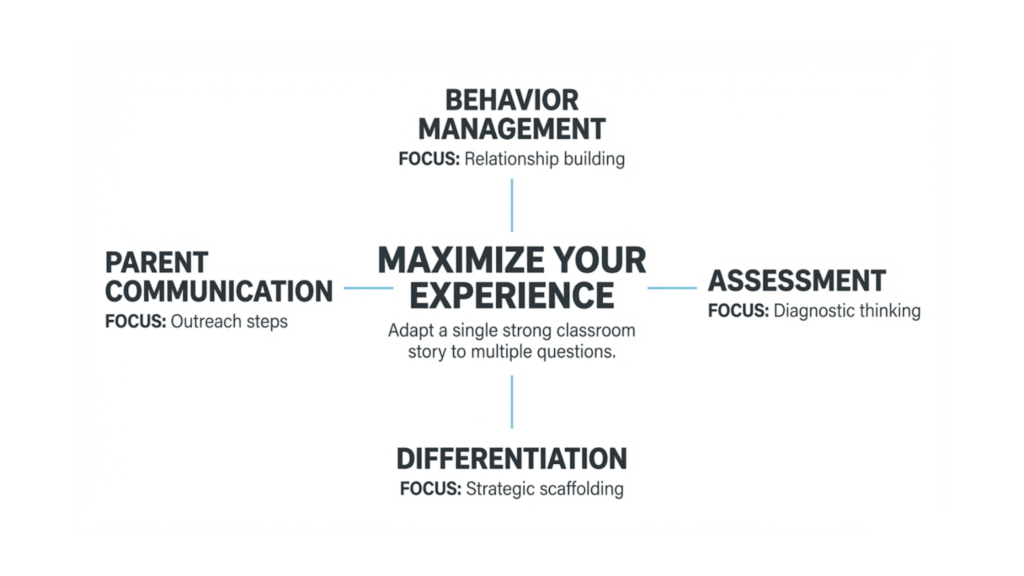
Turning One Story Into Many Answers (Useful Trick)
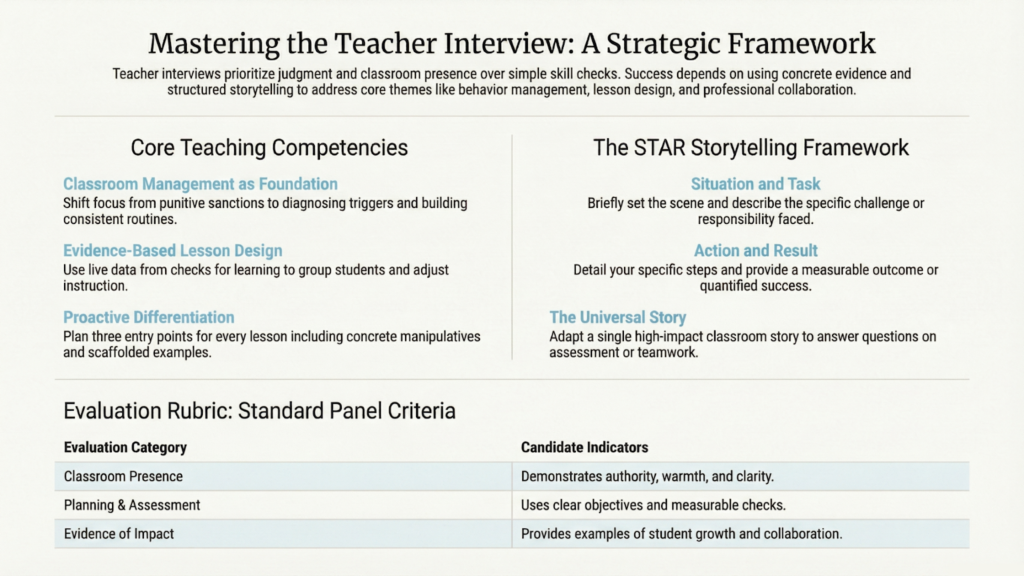
A single well-chosen classroom story can be adapted to answer multiple questions: behavior management, parent communication, assessment, and teamwork. Frame it differently depending on the question. Highlight the diagnostic part for assessment questions, highlight communication steps for parent questions, and highlight scaffolding for differentiation questions. This is especially useful when preparing for interview questions and answers for a teacher who repeats themes in different forms, or when facing a panel-style interview for teaching position questions and answers.
1) Classroom Management and Behavior Is the Non-Negotiable
Why this matters: Classroom management shows whether a teacher keeps students safe and learning. Discipline isn’t just rules; it’s relationships and routines that run a room. Many interview questions for teachers start with this domain because it reveals temperament quickly.
Question: “Describe a time you handled persistent disruptive behaviour.”
Sample answer:
“In a mixed year group, I had one student who regularly interrupted lessons. I first met them one-on-one to understand triggers; it turned out they felt lost during parts of the lesson. I adapted my seating plan so that they sat next to a peer mentor, and I changed the lesson structure to include two short active checks for understanding. I also set a simple positive goal with the student each day. Within two weeks, interruptions dropped significantly, and the student volunteered more in group work. I shared the small wins with parents at the next meeting. The shift came from changing the task and the context, not only from sanctions.”
What interviewers listen for: Ownership (did they act?), analysis (did they diagnose cause?), practicality (was the solution simple and repeatable?), communication (did they involve parents/colleagues?), results (any measurable change?).
Red flags: Blaming students or parents, purely punitive responses, and no collaboration with colleagues or parents.
2) Lesson Design and Assessment Evidence Over Rhetoric
Why this matters: Teachers must design lessons that reach students and measure whether learning happens. Vague references to “engagement” aren’t enough. If you look up elementary teacher interview questions and answers, an assessment always appears in some form.
Question: “Show us a short lesson plan you delivered and explain how you checked for learning.”
Sample answer:
“For a 45-minute lesson on fractions, I began with a 5-minute concrete warm-up using fraction tiles to surface misconceptions. The core activity was three stations: one practical (tiles), one visual (number-line matching), and one written (problem-solving). Each station had a quick exit task graded as A/B/C. I used the A/B/C results live to group students for a 10-minute reteach. The final five-minute plenary asked one applied question; 80% success indicated we could move on to the next lesson; otherwise, I planned a starter review.”
What interviewers listen for: Alignment (did objectives match tasks?), variety (multiple entry points for different learners), actionable assessment (quick checks, formative use), and planning for next steps.
Red flags: No measurable check, a lesson structure that’s lecture-heavy, and no differentiation.
3) Differentiation and Inclusion Teaching for Every Learner
Why this matters: A single approach does not reach all learners. Differentiation isn’t just slower or faster tasks; it’s scaffolds and expectations that let every student contribute.
Question: “How do you adapt lessons for students with different needs?”
Sample answer:
“I plan three entry points for every lesson: concrete manipulatives, scaffolded worked examples, and an extension task. I also prepare one modification form for students with specific needs (visual cues, step-by-step prompts). I use peer support by deliberately pairing students strategically. For students with IEPs, I follow their learning plan and check in with the SENCO weekly to adjust scaffolds.”
What interviewers listen for: Proactive planning, collaboration with specialists, practical scaffolds, and measurable supports.
Red flags: One-off accommodations without follow-up, or treating differentiation as “extra but optional.”
This is one of the common teacher interview questions across schools worldwide.
4) Subject Knowledge and Pedagogy Depth Plus Teachability
Why this matters: You must know your subject and how to teach it in the curriculum context. Overconfidence in content without teaching strategies is useless.
Question: “Explain a common misconception in your subject and how you address it.”
Sample answer (math example):
“Students often think multiplying always makes numbers bigger. I demonstrate with decimals and fractions, use number lines and counter examples, then have them predict outcomes before we compute. The prediction step surfaces thinking, so I can target misconceptions directly.”
What interviewers listen for: Clarity in explanation, use of misconceptions as teaching tools, and strategies to surface thinking.
Red flags: Inability to identify common student errors, reliance on rote instruction.
This question often shows up in interview professor questions as well, especially for content-heavy subjects or remote roles.
5) Parent and Community Communication Diplomacy Matters
Why this matters: Teachers are the bridge between school and family. How you communicate affects trust, attendance, and student progress.
Question: “Tell me about a difficult conversation with a parent and how you handled it.”
Sample answer:
“A parent was upset about their child’s drop in grades. I scheduled a calm meeting, presented specific samples of work, and shared a short action plan (three steps) and monitoring checkpoints. I listened to the parents’ observations and offered to run weekly updates for a month. The parent appreciated the focused plan, and the student improved steadily.”
What interviewers listen for: Evidence, empathy, clarity (no battling), and reasonable action plans.
Red flags: Defensive tone, lack of documentation, or promises without follow-through.
6) Professional Development and Reflection Growth Mindset
Why this matters: Good teachers learn. Interviewers ask about development to see if you will evolve.
Question: “Give an example of feedback you received and how you used it.”
Sample answer:
“My mentor observed that my pacing was too quick for mixed-ability groups. I trialled a two-tiered pacing plan, added formative checkpoints, and asked the mentor to re-observe. My engagement scores improved, and I kept the pacing template for similar lessons.”
What interviewers listen for: Humility, action, measurable follow-up.
Red flags: Dismissing feedback or not showing concrete change.
A strong story here also helps answer behavioral interview questions and answers because it demonstrates adaptability.
7) Culture, Values, and Fit Beyond Subject Knowledge
Why this matters: Schools hire teachers who align with their culture: restorative practice, data-driven, student-centred, etc.
Question: “How would you contribute to our school beyond the classroom?”
Sample answer:
“I can contribute to curriculum mapping across Years 7–9 and run a fortnightly literacy club to support weaker readers. I’m also comfortable mentoring trainee teachers.”
What interviewers listen for: Realistic contributions, time management awareness, alignment with school priorities.
Red flags: Grand promises without time awareness.
8) Demonstration Lessons and Practical Tests Are Performed
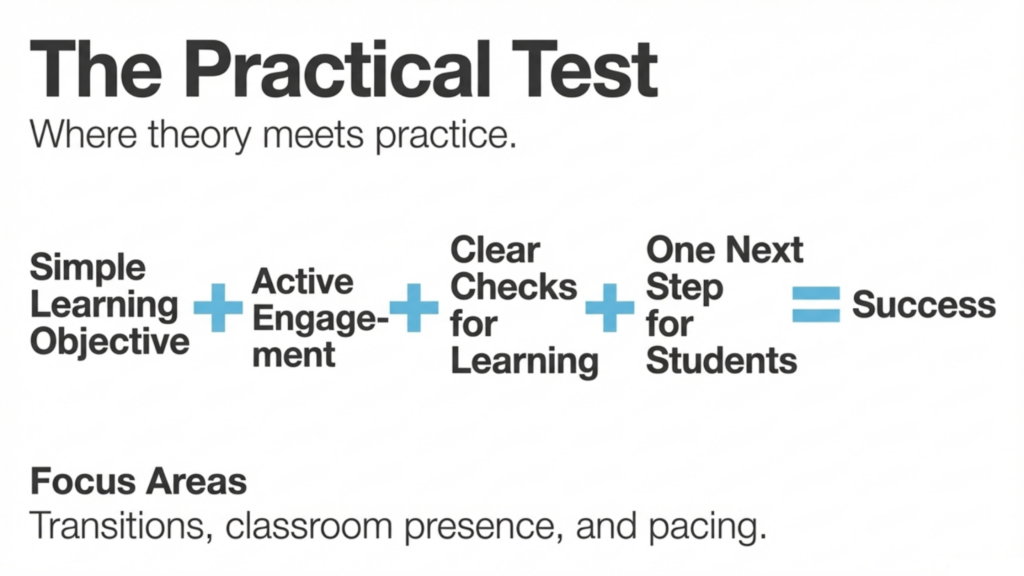
Many interviews now ask for a short demo lesson. This is where theory meets practice.
How to nail it: Choose a simple learning objective, use active engagement, have clear check-for-learning moments (thumbs up, exit ticket), and finish with one clear next step for students. Bring tangible student work samples if possible.
What interviewers score: Clarity of objective, engagement, assessment strategy, classroom presence, and transitions. Be ready to justify your choices afterward.
Demo lessons often reveal more than scripted interview questions and answers for a teacher.
9) Remote or Hybrid Teaching Is the New Expectation
If you’ll teach remotely, especially for roles bordering on remote professor jobs, you may face technology- and communication-based questions.
Question: “How do you run a remote lesson that keeps students engaged?”
Sample answer:
“I chunk lessons into 10–12 minute blocks, use polls and breakout rooms for quick checks, and send a short summary with one follow-up task. I keep a clear visual timetable and ensure students submit a single artefact each lesson so I can track participation.”
What interviewers listen for: Pacing, digital tools for assessment, routine consistency, and accessibility.
10) Interviewer Rubrics: How Decisions Are Often Made
Here’s a compact rubric many panels use (adapt it):
- Classroom presence (1–5): authority, warmth, clarity.
- Planning & assessment (1–5): clear objectives, checks for learning.
- Differentiation & inclusion (1–5): practical scaffolds, SEN awareness.
- Evidence of impact (1–5): measurable examples, parent/colleague collaboration.
- Professionalism & fit (1–5): communication, realistic extra-curricular contribution.
Scores guide discussion, but qualitative notes (especially about temperament) often decide hires. Panels often use short scoring sheets even if they ask open-ended teacher interview questions.
Quick Practical Checklist Before Any Teaching Interview
- Bring 2–3 short lesson plans with objectives and quick checks for learning.
- Have a real example showing impact: sample work with a brief context.
- Prepare one concrete behavior-management story and one parent-conversation story.
- Know school priorities and mention how you can help them (literacy, numeracy, SEND).
- For demo lessons: plan 20 minutes, identify a single measurable outcome, and include an exit task.
Preparing for Behavioral Interview Questions
Behavioral interview questions are designed to assess how candidates have addressed various situations in the past, providing insight into their potential future performance. These questions often begin with prompts like “Tell me about a time when…” and require candidates to share specific experiences relevant to teaching.
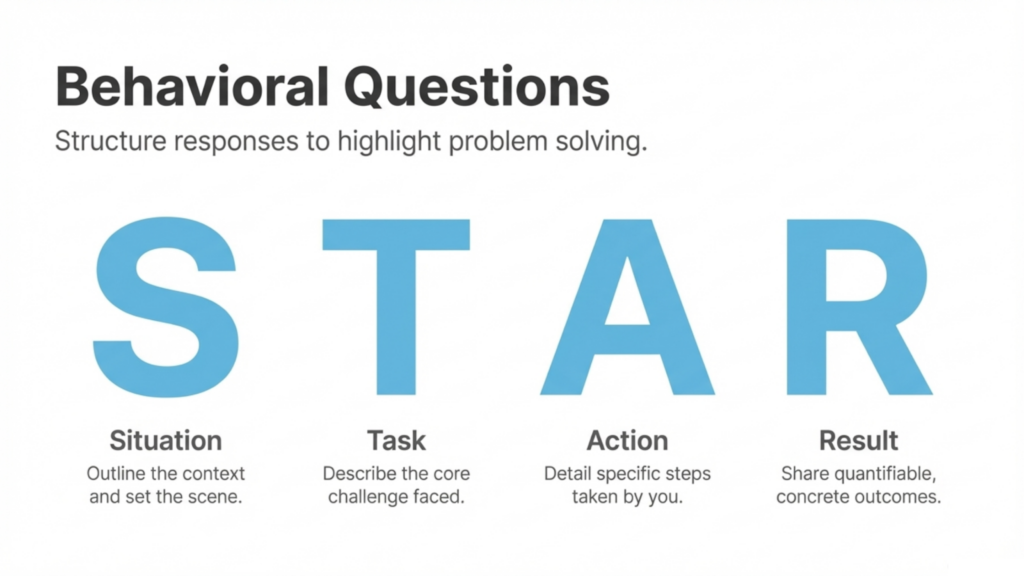
A highly recommended strategy for responding is the STAR method, which stands for Situation, Task, Action, and Result. This structured approach organizes responses and effectively demonstrates problem-solving abilities.
Incorporating the STAR method:
- Situation: Briefly outline the context of your experience. Set the scene.
- Task: Describe your responsibilities or the challenge faced.
- Action: Detail the steps you took to address the task or dilemma, focusing on your contributions.
- Result: Share the outcome of your actions, quantifying your success whenever possible.
Sample Questions and Model Answers:
- Question: Describe a time when you adapted your teaching style to meet a student’s needs.
- Answer: In my previous role, I noticed a student struggling with standard lectures. (Situation) I decided to implement interactive teaching methods tailored to their learning style. (Task) I introduced small group discussions and hands-on activities that allowed for peer learning. (Action) As a result, the student improved their grades, and class engagement increased by 30%. (Result)
Utilizing the STAR method helps present experiences clearly, making responses resonate with interviewers and highlighting readiness for teaching challenges.
Final Note: Be Specific, Brief, Human
Interviewers are not hiring perfect people; they’re hiring real people who will live in a school community. Use short, concrete examples. Avoid jargon. Show you can think on your feet and that you reflect on your practice. If you practice with genuine interview questions and answers for a teacher, rotate one strong story across multiple themes, and prepare for the tell me about yourself interview question, you’ll handle the conversation with clarity that stands out.
If you bring one honest, well-structured story to the table and can make it speak to class management, assessment, and inclusion, you will answer most interview questions effectively.