TL;DR
A statutory employee sits in the gray area between an employee and an independent contractor. They are treated like employees for certain payroll taxes, but often do not receive the same benefits or legal protections. This blog explains how statutory employee status works, how it affects taxes and worker rights, why misclassification is rising, and what both workers and employers should understand before assuming a contract defines everything.
If you’ve ever been told you’re not an employee but also not a contractor, you’re not imagining things. That confusing middle space has a name, and it affects taxes, benefits, and legal protections in ways most people don’t understand until it’s too late.
This is where the statutory employee classification comes in.
It sounds technical, but the impact is very real. It can decide who pays your payroll taxes, what protections you don’t get, and why your paycheck feels lighter without any extra security in return. This guide breaks it down in plain English, using real context, not legal theory.
What Is a Statutory Employee Actually (In Simple Terms)
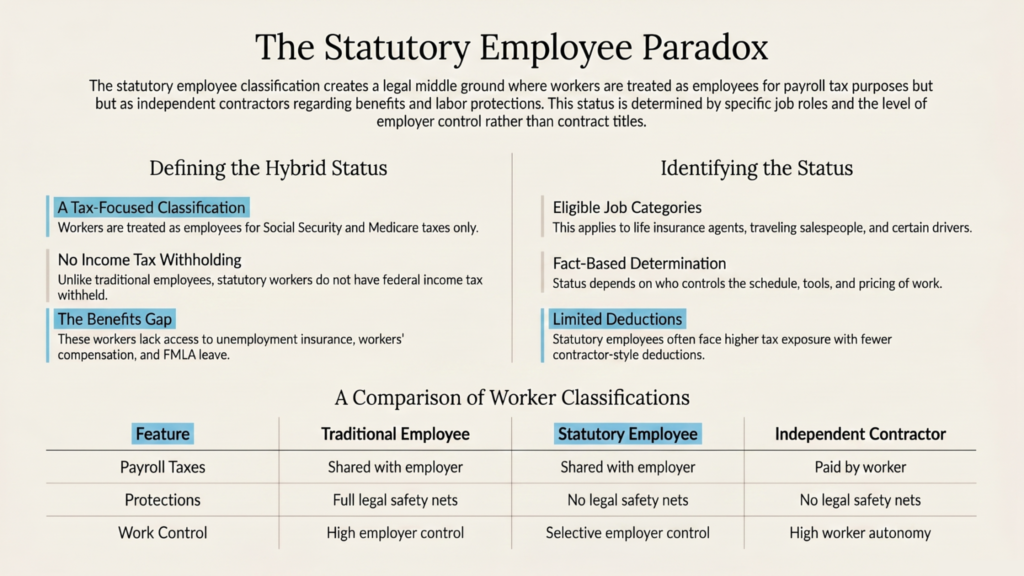
A statutory employee is someone who looks like an independent contractor under normal rules but the law steps in and treats them like an employee for specific tax purposes only.
According to IRS Publication 15-A (2024), this means:
- The employer must pay Social Security and Medicare taxes
- Federal income tax is not withheld
- The worker does not receive full employee protections
This isn’t accidental. It’s a deliberate legal category created decades ago to cover certain work arrangements that didn’t fit neatly into traditional employment.
Importantly, this classification only applies to very specific roles, not everyone working freelance or on contract.
What This Actually Does to Your Paycheck
One reason statutory status feels invisible is that the impact shows up quietly.
Key changes include:
- Social Security and Medicare are withheld
- Federal income tax is not withheld
- Quarterly estimated payments may still be required
- Fewer deductions than contractors
- No access to employer-sponsored tax shelters
For many workers, this means higher effective tax exposure without offsetting benefits. It’s common to feel “taxed like an employee, treated like a contractor.”
Understanding this early prevents underpayment penalties and surprise balances.
How Statutory Employee Status Is Determined in Practice
Statutory employee classification is not decided by job title or preference. It’s determined by how work is actually performed.
Regulators look at:
- Who controls how the work is done
- Whether the worker can profit or lose independently
- Whether the role is ongoing or project-based
- Whether tools, materials, or pricing are dictated by the company
This is why two people doing similar work can be classified differently.
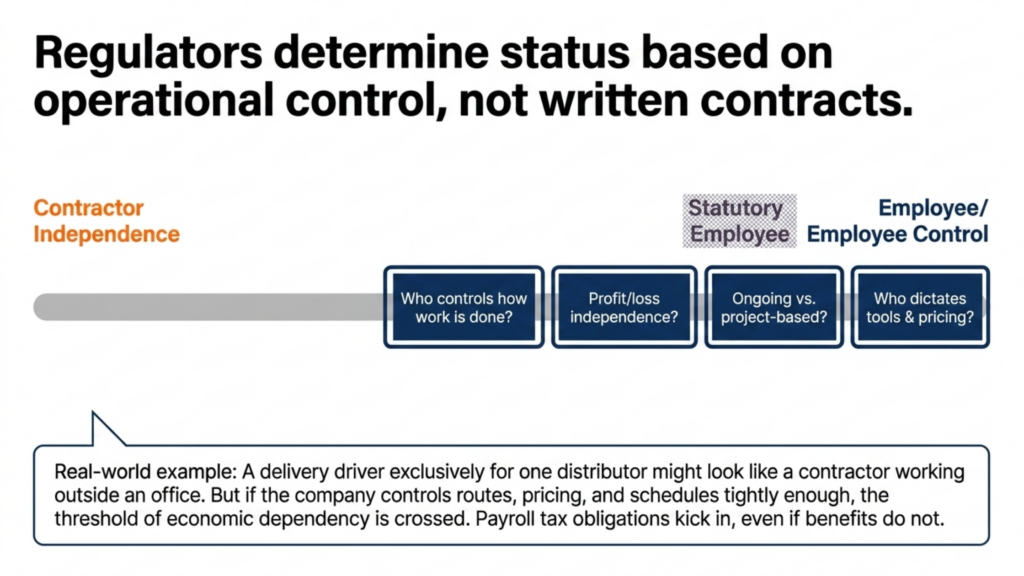
For example, a delivery driver working exclusively for one distributor may appear operationally similar to an independent contractor, especially if they work outside a traditional office structure. But if the company controls routes, pricing, schedules, or delivery conditions closely enough, the worker may still be treated as a statutory employee for payroll tax purposes.
The statutory category exists because lawmakers recognized that some roles are economically dependent but structurally external. When that dependency crosses certain thresholds, payroll tax obligations kick in even if benefits do not.
This is also why classification disputes often hinge on facts, not contracts.
Who Falls Under This Classification (And Who Doesn’t)
The law is narrow here. A statutory employee meaning typically includes people working in roles like:
- Life insurance sales agents working under written contracts
- Full-time traveling or city salespeople distributing specific goods
- Home-based workers using materials supplied by the company
- Certain drivers transporting goods for a single employer
If you’re outside these categories, the label usually doesn’t apply, no matter what a contract says.
And that’s a key point: contracts alone don’t decide status. Regulators repeatedly stress that real-world working conditions matter more than titles.
Why This Category Exists (And Why It’s Still Controversial)
This classification was designed to balance three competing goals:
- Tax collection efficiency
- Employer clarity
- Administrative simplicity
But here’s the tension: while payroll taxes apply, most employment protections do not.
That means no automatic access to:
- Unemployment insurance
- Workers’ compensation
- FMLA leave
- Anti-discrimination protections under Title VII
- Collective bargaining rights
This mismatch of tax obligations without safety nets is often called the classification paradox. Workers pay like employees but live like contractors.
Why Misclassification Is Rising Right Now
The growth of platform-based work has blurred traditional definitions of control. Algorithms now assign tasks, track performance, and influence income without a human manager ever appearing.
Recent legal and policy analysis highlights that:
- Control still exists, just digitally
- Contracts often label workers as “independent” while operations suggest otherwise
- Enforcement agencies are increasing audits where form doesn’t match function
Both the IRS and Department of Labor have warned against “labeling without alignment,” meaning you can’t just name a worker something and hope it sticks.
Helpful reference:
U.S. Department of Labor – Independent Contractor Guidance
https://www.dol.gov/agencies/whd/flsa
What Workers Feel (But Rarely Say Out Loud)
From the worker’s point of view, this classification often feels unfair and confusing.
Common frustrations include:
- Paying payroll taxes without employer benefits
- No access to employer health plans or retirement options
- Income volatility with no safety net
- Stress around audits, reclassification, or sudden contract changes
A 2025 longitudinal study in occupational psychology linked these conditions to higher burnout, elevated stress markers, and lower long-term job confidence, especially when workers perform the same tasks as full employees.
This isn’t about laziness or entitlement. It’s about risk being shifted quietly from organizations to individuals.
How Employers Are Responding (And Why Many Are Rethinking It)
Companies using statutory arrangements are under growing pressure from regulators, workers, and even investors.
Some emerging responses include:
- Voluntary supplemental insurance offerings
- Portable benefit pilots administered by industry groups
- Clearer role separation between contractors and employees
- Internal audits of classification risk
A National Retail Federation survey (2024) found that while many firms now offer voluntary benefits, actual usage remains low largely because workers shoulder the full cost.
The Benefit Cliff Problem Nobody Talks About
One hidden issue is how payroll taxes interact with public assistance.
Because statutory workers are taxed on gross income, even small pay increases can:
- Reduce Medicaid eligibility
- Trigger SNAP benefit loss
- Lower housing assistance
The result? Higher taxes with no net gain in security. This “benefit cliff” effect hits lower-income workers hardest, especially in transportation and home-based service roles.
Policy research from the Economic Policy Institute shows these impacts are not evenly distributed, raising equity concerns.
New Laws, New Experiments, New Risks
Several states are experimenting with hybrid reporting systems that cross-check tax filings with labor data. At the same time, AI-driven compliance tools now flag inconsistencies automatically.
This means misclassification is easier to detect, audits are faster and broader, and “Everyone does it” is no longer a defense.
At the federal level, proposed reforms aim to modernize how statutory classifications work, especially for platform-based labor by introducing portable benefits funded by employer contributions.
Whether these pass or not, the direction is clear: this category is under scrutiny.
What Workers Should Do If This Applies to Them
If you think this classification affects you:
- Review your contract and your actual work conditions
- Track who controls your schedule, pricing, and tools
- Consult IRS and DOL guidance before filing taxes
- Ask clear questions about benefits and protections
Understanding the rules early is far better than dealing with penalties or surprises later.
Statutory Employee vs Employee vs Independent Contractor
This distinction is where most confusion lives.
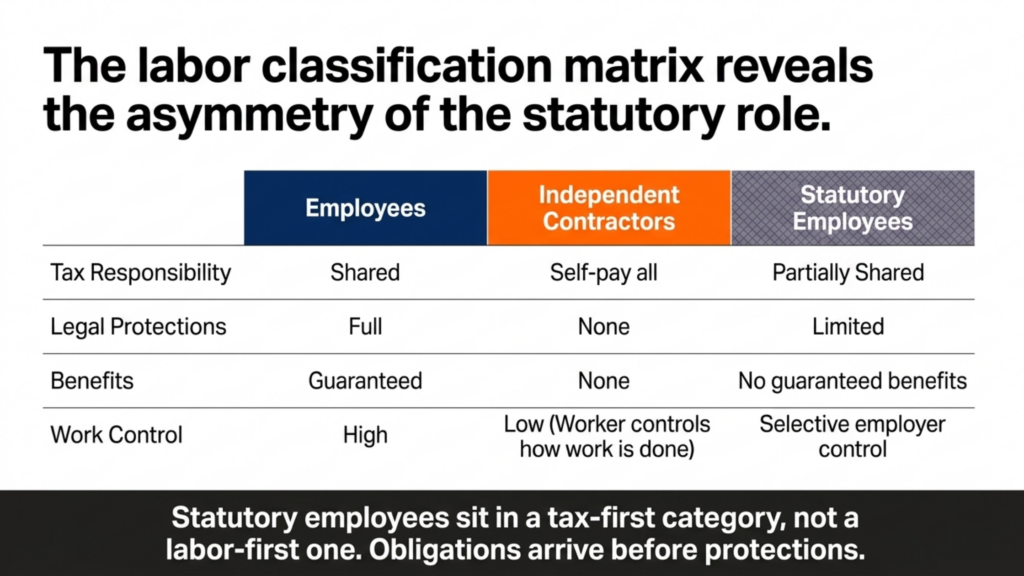
Employees
- Payroll taxes shared
- Benefits and protections apply
- Employer controls work structure
Independent Contractors
- Self-pay all taxes
- No benefits or protections
- Control how work is done
Statutory Employees
- Payroll taxes are partially shared
- No guaranteed benefits
- Limited legal protections
- Employer control exists, but selectively
Statutory employees sit in a tax-first category, not a labor-first one. That’s why many workers feel the arrangement is asymmetric: obligations arrive before protections.
What Employers Should Think About (Beyond Compliance)
For companies, the risk isn’t just legal, it’s reputational and cultural.
Workers who feel exposed don’t stay loyal. Teams with uneven protections develop trust gaps. And regulators are paying attention.
The smartest employers are already treating this classification as a temporary bridge, not a long-term workforce strategy.
A Practical Reality Check
If you’re evaluating whether statutory employee status applies, ask:
- Who sets my schedule?
- Who sets pricing or pay?
- Who owns tools or materials?
- Can I refuse work without consequence?
- Do I perform the same role as employees?
If the answers lean toward employer control, statutory classification deserves scrutiny.
Why This Topic Matters More Than Ever
The modern workforce doesn’t fit into 1950s categories anymore. Technology, remote work, and flexible labor models demand updated thinking.
The statutory employee is not just a tax label; it’s a signal that our systems haven’t caught up to reality yet.
Understanding it is no longer optional for workers or employers. It’s foundational.
Frequently Asked Questions:
When Statutory Status Can Actually Help Workers?
This is rare, but important for balance. Statutory status can be beneficial when:
- Workers want employer-paid payroll taxes
- Roles are stable but benefits are unnecessary
- Workers value simplified tax filing
- Income volatility is low
In these cases, statutory classification can act as a transitional structure. But it only works when workers understand the trade-offs upfront.
Statutory employee definition?
A statutory employee is a worker who is treated as an employee for Social Security and Medicare taxes, but not for most employment benefits or protections, even though they may look like an independent contractor.
How do I know if “Am I a statutory employee?”
If your employer controls how you work, supplies tools, and pays payroll taxes, but you receive no employee benefits, you may be a statutory employee.