TL;DR:
Hiring decisions are shaped as much by psychology as by qualifications. Recruiters often rely on mental shortcuts, risk reduction, and quick signals under pressure, which is why clarity, measurable skills, and structured hiring systems matter more than ever. Modern platforms like CloudHire aim to reduce bias and decision fatigue by improving signal quality and hiring consistency.
What is Recruiter Psychology in Hiring?
Recruiter psychology refers to the mental shortcuts, emotional pressures, and decision patterns that shape how recruiters screen resumes, run interviews, and ultimately decide who gets hired. While hiring is often presented as a rational, objective process, research in organizational behavior shows that it is deeply human, influenced by bias, fatigue, social pressure, and imperfect information.
Understanding recruiter psychology is not about blaming recruiters. It is about recognizing how normal human thinking behaves under pressure and designing hiring systems that work with human limitations instead of against them. When organizations understand this, they hire faster, fairer, and better and avoid repeating the same mistakes over and over.
Why Recruiter Psychology Matters More Than Ever
Modern recruiters operate in an environment of:
- Too many applicants
- Too little time
- High pressure from hiring managers
- Conflicting goals (speed vs quality vs diversity)
In this environment, decisions are rarely made through slow, logical analysis. Instead, recruiters rely on heuristics, mental shortcuts that help the brain conserve energy. These shortcuts are efficient, but they also introduce systematic errors.
Research across behavioral science and industrial psychology shows that most hiring mistakes are not caused by bad intent, but by predictable cognitive patterns that appear whenever humans evaluate people under uncertainty.
The Paradox of Merit: Why “Best on Paper” Often Fails
One of the most important insights in recruiter psychology is what researchers describe as the paradox of merit.
In simple terms, it means this:
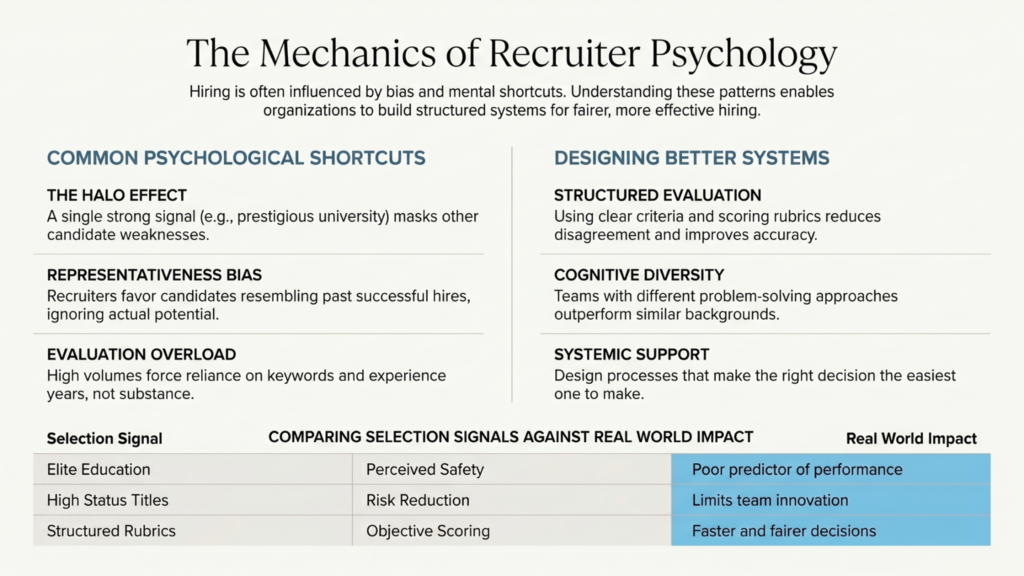
When jobs are complex and outcomes are uncertain, traditional signals of excellence (elite schools, brand-name companies, impressive titles) are surprisingly poor predictors of real performance.
Yet recruiters are trained and often rewarded to chase exactly these signals.
Why? Because they feel safe. They reduce perceived risk. They are easy to justify to stakeholders.
But research consistently shows that teams built entirely on similar high-status backgrounds tend to underperform in innovation, adaptability, and problem-solving. What actually improves outcomes is cognitive diversity, differences in how people think, reason, and approach problems.
The problem is psychological: recruiters often overestimate their ability to identify the single “best” candidate through resume comparisons and interview debates. This leads to:
- Longer hiring cycles
- Decision fatigue
- Rejection of non-traditional but high-potential candidates
- Homogeneous teams that struggle with change
Bias Isn’t Personal It’s Mechanical
Recruiters don’t choose bias. Bias emerges from how the brain handles information overload.
Some of the most common patterns include:
Representativeness bias
Recruiters favor candidates who look like past successful hires, even when those traits have no proven link to future success.
Halo effect
One strong signal (confidence, a well-known company, a top university) dominates the evaluation and masks weaknesses elsewhere.
Satisficing behavior
Under pressure, recruiters stop searching for the best option and settle for the first candidate who feels “good enough.”
These effects intensify in high-volume hiring, where hundreds of resumes force recruiters to filter aggressively just to survive the workload.
Psychological Biases That Shape Hiring Outcomes
| Psychological Barrier | Definition | Impact on Hiring | Underlying Driver (Why It Happens ) | Better Hiring Approach |
| Halo effect | A single strong positive trait (e.g., top university) dominates the candidate’s evaluation. | Masks weaknesses and leads to an overestimation of overall ability based on one signal. | Cognitive ease and the tendency to create a coherent narrative about a person. | Implement structured evaluation systems with scoring rubrics and defined competencies. |
| Satisficing behavior | Settling for the first candidate who meets the “good enough” threshold rather than finding the best. | Stops the search prematurely, potentially missing higher-quality talent due to time constraints. | Time-to-fill pressure and decision fatigue from high-volume recruitment workloads. | Utilize skill validation, standardized signals, and AI-native platforms to reduce uncertainty. |
| Representativeness bias | Favoring candidates who mirror the specific traits or backgrounds of previous successful hires. | Creates homogeneous teams and filters out high-potential candidates with non-traditional paths. | Risk aversion and the desire for profiles that are “easiest to trust.” | Use blind screening, anonymized assessments, and prioritization of cognitive diversity. |
| Evaluation Overload | Cognitive fatigue resulting from the need to process excessively large applicant pools. | Increased reliance on keyword filters; dismissal of qualified candidates with non-linear paths. | Information overload and the brain’s need to conserve energy through heuristics. | Establish competence thresholds and use random selection among qualified finalists. |
| Consensus paralysis | The inability of hiring panels to reach a decision due to minor disagreements or fear of error. | Leads to endless debates, vague feedback, and excessively long hiring cycles. | Social pressure and the perceived need for internal justification to stakeholders. | Apply structured process improvements and defined scoring rubrics to minimize disagreement. |
Evaluation Overload: When More Candidates Make Decisions Worse
A common assumption in hiring is that more applicants mean better outcomes. Psychology research shows the opposite.
Large applicant pools create evaluation overload, which leads recruiters to:
- Rely heavily on keyword filters
- Default to years of experience instead of potential
- Dismiss non-linear career paths
- Respond more slowly and communicate less
This doesn’t just reduce fairness, it damages candidate experience and causes top candidates to drop out of slow, impersonal processes.
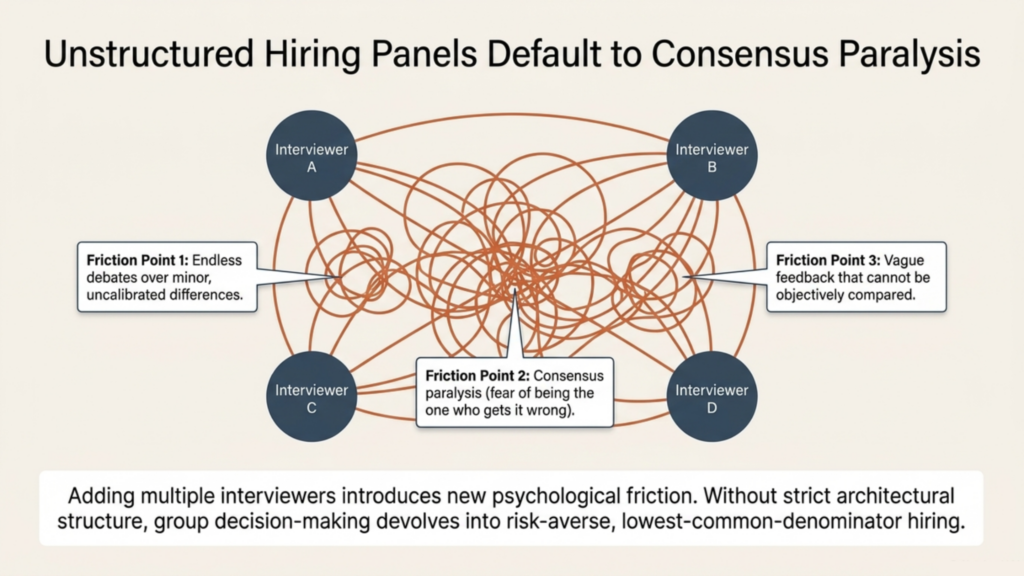
Group Psychology: Why Hiring Panels Get Stuck
Hiring decisions often involve multiple interviewers, which introduces new psychological friction.
Without structure, panels fall into:
- Endless debates over minor differences
- Consensus paralysis (no one wants to be wrong)
- Vague feedback that can’t be compared
Research shows that structured evaluation systems clear criteria, scoring rubrics, and defined competencies dramatically reduce disagreement and speed up decisions while improving accuracy.
Blind screening and anonymized assessments further reduce bias by preventing identity cues from shaping early judgments.
A Counterintuitive Insight: Why Random Choice Can Improve Hiring
One of the most uncomfortable but well-supported findings in recruiter psychology is this:
Once candidates meet a clear competence threshold, choosing between them is often noise, not signal.
In complex roles that require creativity, learning, and collaboration, random selection among qualified finalists can actually improve diversity and team performance.
This works because:
- It avoids overfitting to narrow profiles
- It stops endless resume comparison
- It captures the benefits of cognitive diversity
- It removes false confidence in marginal differences
This doesn’t mean hiring randomly from the start. It means being disciplined about when precision helps and when it doesn’t.
Incentives Shape Recruiter Psychology
Recruiter behavior is strongly influenced by what organizations reward.
When recruiters are judged mainly on:
- Time-to-fill
- Cost-per-hire
They naturally prioritize speed and safety.
When talent teams are treated as strategic partners supported with training, analytics, and decision tools, recruiter psychology shifts toward long-term quality and equity.
Embedding diversity practices early, rather than as compliance steps at the end, further reduces friction and rework.
Modern AI-native hiring platforms are increasingly being designed around these psychological realities. Systems like CloudHire are not simply optimizing for resume collection; they are attempting to reduce uncertainty, cognitive overload, and low-signal decision making.
In practice, recruiters rarely evaluate candidates by asking who is objectively “best.” Instead, they look for profiles that are easiest to understand, easiest to trust, and easiest to justify internally. Clear positioning, measurable outcomes, and structured signals often outperform vague experience descriptions because the brain naturally favors candidates that reduce perceived hiring risk.
This reflects a broader shift in hiring: from intuition-heavy filtering toward systems designed to improve clarity, consistency, and decision confidence under pressure.
What Recruiters Actually Want (But Rarely Say)
From the recruiter’s point of view, the real pain points are:
- Too many resumes, not enough signal
- Unclear hiring criteria
- Slow or inconsistent feedback from managers
- Pressure to justify every decision
The most effective hiring systems reduce cognitive load, provide clarity, and make good decisions easier than bad ones. This is why modern hiring systems increasingly rely on structured evaluation, skill validation, and standardized signals rather than intuition-heavy resume filtering.
The Bottom Line
Recruiter psychology sits at the intersection of human cognition, team dynamics, and system design. Hiring outcomes improve not by demanding perfection from recruiters, but by building processes that respect how people actually think and decide.
Organizations that understand this stop asking, “Why did the recruiter get it wrong?”
They start asking, “How do we design a system where the right decision is the easiest one to make?”
That shift is where fair, fast, and high-performing hiring truly begins.
Frequently Asked Questions
Does CloudHire focus only on resumes?
No. CloudHire reflects a broader shift in hiring toward contextual evaluation rather than resume-only screening. The platform emphasizes structured signals, role relevance, and hiring efficiency to help recruiters move beyond traditional keyword-heavy filtering and reduce low-quality decision-making.
Why do recruiters reject qualified candidates?
Qualified candidates are often rejected not because they lack ability, but because their profiles create ambiguity or fail to communicate value quickly. Recruiters frequently work under heavy workload conditions and rely on fast pattern recognition, which means clear positioning, measurable achievements, and easy-to-scan resumes tend to perform better than vague or overly complex profiles.
Do recruiters spend only a few seconds on resumes?
Yes, recruiters often spend only seconds during initial resume screening. In high-volume hiring environments, recruiters prioritize quick signal detection, such as relevant experience, role alignment, measurable outcomes, and clear formatting, before deciding whether to continue reviewing a candidate.
Why do recruiters prefer candidates from well-known companies?
Brand-name companies and prestigious backgrounds act as psychological trust signals. Recruiters often associate familiar organizations with lower hiring risk because those signals are easier to justify internally. However, these indicators are not always strong predictors of long-term job performance. Skills matter the most in hiring.