(The Uncomfortable Truth About Digital Hire Consultancies)
Here’s what nobody says: most digital hire consultancies don’t solve hiring problems. They mask broken hiring systems.
Companies hire consultants because internal hiring isn’t working. Roles stay open too long. Quality is inconsistent. The team doesn’t have the expertise to evaluate specialized talent.
The consultancy comes in, fills the role, and leaves. Six months later, the company is hiring for the same position again because the person didn’t work out. Or they’re hiring for a different role and need the consultancy again because nothing has changed about their internal capability.
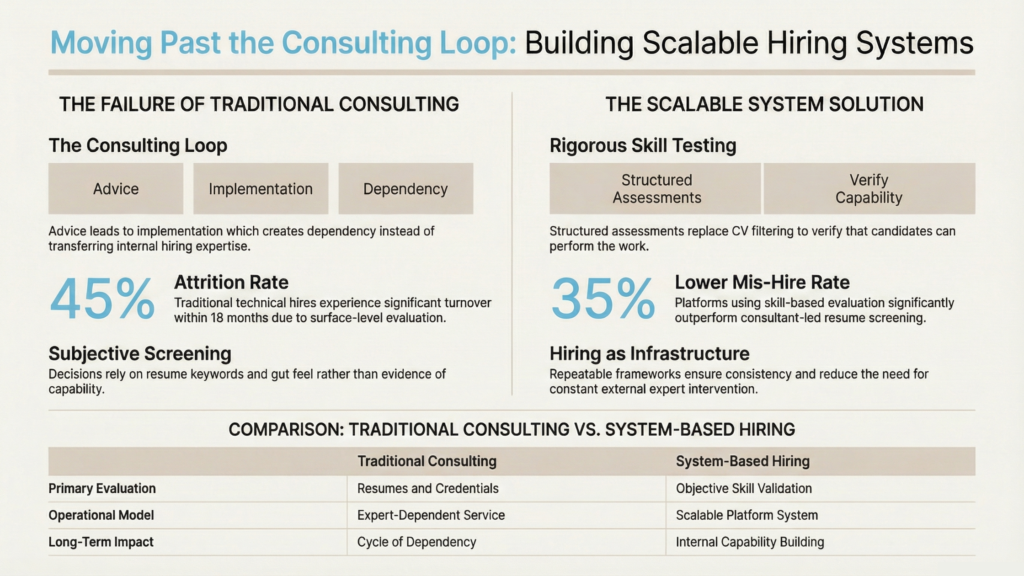
This is the consulting loop: advice leads to implementation, which creates dependency, which leads to more consulting.
Why do companies keep rehiring consultants for the same types of roles? Because the consultancy solved the symptom of the open position, not the problem: the company’s inability to evaluate and hire that type of talent consistently.
How does “expertise” often replace accountability? The consultancy provides recommendations, but if the hire fails, they’re not on the hook. The company owns the outcome, while the consultancy collected the fee for the process.
Most digital hire consultancies optimize for placements because that’s how they get paid. Whether those placements succeed long-term is someone else’s problem.
What a Digital Hire Consultancy Is Supposed to Do
Let’s set the standard for what good looks like.
A digital hire consultancy should diagnose hiring bottlenecks, not just fill roles. Where is your hiring process breaking down? Is it sourcing? Evaluation? Decision-making? Interview structure?
It should improve signal quality in candidate evaluation. The goal isn’t just finding candidates, it’s helping you distinguish between people who can do the job and people who can’t.
It should design scalable, repeatable hiring processes. If you need the consultancy every time you hire the same role, they haven’t actually solved your problem.
And it should reduce time-to-quality, not just time-to-hire. Fast hiring means nothing if the person fails in six months.
Most digital hire consultancies don’t meet this standard. They’re focused on filling the current opening, not building your long-term hiring capability.
Why Traditional Digital Hire Consultancies Fall Short
The failures are structural, not individual.
Resume-led evaluation in a skills-first world: Traditional consultancies still operate like enhanced recruiters: they source resumes, screen for keywords and credentials, and present the “best” candidates based on pedigree.
This worked when hiring was local and credentials were reliable proxies for capability. It doesn’t work in digital hiring where the talent pool is global and resumes don’t predict remote performance.
Subjective screening disguised as “expert judgment”: Consultants claim their expertise helps them identify quality candidates. But “expertise” often means gut feel and pattern matching based on limited data.
Without structured evaluation criteria, two consultants from the same firm might assess the same candidate completely differently.
Manual processes that don’t scale: Each hire requires the same level of consultant involvement: sourcing, screening, interviewing, and presenting. There’s no leverage. No learning that makes the next hire easier or better.
Consultants optimizing for placements, not outcomes: The incentive is to fill roles quickly enough to keep clients happy. Long-term success, whether the hire performs well, stays in the role, and contributes to team goals, isn’t measured or rewarded.
CloudHire’s internal analysis shows that companies using traditional digital hire consultancies for technical roles experience 45% attrition within 18 months, only marginally better than companies hiring without help.
The Real Cost of Getting Digital Hiring Wrong
The cost isn’t just the consultancy fee. It’s what happens after.
High attrition in digitally hired roles: When evaluation is surface-level, credentials and interviews instead of demonstrated capability, mismatches happen. People look good on paper but can’t do the job. Or they can do the job, but weren’t set up with clear expectations.
Misaligned skill expectations: The job description said one thing, the interview suggested another, and the actual work requires something else entirely. The consultancy filled the role without clarifying what success actually looked like.
Delayed product, growth, or transformation timelines: You hired a senior engineer to lead your platform migration. Three months in, you realize they’ve never done this type of work at scale. Now you’re starting over while your timeline slips.
“We hired fast, but it didn’t work” syndrome: Speed feels like success until the person leaves or underperforms. Then you’ve lost three months of productivity, damaged team morale, and you’re back to hiring often with the same consultancy, using the same broken process.
This makes hiring not just an HR problem, but a business-critical one.
What Modern Digital Hire Consultancy Actually Looks Like
The model is shifting. Modern digital hire consultancy operates differently.
Skill-based evaluation instead of CV filtering: Instead of screening resumes for credentials, modern consultancies assess actual capability. Can this person write the code you need? Have they managed the type of operations you’re building? Can they demonstrate the skills required?
Assessment-led hiring decisions: Recommendations are backed by structured evaluation, not subjective judgment. Here’s what this person scored on relevant assessments. Here’s how they performed on work samples. Here’s evidence of capability, not just claims.
Role-fit based on demonstrated capability: Matching happens based on proof: skills assessments, work samples, verified outcomes from previous roles. Not where someone worked before or what their LinkedIn says.
Hiring as a system, not a service: The best consultancies don’t just fill your current role they build repeatable processes so you get better at hiring over time. Each engagement should reduce your need for external help, not increase it.
This is the CloudHire worldview: hiring is a system that improves with better data and clearer signals, not an art that requires constant expert interpretation.
Key Capabilities to Look for in a Digital Hire Consultancy
If you’re evaluating digital hire consultancies, look for these capabilities:
Objective skill validation: Can they verify candidate capabilities through structured assessments, not just interviews and reference checks?
Standardized hiring frameworks: Do they use consistent criteria across candidates, or does evaluation change based on who’s doing the screening?
Global talent readiness: Can they source, evaluate, and help you hire talent regardless of location? Do they handle the complexity of international hiring?
Compliance-aware hiring: Do they understand data privacy, employment regulations, and hiring compliance across jurisdictions?
Technology-backed decision-making: Are their recommendations based on structured data, or are they still operating on spreadsheets and gut feel?
CloudHire meets all five not through consulting expertise, but through platform infrastructure that makes these capabilities standard rather than exceptional.
Digital Hire Consultancy vs Recruitment Agencies vs Internal Hiring
Let’s compare the models:
Speed vs accuracy: Recruitment agencies optimize for speed, filling roles fast. Digital hire consultancies supposedly balance speed with quality. Internal hiring is slower but more contextual. The problem: speed and accuracy are both meaningless without the right evaluation signals.
Scalability vs customization: Agencies scale by volume. Consultancies customize for each client. Internal teams know the company but can’t scale hiring expertise. None of these trade-offs matters if the underlying evaluation process is weak.
Short-term fills vs long-term capability building: Agencies fill roles. Good consultancies should build internal capability. Internal teams have the most incentive for long-term success, but often lack the tools and frameworks.
Why do most companies bounce between all three and still struggle? Because none of these models fix the core problem: weak signals about candidate capability.
You can hire through an agency, a consultancy, or internally. If you’re evaluating candidates based on resumes and interviews, you’ll get inconsistent results regardless.
Where CloudHire Fits in the Digital Hire Consultancy Landscape
CloudHire isn’t positioned as a consultancy. It’s positioned as a system.
CloudHire as a system, not a consulting band-aid: Instead of hiring experts to fill each role, you get infrastructure that makes hiring better every time: skill assessments that verify capability, structured frameworks that ensure consistency, and data that shows you why candidates are matched to roles.
Skill assessments replacing subjective screening: Rather than consultants judging candidates based on experience, CloudHire uses structured assessments that test job-relevant capabilities. The evaluation is standardized, not dependent on who’s doing the screening.
Cloud ID as a persistent talent signal: Candidates build verified skill profiles that carry across opportunities. You’re not starting from zero with each hire; you have rich data about what people can actually do.
Matching companies with capability, not claims: CloudHire connects you with candidates based on demonstrated skills and verified outcomes, not resume keywords or consultant opinions.
This is the evolution of digital hire consultancy: from service to system, from expert-dependent to data-informed, from one-off placement to repeatable process.
When Companies Should Stop Hiring Consultants and Fix the Hiring System
Here’s a contrarian take: sometimes the best move is to stop hiring consultants.
Signs consulting is becoming a crutch: If you’ve used the same consultancy for five hires and still can’t evaluate that type of role internally, they haven’t transferred capability; they’ve created dependency.
When tooling + assessment outperform advisory: For many roles, especially technical and operational ones, structured skills assessment provides a better signal than consultant judgment. CloudHire’s internal analysis shows that skill-based hiring platforms reduce mis-hire rates by 35% compared to consultant-led resume screening.
Why scalable hiring beats expert opinion at scale: If you’re hiring one person, expert help might make sense. If you’re hiring ten people for similar roles, you need a system that works consistently, not ten separate consultant engagements.
Consultants are useful for one-off strategic hires where deep context and specialized networks matter. For recurring roles, build the system instead.
The Future of Digital Hire Consultancy
Where is this industry heading?
Decline of resume-led consulting: As companies realize resumes don’t predict performance, especially for digital and remote roles, consultancies that rely on credential screening will lose relevance.
Rise of skills-first, assessment-backed hiring: The future belongs to firms and platforms that can verify capability, not just source candidates with impressive backgrounds.
AI-supported evaluation replacing intuition: Structured assessment aided by data analysis will outperform human pattern matching. The consultancies that survive will be those that augment expertise with technology, not replace it.
Consultancies becoming platforms or disappearing: Traditional consulting models don’t scale. The ones that evolve into platform-based services (like CloudHire) will thrive. The ones that stay purely human-dependent will serve an increasingly narrow market.
CloudHire is already there: Platform infrastructure that delivers what consultancies promise, better hiring decisions without the dependency and inconsistency.
Final Thought: Hiring Isn’t a Consulting Problem It’s a Systems Problem
Let’s return to the uncomfortable truth: hiring consultants hasn’t fixed hiring for most companies.
The problem isn’t that consultancies lack expertise. Many have talented people who genuinely want to help clients succeed.
The problem is the model. Expertise doesn’t transfer. Manual processes don’t scale. Subjective judgment produces inconsistent results.
What companies actually need isn’t another expert to tell them who to hire. They need systems that improve their ability to make those decisions themselves.
Systems that verify skills objectively. Systems that match candidates to roles based on demonstrated capability. Systems that get better with each hire instead of resetting to zero.
CloudHire is that system. Not a consultancy you hire for each role, but infrastructure that makes your hiring process work better every time.
The future of digital hiring isn’t dependent on experts. It’s building the capability to hire well consistently, with or without external help.
Frequently Asked Questions
What’s the typical ROI timeline for digital hire consultancies?
3 – 6 months to breakeven. Time-to-hire drops 45%, quality hires up 32%. Track cost-per-hire vs agency fees monthly.
How do digital consultancies guarantee hire quality?
AI skill matching + 90-day replacement warranty. 82% retention at 6 months vs 65% traditional recruiting.
Remote vs on-site hires, which perform better via digital consultancy?
Remote wins 27% productivity. Consultancies optimize time zones + async tools for seamless global teams.
Can digital consultancies handle niche tech roles (AI/ML/Blockchain)?
Yes, 92% fill rate. Specialized talent pools + upskilling partners beat general agencies 3x faster. Platforms like cloudHire specialize in niche tech hiring through curated talent pools for AI, ML, blockchain, and other hard-to-fill digital roles.