TL;DR: Most candidates lose interviews not because they lack knowledge, but because they haven’t practiced performing under pressure. Mock interviews, structured rehearsals of real interview conditions, directly improve confidence, answer structure, and delivery. Candidates who practice consistently are 30% more likely to receive job offers. This article breaks down exactly what mock interview wins look like, why smart candidates still fail without them, and how AI-powered platforms like CloudHire are changing the preparation game in 2026.
Truth: Most Interviews Are Lost Before the First Answer Ends
You studied. You researched the company. You know your resume inside out.
And then the interviewer says, “So tell me about yourself.”
Your mouth goes dry. You start somewhere in the middle of your career story. You trail off. You say “basically” three times in one sentence. You wrap up 90 seconds later, unsure whether you sounded confident or rambling.
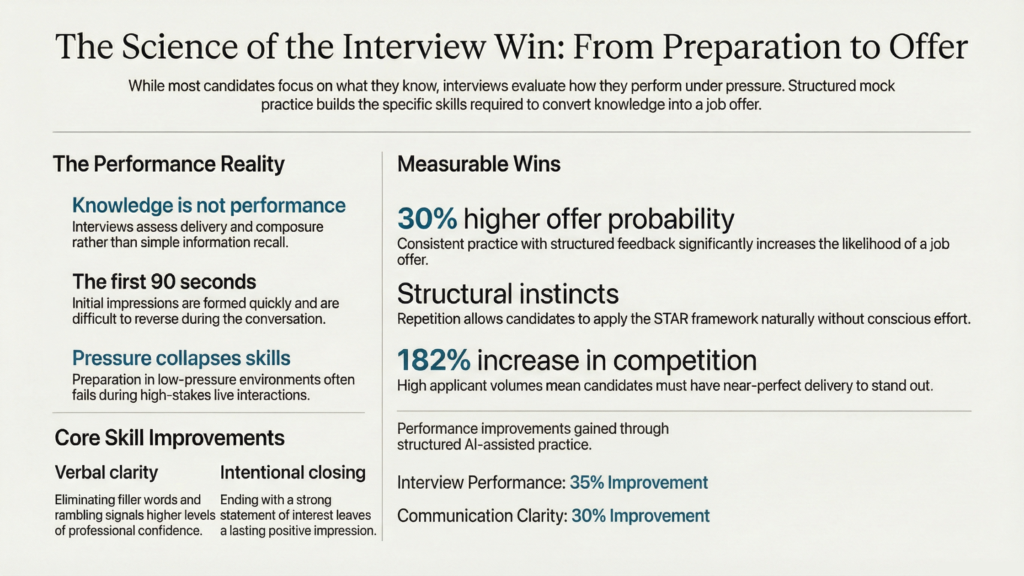
At that moment, the first 90 seconds set the tone for everything that follows. Research consistently shows that interviewers form strong impressions within the first few minutes of a conversation, and those impressions are extremely hard to reverse. A nervous opening doesn’t just hurt your score on that question. It shakes your own confidence for every question that comes after.
This is the painful reality: the problem is almost never intelligence.
Candidates who fail interviews often know the answers. They understand the STAR framework. They’ve read about Amazon’s leadership principles. They can articulate their greatest achievement on paper. But knowledge and live performance are two completely different things.
An interview is a performance event. You are being assessed not just on what you know, but how you deliver it, your tone, your pacing, and your composure when a follow-up question catches you off guard. And performance skills are built through repetition, not through reading.
That’s where mock interview practice changes everything.
What Does “Mock Interview Wins” Actually Mean?
Before going deeper, it’s worth defining the term clearly.
A mock interview is a simulated job interview, a structured practice session where you answer real-style questions under conditions that mimic an actual interview. You get asked questions, you answer in real time, and you receive feedback on both content and delivery.
Mock interview wins refer to the measurable improvements that consistent practice produces:
- Higher callback rates from initial screens
- Better performance in final rounds
- Fewer anxiety-driven mistakes
- Cleaner, more structured answers
- Genuine confidence that comes across on camera and in person
It’s not just about feeling more ready. The data backs it up. According to multiple 2025 studies, candidates who use AI interview preparation tools experience up to a 35% improvement in performance and are 30% more likely to receive job offers compared to those who don’t practice with structured feedback. Cloudhire’s internal study of 500 candidates on an AI mock interview platform found consistent improvement of over 30% in parameters like pronunciation, fluency, answer structure, and confidence with repeated practice sessions.
And consider the scale of what you’re up against: in 2025, the average job posting attracted 340 applicants, a 182% increase from 2021. Only about 2% of those applicants reach the interview stage. If you get there, you cannot afford to lose those hours to poor delivery.
Why Smart Candidates Still Fail Real Interviews
Understanding the root cause of interview failure is the first step toward fixing it.
They Practice Answers, Not Delivery
Most candidates prepare by writing answers. They jot down bullet points for behavioral questions. They rehearse in their heads. They might even say an answer out loud once or twice in the shower.
But they never actually practice delivering an answer the way an interview demands, with a real human (or AI) watching them, with time pressure, with the social stakes that cause your body to go into a mild fight-or-flight response.
What gets left unpracticed:
- Tone modulation (sounding confident, not nervous)
- Strategic pausing (thinking before speaking, not rambling)
- Eye contact and body language calibration
- Answer timing (staying concise, not going over two minutes)
- Smooth transitions between points
These are not natural for most people. They are skills, and skills require rehearsal.
They Never Simulate Pressure
There is a well-known phenomenon in performance psychology: skills developed in a low-pressure environment often collapse under high-pressure conditions.
A perfect answer in your notes does not automatically transfer to a perfect answer on a video call with a senior director watching you. The cognitive load of managing the conversation, reading the room, and monitoring your own delivery simultaneously is far greater than simply recalling what you planned to say.
When you’ve never practiced under simulated pressure, even your best-prepared answers can come out fragmented, rushed, or over-explained. Real mock interview practice, where someone is actually watching and you’re actually being timed, trains your nervous system to perform under that load.
They Get No Feedback Loop
This is the single biggest gap in most candidates’ preparation.
After a real interview, candidates almost never find out where they lost points. What sounded weak to the recruiter? Which answer ran too long? Was there a moment where confidence visibly dropped?
According to survey data, 94% of job seekers want interview feedback, but only a fraction ever receive it. Without feedback, candidates repeat the same mistakes in every interview and wonder why they keep reaching final rounds without offers.
A feedback loop is what separates practice from improvement. Without knowing what’s broken, you cannot fix it.
7 Mock Interview Wins That Directly Improve Offer Rates
These are not abstract confidence boosts. These are specific, measurable improvements that structured mock interview practice produces and that directly affect whether you move forward in hiring processes.
1. Better First-Answer Confidence
“Tell me about yourself” is asked in 93% of interviews, according to research by Apollo Technical. It is also the question candidates fumble most often, not because they don’t know their own story, but because they’ve never actually practiced telling it cleanly in under two minutes.
Mock interviews force you to nail this question repeatedly until the opening becomes second nature. A strong first answer changes your energy for the rest of the conversation.
2. Stronger STAR Responses
Behavioral questions (“Tell me about a time when…”) are used by 75% of recruiters to assess soft skills. The STAR framework Situation, Task, Action, Result is the gold standard for answering them. Most candidates know the framework. Few can apply it cleanly under pressure.
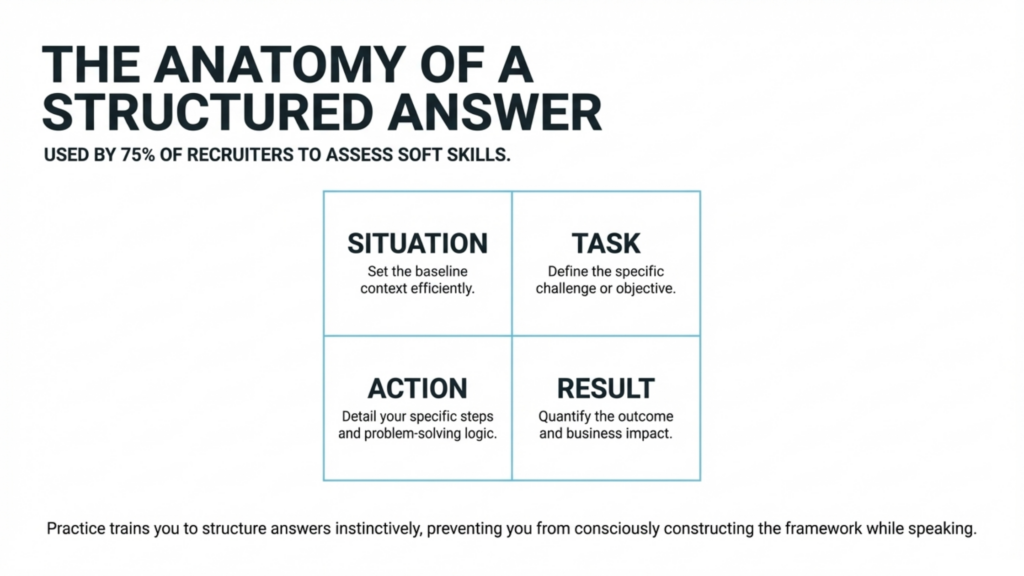
Mock interview practice trains you to structure your answers instinctively, so you’re not consciously constructing the framework while also trying to sound natural and recall specific details.
3. Reduced Filler Words and Rambling
Most candidates have no idea how often they say “um,” “like,” “basically,” or “you know” during an interview. These filler words are invisible to the speaker and completely visible to the listener. They signal uncertainty and reduce perceived confidence significantly.
AI-powered mock interview tools can detect and flag filler words in real time, something a friend helping you practice probably won’t catch consistently. Eliminating these patterns requires awareness first, and then repetition.
4. Faster Thinking Under Pressure
For technical, product, and consulting roles, especially, the ability to think clearly and structure a response quickly under pressure is a core evaluation criterion. It is not something you can develop by reading. You develop it by repeatedly doing it until your processing speed under pressure approaches your processing speed at rest.
Consistent mock interview practice effectively narrows that gap.
5. Better Company-Specific Preparation
Amazon uses leadership principles. Google uses structured behavioral frameworks. Consulting firms use case-based formats. Startups often prioritize culture-fit conversations. Sales interviews evaluate objection handling and storytelling.
Each company’s style requires a different kind of preparation. Mock interviews tailored to specific formats help you understand not just what to say, but how the answer needs to be framed for that audience.
6. Improved Closing Statements
Candidates often fade at the end of an interview. They answer the last question, nod awkwardly, and wait to be dismissed. But a strong close, a clear statement of continued interest, a thoughtful question, a confident handshake equivalent on video creates a lasting impression that reviewers often mention in debrief sessions.
Most people never practice this moment. It shows.
7. Higher Confidence in Final Rounds
Final rounds are higher stakes, often involving more senior decision-makers. They also tend to involve less predictable questions and more direct probing.
Candidates who have done dozens of mock interviews arrive at final rounds having already encountered most of the discomfort the format can produce. The environment feels familiar. The pressure feels manageable. That settled confidence is perceivable and it converts.
The Hidden Reason Mock Interviews Actually Work
Confidence is rarely natural. For most people, it is built.
The underlying mechanism behind mock interview wins is a well-established learning loop: practice → feedback → iteration → familiarity → reduced anxiety → better performance.
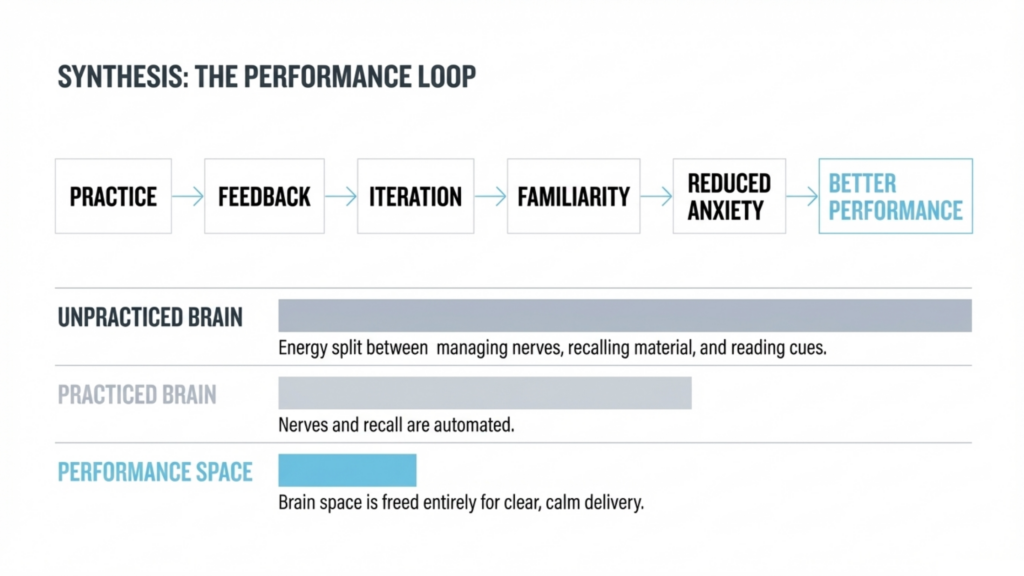
When you sit in an interview for the first time in six months, your brain is running several unfamiliar processes simultaneously: managing nerves, recalling prepared material, reading social cues, and monitoring your own delivery. The cognitive overload is enormous.
When you’ve done 20 mock interviews in the past month, your brain has already automated the unfamiliar parts. Managing nerves becomes easier because you’ve experienced them before and survived. Recalling prepared answers becomes faster because you’ve retrieved them under pressure repeatedly. Social cues become easier to read because the baseline anxiety is lower.
The result is a candidate who appears calm, clear, and prepared because they genuinely are.
This is also why one-time practice sessions produce limited results. The improvement is not linear from zero to one repetition. It compounds over multiple sessions, with feedback accelerating each iteration.
Human Practice vs AI Mock Interviews: Which Delivers Faster Wins?
Both approaches have value. But in 2026, the comparison has shifted decisively.
Traditional Mock Interviews
Practicing with a friend, mentor, or career coach is valuable when done well. You get human nuance, empathy, and the social realism of an actual two-way conversation.
The limitations are real, though:
- Dependent on someone else’s availability and willingness
- Feedback quality varies dramatically based on the other person’s interview experience
- Scheduling friction means practice happens less frequently
- Inconsistency, the same friend won’t ask different follow-up probes each time
- No objective scoring to track improvement over time
AI Mock Interview Practice
AI-powered platforms have addressed nearly all of the above constraints. The advantages are now substantial:
- Available 24/7 – practice at 11 PM before a 9 AM interview
- Unlimited repetitions – no scheduling, no favors, no coordination
- Objective scoring – consistent evaluation criteria applied the same way every time
- Filler word detection – catches patterns human friends miss
- Role-specific question banks – tailored to actual formats used in your target industry
- Company-specific preparation – Amazon-style, Google-style, startup-style
- Instant feedback – no waiting days for notes
Cloudhire’s internal research found that candidates using AI mock interview platforms showed 43% greater improvement in subsequent interviews compared to those receiving generic feedback from non-specialized sources.
The tradeoff is real: human practice captures conversational nuance that AI is still developing. The smart approach in 2026 is to use AI mock interviews as the primary volume driver, with many sessions, consistent feedback and supplement with occasional human practice for the interpersonal layer.
How CloudHire Turns Practice Into Real Mock Interview Wins
CloudHire is built on a simple premise: the gap between knowing and performing can be closed with the right system.
CloudHire.ai offers an AI video interview simulation that replicates the pressure and format of real interviews, not just a chatbot asking questions, but a scored, timed, assessed performance event. Here’s what that looks like in practice:
Recruiter-style question flows: CloudHire asks questions the way actual interviewers do, including follow-up probes, silence that demands you fill it, and pivots mid-answer that test your ability to adapt.
Instant scoring and confidence analytics: After each session, candidates receive a detailed performance breakdown: answer structure, delivery pace, filler word count, confidence indicators, and STAR response quality. The score isn’t just a number; it’s a diagnostic tool.
Answer improvement suggestions: CloudHire doesn’t just tell you where you fell short. It shows you what a stronger version of your answer could look like, giving you a concrete model to iterate toward.
Company-specific interview flows: Whether you’re preparing for a Big Tech behavioral round, a consulting case interview, or a sales objection-handling evaluation, CloudHire’s question banks are calibrated to the formats those companies actually use.
The important distinction: CloudHire is not practice for the sake of practice. It is interview performance training, a systematic approach to building the specific skills that hiring managers evaluate and that lead directly to offers.
Mock Interview Wins by Role
Different roles require different kinds of preparation. Here’s what consistent practice specifically produces for some of the highest-volume categories.
Mock Interview Wins for Software Engineers
For software engineers, the challenge is rarely technical knowledge. It’s the ability to communicate complex reasoning clearly and confidently while someone is watching. Candidates who win technical rounds explain their thinking out loud, articulate trade-offs without prompting, and recover cleanly when they hit a dead end.
Mock interviews for engineers build the habit of narrating the problem-solving process, which is what most evaluators are actually assessing.
Mock Interview Wins for Sales Roles
Sales interviews are performance tests by design. Recruiters evaluate storytelling, objection handling, energy, and the ability to read and influence a conversation. Candidates who haven’t practiced these, specifically not just generic behavioral answers, but live simulation of sales-style pressure, often underperform relative to their actual sales ability.
Mock interview practice for sales roles specifically trains handling pushback, staying composed during aggressive follow-ups, and closing conversations with intention.
Mock Interview Wins for Fresh Graduates
For candidates with limited work experience, the challenges are confidence and framing. How do you answer “Tell me about a time when you led a team” with only academic or internship examples? How do you sound credible without sounding apologetic?
Mock interview practice for fresh graduates focuses on reframing entry-level experience with clarity and specificity and on building the baseline confidence that makes inexperience appear less significant than it otherwise would.
Signs Your Mock Interview Practice Is Actually Working
Progress in interview preparation is sometimes hard to see in real time. These are the signals that your practice is producing real improvement:
- Your answers are getting shorter and more precise, not because you’re saying less, but because you’ve eliminated padding
- You pause before answering rather than speaking immediately and correcting course mid-sentence
- Filler words appear less frequently, and you catch them when they do
- You no longer lose structure when a follow-up question interrupts your train of thought
- You remember to close strongly rather than trailing off at the end
- You feel curious about difficult questions rather than threatened by them
- Your score in mock sessions improves across multiple sessions in the same week
None of these are personality changes. They are skill improvements and they show up in real interviews exactly the way they showed up in practice.
Final Thought: Interviews Are Won in Practice, Not in the Room
The interview room doesn’t create winners. It reveals who prepared like one.
Every candidate who walks into a final round and performs with calm confidence got there through repetition, feedback, and iteration. They’ve already answered the hard questions. They’ve already heard the silence. They’ve already stumbled, corrected, and improved before anyone who matters was watching.
That is what mock interview wins actually mean.
It’s not a shortcut or a trick. It’s a training system, the same principle that any high-performance discipline operates on. The outcome isn’t guaranteed. But the gap between a prepared candidate and an unprepared one is measurable, perceivable, and consequential.
In 2026’s job market, where a single posting draws hundreds of applicants, where interview processes stretch across weeks, and where the margin between an offer and rejection is often narrower than candidates realize, preparation is the one variable entirely within your control.
Use it.
Practice Smarter With CloudHire
Run unlimited AI mock interviews, get instant recruiter-style feedback, and walk into your next interview already knowing what works.
[Start practicing with CloudHire →]
Frequently Asked Questions
What is a mock interview?
A mock interview is a simulated job interview used for practice. It replicates the format, pressure, and question types of a real interview so candidates can rehearse their performance, identify weaknesses, and receive feedback before the actual event.
What are mock interviews used for?
Mock interviews are used to improve answer structure, reduce interview anxiety, build confidence, eliminate filler words, and practice role-specific or company-specific question formats. They are used by candidates at all experience levels, from fresh graduates to senior professionals.
What’s a mock interview in the context of AI tools?
An AI mock interview is a simulated interview session conducted with an AI platform rather than a human. The AI asks role-specific questions, evaluates your responses in real time, scores your delivery and content, and provides instant feedback. It offers the core benefits of traditional mock interviews with the added advantages of unlimited access, objective scoring, and 24/7 availability.
How do I prepare for a mock interview?
To get the most out of a mock interview session: choose a platform or format aligned with your target role; review common question types for that role (behavioral, technical, situational); practice answering out loud, not just in writing; record yourself if possible; and review the feedback critically after each session. Prioritize consistent repetition over occasional long sessions.
How many mock interviews should I do before a real interview?
There’s no universal number, but research supports that multiple sessions with feedback between them produce the strongest results. For most candidates, five to ten structured practice sessions spaced over one to two weeks produce meaningful improvement in delivery confidence and answer quality.
Do mock interviews actually help?
Yes, significantly. Candidates using structured AI mock interview tools show up to a 35% improvement in interview performance and are 30% more likely to receive job offers than those who don’t practice with feedback. One study of 500 candidates on an AI platform found improvements of over 30% in communication clarity, fluency, and confidence with consistent use.