TL;DR: Most job rejections follow predictable, systemic patterns, not random bad luck. The biggest culprits are application volume overload, early-stage timing cutoffs, demographic bias embedded in AI screening tools, and human-configured knockout filters. Understanding when and why rejections cluster together is what actually helps you change the outcome.
The Scale Problem Nobody Talks About Honestly
Before anything else, one number frames every other pattern on this list.
Many applicants now submit anywhere from 32 to over 200 job applications before receiving an offer, with only 0.1% to 2% of cold applications resulting in a job offer.
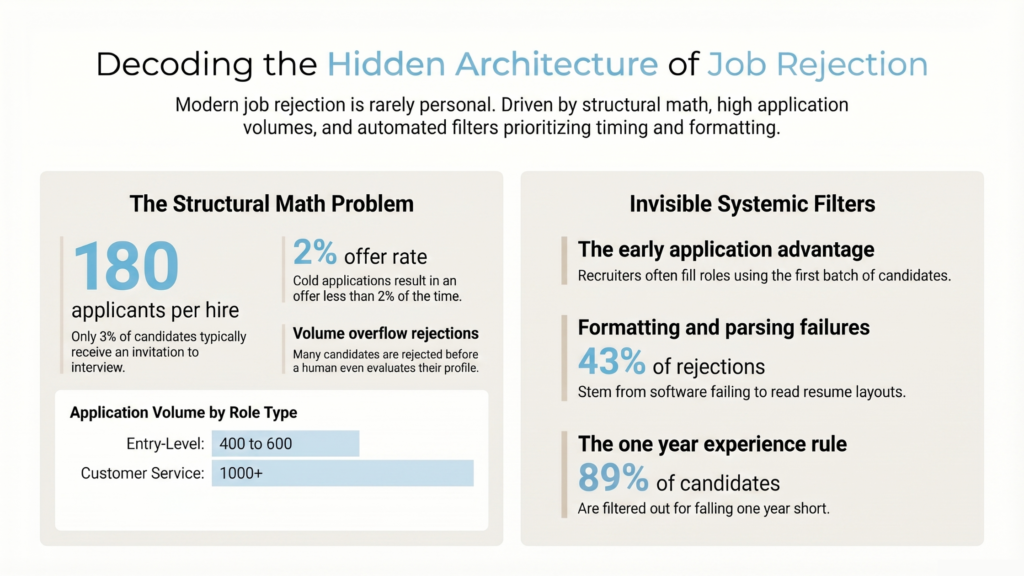
That’s not a skills gap. That’s a structural math problem: too many candidates, not enough slots, and a hiring system that was never designed for this kind of volume. On average, employers now need around 180 applicants per hire, and only 3% of applicants are ever invited to interview.
This matters because it reframes the entire conversation around job rejection patterns. Most people think they’re being rejected for a specific reason. The data suggests a large chunk of rejections happen for no individual reason at all; candidates are simply caught in volume overflow before any human evaluates them.
Pattern 1: The Timing Cutoff
One of the most consistent job rejection patterns has nothing to do with your qualifications. It has to do with when you applied.
Recruiters working high-volume roles don’t wait for all applications to come in before reviewing. Entry-level and administrative roles attract an average of 400–600 applicants per opening, and customer service positions often surpass 1,000 applications in their first week. When strong candidates appear in the first batch, many recruiters begin interviewing before even looking at the rest.
This creates a de facto early-application advantage that operates completely independently of resume quality. If you’re in the second wave of applicants on a popular listing, you may be rejected not because you’re underqualified, but because the role was effectively filled before your application was opened.
The downstream effect is significant: 42% of candidates withdrew from hiring processes because scheduling took too long, often because they applied late, waited, and then accepted something else.
Pattern 2: Knockout Questions The Invisible Filter
This is the most underreported job rejection pattern in most career content. While there’s enormous focus on ATS algorithms and resume formatting, the actual mass-rejection mechanism for most employers is far simpler: binary knockout questions.
Every recruiter uses knockout questions for compliance things like work authorization status, required certifications, or location, but only 8% configure content-based auto-rejection beyond those eligibility filters.
These knockout questions are responsible for large volumes of early-stage rejections, and they’re almost entirely non-negotiable. Binary filters such as “Do you require visa sponsorship?” or “Are you willing to relocate?” account for around 22% of rejections before a recruiter even reviews an application.
The pattern here is consistent: candidates who clear knockout questions get reviewed by a human; those who don’t are filtered regardless of their resume. This means a significant portion of what people experience as “ATS rejection” is actually a pre-configured compliance screen built by a human recruiter.
Pattern 3: The ATS Myth vs. The Real Formatting Problem
The widely repeated claim that “75% of resumes are rejected by ATS before a human sees them” has no credible source. That said, formatting does matter, just not in the way most people think.
When 1,000 real resumes were run through leading ATS platforms, only 57% of rejections were due to qualification gaps. The remaining 43% were formatting, parsing, or arbitrary filter failures.
So ATS systems aren’t rejecting resumes autonomously at massive rates, but they are misreading resumes with complex layouts, tables, columns, or non-standard headers. When a system can’t parse a resume correctly, it fails to surface it in keyword searches, which produces the same outcome as rejection, without any explicit flag.
73% of hiring managers report rejecting candidates due to poor resume formatting, a human decision, not an automated one, but one triggered by a parsing failure upstream.
Pattern 4: Demographic Bias in AI Screening
This is the pattern with the most serious implications, and it’s the least addressed in mainstream career content.
Researchers at the University of Washington analyzed over three million comparisons between resumes and job descriptions using state-of-the-art AI models. AI screening tools favored white-associated names 85% of the time versus Black-associated names just 9% of the time. Male-associated names were preferred 52% of the time versus female-associated names 11% of the time.
The intersectional findings are even starker. When gender and race were considered together, names associated with Black men led to the most significant disparities compared to white men’s names; they were selected 0% of the time across the test scenarios.
This isn’t a fringe finding. Companies themselves acknowledge these problems: nearly half (47%) recognize age bias in their AI tools, 44% cite socioeconomic bias, 30% mention gender bias, and 26% point to racial bias, yet 83% of companies were planning to use AI resume screening by the end of 2025. Now in 2026, AI resume screening is at the top of every funnel.
The job rejection pattern created here is systemic: candidates from certain demographic groups face structurally higher rejection rates at the screening stage, before any human ever evaluates their actual qualifications.
Pattern 5: Experience Mismatch and the One-Year Rule
Rigid experience requirements disproportionately affect job seekers, with 89% of candidates being rejected for falling just one year short of the stated criteria.
This creates a consistent rejection cluster around career transitions, new graduates, and returners. A candidate with three years of experience applying for a role requiring four years faces an automatic screen-out in many systems despite the fact that the one-year difference rarely predicts on-the-job performance.
The shift toward skills-based hiring is supposed to address this. 73% of employers adopted skills-based hiring in 2024, up from 56% in 2022, and 45% of companies are expected to drop degree requirements for key roles in 2026. But implementation is uneven, the same companies claiming to use skills-based hiring often retain experience-year minimums as ATS filters.
Pattern 6: Ghosting as a Rejection Pattern
Ghosting isn’t just rudeness. At scale, it’s a documented job rejection pattern with predictable timing.
61% of job seekers report being ghosted after an interview, up nine points from the prior year. The silence itself communicates rejection, but without a timestamp, candidates have no signal about whether to keep waiting or move on.
44% of applicants cite never hearing back after applying or interviewing as their top frustration, and 66% of job seekers said they would wait only two weeks for a callback before considering the role a lost cause.
The pattern here is that ghosting clusters around two specific stages: post-application (high volume, early dropout) and post-final interview (decision paralysis). 81% of hiring managers have been identified as experiencing decision-making paralysis, waiting indefinitely for a “perfect” candidate rather than progressing with strong ones.
Pattern 7: The Mental Health Spiral That Distorts Behavior
This is a pattern within the candidate, not the system, but it feeds back into the system in ways that generate more rejections.
72% of job seekers report that long hiring processes and poor employer communication negatively affected their mental health. What follows is well-documented: candidates apply more indiscriminately, tailor applications less carefully, and perform worse in later interview stages because of accumulated rejection fatigue.
The irony is that mass-applying a direct response to the stress of rejection reduces the match quality of each application, which increases the rejection rate further. The data on application success backs this up: cold applications from high-volume spray-and-pray approaches produce the lowest conversion rates, while targeted, network-connected applications consistently outperform them.
What These Patterns Have in Common
Across all seven of these patterns, one thing is consistent: the rejection is rarely about what it appears to be about.
Timing cutoffs look like qualification mismatches. Knockout filters look like ATS decisions. Demographic screening bias looks like a culture fit judgment. Ghosting looks like disinterest. Each of these has been reframed by the career industry as something the candidate can solve by rewriting their resume.
The data points elsewhere. Most job rejection patterns are structurally built into how hiring pipelines are configured, when listings go live, and which tools are used to triage volume. Recognizing the pattern behind a rejection is the only way to accurately diagnose what, if anything, needs to change.
Once you understand the job rejection patterns, the next step is improving the parts you can control: how you apply, how you present your experience, and how you perform when you do get the interview. That’s exactly where CloudHire can support you with AI-led interview practice and feedback designed to help you convert opportunities better.
Frequently Asked Questions
Why do I keep getting rejected even when I’m qualified?
Rejections often happen for reasons that have nothing to do with your actual ability to do the job. High application volume, timing cutoffs, knockout questions, ATS parsing issues, and internal hiring delays can all filter out strong candidates before a recruiter reviews the resume. In many cases, it is a system issue, not a skills issue.
Does applying early really improve my chances?
Yes, in many cases it does. Recruiters often start screening and scheduling interviews as soon as the first strong batch of applications comes in. For high-volume roles, applying within the first 24–72 hours can significantly improve visibility compared to applying later in the cycle.
Are ATS systems automatically rejecting most resumes?
Not exactly. The common claim that most resumes are automatically rejected by ATS tools is often overstated. The bigger issue is resume parsing. Complex layouts, columns, graphics, and non-standard section headers can prevent the system from reading your experience correctly, which lowers your chances of appearing in recruiter searches.
What are knockout questions in job applications?
Knockout questions are binary filters used early in the hiring process. These typically include questions about work authorization, location, certifications, notice period, or willingness to relocate. If your answer does not meet the employer’s requirements, the application may be automatically filtered out before a human sees it.
How many job rejections are normal before getting an offer?
Unfortunately, multiple rejections are now a normal part of modern hiring. Many candidates apply to dozens of roles before landing an interview, and cold application conversion rates are often extremely low. The key is to focus on improving match quality rather than increasing volume alone.
Why do companies ghost candidates after interviews?
Ghosting usually happens because of hiring delays, decision paralysis, shifting role requirements, or internal approvals taking longer than expected. While frustrating, it often reflects process issues inside the company rather than a direct judgment of your candidacy.
What should I change after repeated job rejections?
Start by identifying the pattern. If rejections happen immediately, check knockout questions and formatting. If they happen after interviews, focus on interview performance and role alignment. If there is no response at all, timing and application strategy may be the issue. Looking at where the rejection happens is more useful than rewriting your resume every time.