TL;DR: IT remains one of the highest-earning, highest-growth career categories, but the landscape has shifted sharply. Entry-level saturation, AI-driven layoffs, and rising skill expectations mean that “getting into tech” is no longer enough. What matters now is which path you choose, which skills you build, and whether you’re prepared to stay current. This article gives you the unfiltered picture.
IT is No Longer the Easy Career Path it Once Was
For most of the last two decades, IT was the default answer for anyone who wanted a stable, well-paying career. The advice was simple: learn to code, get a computer science degree, or pick up a certification, and you’d be set.
That version of the story is no longer accurate.
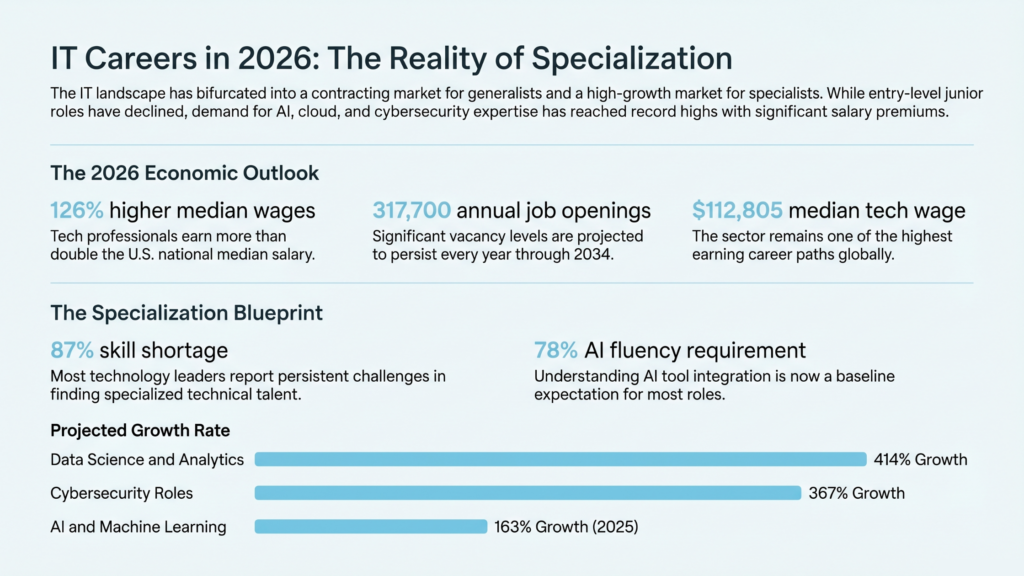
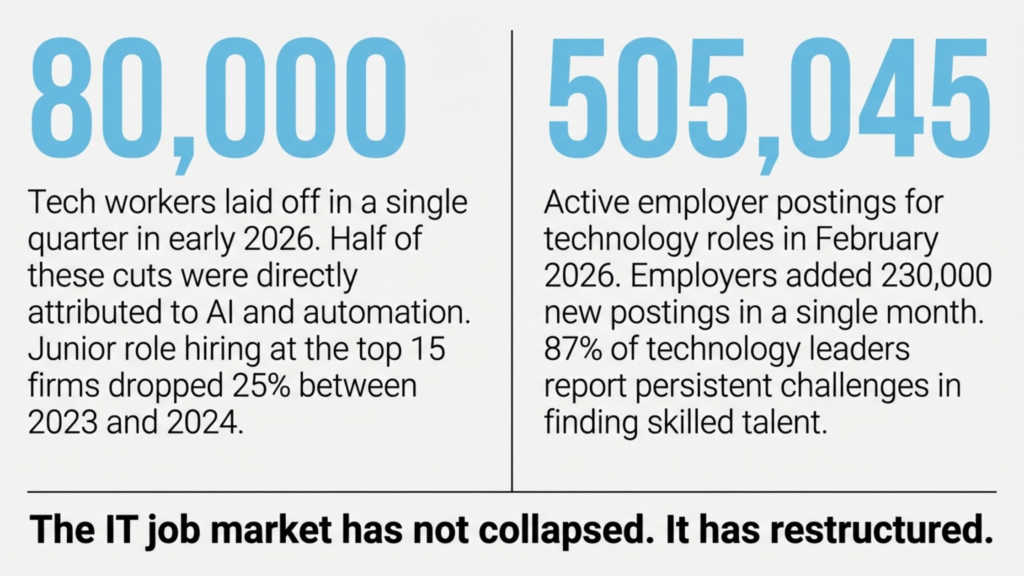
In early 2026, nearly 80,000 tech workers were laid off in a single quarter. Around half of those cuts were directly attributed to AI and automation. Entry-level positions in IT have seen a steep decline in hiring at the 15 largest tech firms, dropped 25% for junior roles from 2023 to 2024, and that trend has continued. Meanwhile, AI, ML, and data science job postings grew by 163% in 2025 alone.
The IT job market hasn’t collapsed. It’s bifurcated.
Two IT careers are happening simultaneously right now. One is contracting the generalist, certificate-collector, junior-developer path that once worked. The other is expanding at an aggressive pace, the AI-adjacent, cloud-native, cybersecurity-focused, deeply skilled path that companies cannot hire for fast enough.
The question is no longer “Is IT a good career?”
It’s “Can you keep up with how fast IT changes?”
So, Is IT a Good Career Path? The Short Answer
Yes, but only if you choose the right specialization and build skills that are genuinely employable, not just certifiable.
IT still has median wages approximately 126% higher than the U.S. national median. The Bureau of Labor Statistics projects around 317,700 IT job openings every year through 2034. CloudHire is forecast to see 414% occupational growth over the next decade. Cybersecurity roles are close behind at 367% projected growth.
The opportunity is real and substantial. But it is no longer evenly distributed. Demand is concentrated in specific roles, and the bar for entry is higher than it was even three years ago.
If you go in with clear eyes about where the market actually is and build toward those concentrations, IT is one of the best long-term career bets available. If you chase hype, collect generic certifications, and treat “tech” as a single monolithic path, the results will be frustrating.
Why IT Is Still One of the Best Career Paths in 2026
1. High Demand Is Still Real, But Selective
CloudHire’s internal research report projects net tech employment to grow 1.9% this year, reaching approximately 9.8 million workers in the U.S. alone. Active employer postings for technology roles hit 505,045 in February 2026, with more than 230,000 new postings added in a single month.
But the demand isn’t distributed evenly. The areas with the strongest hiring momentum are specific: AI and ML engineering, cybersecurity, cloud engineering, DevOps, data roles, and software development at the mid-to-senior level. These are not niche categories. They are now the core of most organizations’ IT strategy.
87% of technology leaders say they currently face challenges in finding skilled talent. That number has stayed consistent for years. The skills shortage is real, structural, and worsening, which means prepared candidates with the right expertise enter markets with significant leverage.
2. Strong Salary Growth Potential
The median U.S. tech wage sits at approximately $112,805, which is about 126% higher than the national median across all occupations. Entry-level IT roles typically start around $70,000 annually, while senior positions in cloud architecture, AI engineering, and security consulting regularly exceed $150,000 to $200,000.
Professionals with AI and machine learning expertise now command a 15 to 25% salary premium compared to generalist counterparts. Certifications in cloud platforms (AWS, Azure) and cybersecurity (CompTIA Security+, CISSP) are directly tied to higher compensation tiers. This is not a sector where income plateaus early; the growth curve rewards continuous upskilling more than almost any other field.
3. Remote and Global Career Access
IT remains one of the few fields where geography is genuinely optional for a significant portion of roles. Remote-first teams, global companies, cross-border hiring, and freelance opportunities have made it possible to build a career without being tied to a specific city or country.
This is especially relevant for candidates in markets where local tech employment is limited. Platforms that connect skilled professionals to global remote roles rather than just local job boards change the calculus entirely. A software engineer in Nairobi or a cybersecurity analyst in Chennai can access roles that weren’t reachable five years ago.
The remote landscape is tightening slightly. Fully remote roles are becoming more competitive and sometimes carry lower compensation than hybrid equivalents, but the access it creates remains a meaningful structural advantage of an IT career.
4. Career Switching Is Easier Than Most Other Industries
IT is one of the few fields where a motivated career changer can move from a completely unrelated background into a substantive role within one to two years. Bootcamps, self-taught portfolios, open-source contributions, and skills-based hiring have made traditional four-year degrees less mandatory than they once were.
The number of HR leaders using skills-first hiring has tripled in just two years, according to General Assembly’s State of Tech Talent report. Companies are increasingly hiring on demonstrated competency rather than credentials alone. That is a meaningful opening for non-traditional candidates who are willing to do the actual work of building skills.
The Hard Truth: Why Many People Fail in IT Careers
They Learn Tools, Not Problem-Solving
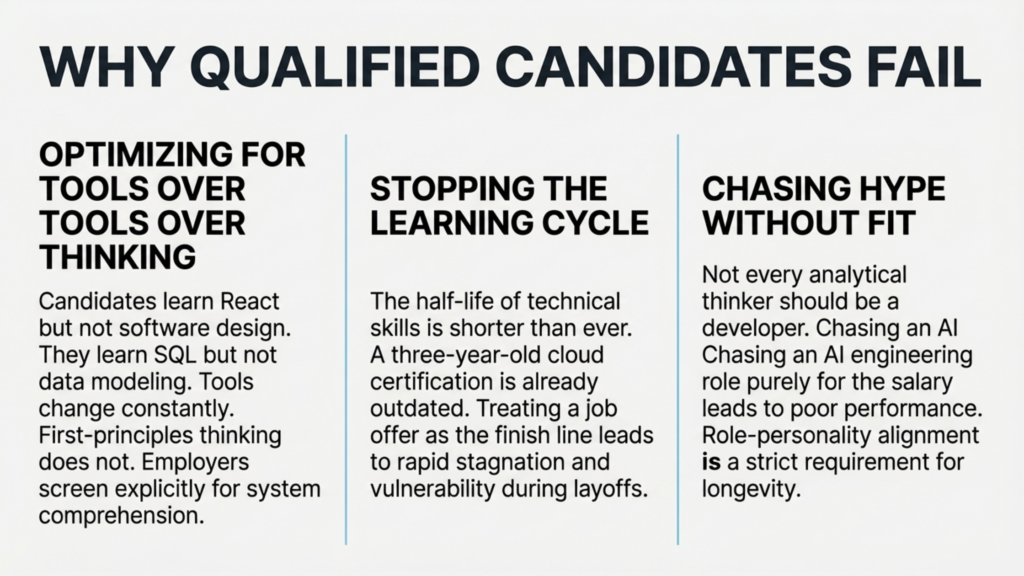
The single most common failure mode in IT careers is optimizing for tool familiarity rather than thinking ability. Candidates learn React but not software design principles. They learn SQL queries but not data modeling. They pursue a Python certification but struggle to approach an unfamiliar problem from first principles.
Tools change constantly. Thinking skills do not.
The professionals who stay relevant through multiple technological transitions are those who understand why systems are built the way they are, not just how to use the currently popular stack. Employers increasingly recognize this distinction and screen for it explicitly.
They Stop Learning After Getting Hired
IT rewards continuous upskilling more than almost any other profession. The half-life of technical skills is shorter now than it has ever been. A cloud certification from three years ago may cover services that have been significantly updated. A security framework you mastered in 2022 may not account for threat vectors that have emerged since.
Professionals who treat their first job offer as the finish line tend to plateau quickly and find themselves vulnerable during restructuring cycles. Those who treat learning as a permanent condition of employment stay current, stay valuable, and tend to be the last ones affected when headcount decisions are made.
They Chase Hype Roles Without Fit
Not everyone who wants an IT career should become an AI engineer. Not every analytical person should be a software developer. Not every developer should be a DevOps engineer.
Role-personality fit matters significantly in IT. Someone who thrives on open-ended systems thinking and ambiguity will struggle in a structured QA role. Someone who prefers clear deliverables and process will find product engineering frustrating. Someone who genuinely enjoys reading about emerging threats will make a far better cybersecurity analyst than someone who chose it solely for the salary.
Chasing hype roles without honest self-assessment leads to poor performance, poor job satisfaction, and early career stagnation. The market will find this out, and so will you.
Which IT Career Path Is Right for You?
Best IT Careers for Analytical Thinkers
If you think systematically, enjoy finding patterns, and are comfortable with ambiguity in data, roles to consider include data analyst, cybersecurity analyst, systems administrator, and database architect. These roles reward methodical investigation and structured reasoning over creative output.
Best IT Careers for Builders
If you find satisfaction in creating functional things from scratch and can tolerate the feedback loop of debugging and iterating, software engineering roles, frontend, backend, and full-stack development are the clearest fit. The barrier to entry is higher than it was, but the demand remains structural.
Best IT Careers for Creative Problem-Solvers
UI/UX design, product management, no-code and low-code automation development, and tech consulting all sit at the intersection of technical understanding and human-centered thinking. These roles are increasingly in demand as companies realize that technical capability alone doesn’t produce products people want to use.
Best IT Careers for Non-Coders
This is one of the most underserved conversations in IT career content: a large portion of IT roles require no coding whatsoever.
IT project management, business analyst positions, technical recruiting, customer success in SaaS companies, technical writing, and IT support management are all substantive careers with meaningful salaries and growth trajectories. They require an understanding of how technology works, not the ability to build it. Many people who assume IT isn’t for them are actually strong candidates for these roles and simply haven’t considered them.
The Skills That Actually Get You Hired in IT Today
Technical Skills
The specific technical skills commanding the most attention from employers in 2026 include Python and SQL as baseline data and scripting competencies, cloud platform experience with AWS or Azure, Git for version control and collaborative development, API integration and design fundamentals, and security basics increasingly considered a requirement across roles, not just in dedicated security positions.
AI fluency is now considered a baseline expectation across most tech roles. 78% of information and communications technology job postings included AI-related skills in their requirements in 2025. This doesn’t mean every role requires building models; it means understanding how AI tools work and being able to integrate them into workflows.
Career Skills
This is the area most IT candidates underinvest in, and it consistently determines who gets the offer.
- Communication: the ability to explain technical concepts clearly to non-technical stakeholders is increasingly treated as a core competency, not a soft bonus.
- Interview performance: many technically strong candidates fail at interview stages, not because they lack knowledge, but because they haven’t practiced structured delivery of their thinking.
- Project storytelling: being able to articulate what a project accomplished, what problems it solved, and what your specific contribution was clearly and concisely is what separates candidates who make strong impressions from those who blur together.
- Portfolio presentation: especially for development, data, and design roles, the quality of how your work is presented often matters as much as the work itself.
These skills are almost never taught in technical programs. They have to be specifically and deliberately practiced.
Is AI Replacing IT Jobs or Creating Better Ones?
This is genuinely a both/and situation, not an either/or.
AI is clearly eliminating certain categories of entry-level work. Customer support automation, routine content generation, basic QA scripting, and standardized data processing tasks have all contracted significantly. Entry-level positions at the 15 biggest tech firms fell 25% from 2023 to 2024. In 2026, nearly half of Q1 tech layoffs were attributed to AI or automation by the companies themselves.
At the same time, AI is creating entirely new role categories that didn’t exist three years ago. AI/ML engineer hiring grew 88% in 2025. Demand for AI governance and ethics skills is up 125% to 150%. Generative AI job postings increased 170% from January 2024 to January 2025.
The key insight is this: AI is replacing repetitive execution, not strong technical thinking.
The roles that are contracting are those built around doing the same narrow thing repeatedly, processing, templating, triaging, and basic coding tasks. The roles expanding are those that require judgment, architecture, problem framing, and the ability to work alongside AI systems rather than be replaced by them.
There’s also an honest caveat worth acknowledging: some of what’s being labeled as AI-driven restructuring is actually post-pandemic correction and strategic overhaul being attributed to AI for PR reasons.
CloudHire’s internal research found that 55% of employers report regretting AI-driven layoffs, and predictions suggest many of those roles will be quietly refilled within a year or two, sometimes offshore, sometimes at different pay levels. The picture is messy. The structural direction, however, is clear: human roles that sit alongside AI perform better than those that sit beneath it.
How to Know If IT Is the Right Career Path for You
Before committing significant time and resources to an IT career, honestly work through these questions:
- Do you find satisfaction in solving system problems, situations where something isn’t working and you need to figure out why?
- Do you genuinely enjoy continuous learning, or does the idea of needing to update your skills every year feel exhausting rather than interesting?
- Can you tolerate cycles of confusion, dead ends, and debugging without shutting down?
- Do you enjoy logic, iteration, and incremental progress more than tasks with a clear right answer from the start?
If the majority of these land positively, IT is likely a strong fit. If most of them feel forced, it’s worth examining whether IT is the right direction or whether an adjacent field that uses technology without requiring you to live inside it might serve you better.
Why Candidates Still Struggle to Break Into IT
Here’s a painful and consistent reality: many people who have the technical skills to perform well in IT roles still fail to get hired.
The reason is almost always interview performance, not technical ability.
IT hiring processes are rigorous and multi-stage. They typically include technical assessments, behavioral interview rounds, system design discussions, and, in some cases, take-home projects. Each of these stages rewards not just knowing the answer but being able to communicate your reasoning clearly, handle follow-up questions without losing composure, and articulate your experience in a way that maps to the role.
Many candidates are skilled enough to do the job. They’re simply not prepared enough to demonstrate that through an interview process designed to filter aggressively. That gap between capability and selection is exactly where interview preparation makes the difference.
Final Verdict: Is IT a Good Career Path to Go Down?
Yes, if you treat IT as a career of continuous evolution, not a one-time qualification.
The candidates who build lasting IT careers are those who stay honest about where the market is actually going, choose a specific path with genuine demand, develop the depth of skill that makes them hard to replace, and invest in the career performance skills that get them through hiring processes.
IT is not a safety net. It never really was. It’s a high-reward field for people who are genuinely willing to keep developing.
For those people, the data in 2026 still points firmly in the same direction it always has: IT is one of the strongest career investments available. The terms are just clearer now than they used to be.
Explore vetted tech roles, optimize your resume, and prepare for real interviews with AI-powered support built for today’s hiring market.
Frequently Asked Questions
Is IT a good career path to go down in 2026?
Yes, if you choose the right specialization. IT remains high-paying and in demand, but success now depends on building great, specialized skills rather than staying a generalist.
Which IT careers have the most demand in 2026?
AI/ML, cybersecurity, cloud engineering, data analytics, DevOps, and experienced software development roles have the strongest demand and are currently the most future-resilient paths.
Is AI replacing IT jobs?
AI is replacing repetitive, entry-level tasks but also creating new roles in AI engineering, governance, and integration. The market is shifting rather than eliminating IT careers.
Do you need a degree to get into IT?
No. Certifications, bootcamps, portfolios, and practical projects are increasingly accepted, but demonstrated skills and real-world experience matter more than credentials alone.
What are the best IT careers for people who can’t code?
Project management, business analysis, technical recruiting, SaaS customer success, technical writing, and IT support management are strong career paths without coding requirements.
What skills actually get you hired in IT today?
Technical skills like Python, SQL, cloud, and security matter, but communication, interview performance, project storytelling, and portfolio presentation often make the difference in getting hired.