TL;DR: Interview anxiety is not about nerves. It’s about identity. The more you’ve tied your self-worth to the outcome of one interview, the harder your nervous system fires. That’s why the most prepared candidates often blank the hardest. This article names the actual mechanism the identity threat explains what interviewers genuinely observe when you’re anxious (it’s not what you think), and offers a reframe that actually addresses the root, not just the symptoms.
The Thing Everyone Gets Wrong About Interview Anxiety
There’s a version of interview anxiety you’ve probably read about a hundred times. The amygdala fires. Cortisol spikes. Your prefrontal cortex goes offline. You forget your own name. Breathe deeply. Visualize success. Arrive ten minutes early.
All of this is true. None of it gets to the point.
Because interview anxiety isn’t primarily a physiological problem. If it were, breathing exercises would fix it and for most people, breathing exercises help for about thirty seconds before the spiral restarts. The physiological symptoms are real, but they’re a downstream effect. The source is something older and harder to name.
Here’s what’s actually happening: you’ve assigned this interview a meaning that goes far beyond the job itself.
The Identity Threat Nobody Names
Ask someone why they’re anxious before an interview, and they’ll say things like: “I don’t want to mess up,” or “I’m worried I’ll forget something,” or “What if I blank on a question I know the answer to?”
None of these are the real answer.
The real answer, underneath all of them, is: If I fail this, what does that make me?
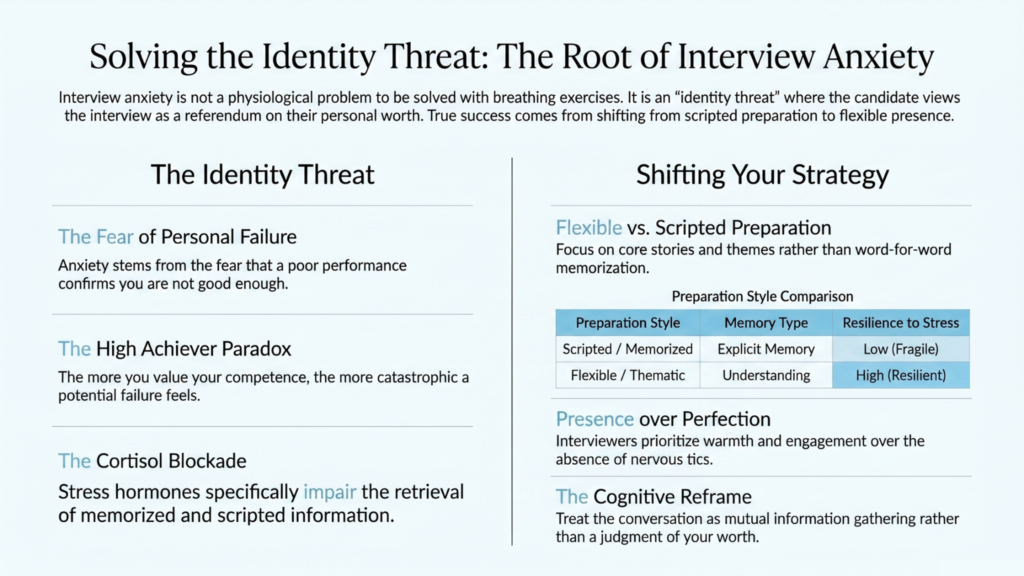
This is the identity threat. It’s not fear of the interview. It’s the fear of what a poor performance would confirm about your intelligence, your preparation, your readiness, your worth as a professional, your chances of ever making it. The interview has stopped being an evaluation of your fit for one specific role and has become a referendum on you as a person.
And here’s the brutal part: the more qualified, prepared, and capable you are, the worse this gets. Because the more you’ve built an identity around being competent and capable, the more catastrophic a failure feels. High achievers often have the worst interview anxiety, not despite their preparation, but because of it. They have more to lose.
This is why you can spend three weeks drilling answers, know every response cold at home, and still blank the moment an interviewer looks at you and asks the first question. It’s not because you forgot. It’s because your nervous system registered the stakes, escalated the threat, and cortisol, which directly impairs retrieval from memorized, scripted knowledge, stripped your access to the very answers you spent weeks building.
The more the interview means, the more your body treats it like danger. And the more it treats it like danger, the less access you have to your own knowledge.
Why “Prepare More” Is Both Right and Wrong
The standard advice in response to interview anxiety is to prepare until the anxiety goes away. Practice more. Do mock interviews. Know your answers so well they come automatically.
This advice is not wrong. But it hides a critical distinction that nobody in the prep space explains clearly.
There are two types of preparation. One makes you resilient. One makes you fragile.
Scripted preparation, memorizing a word-for-word answer to “tell me about yourself,” and rehearsing exact phrases for behavioral questions is fragile preparation. It lives in your brain’s explicit memory system. And cortisol, the stress hormone that floods your body the moment you sit across from an interviewer, directly impairs explicit memory retrieval. The more precisely you memorize something, the more vulnerable that memory is to stress.
This is the preparation paradox. The candidates who blank the hardest are often the ones who prepared the most rigorously.
Flexible preparation is different. It works with understanding rather than scripts. Instead of “what exact words will I say,” it builds around “what am I actually trying to communicate? ” Instead of memorizing a STAR-format answer verbatim, it means knowing your stories well enough to enter them from any direction because the question might not land the way you rehearsed. Flexible knowledge survives cortisol. Scripted knowledge often doesn’t.
This is a distinction CloudHire’s internal analysis consistently surfaces. Candidates who reported freezing despite “extensive preparation” almost universally described script-based drilling as their method. Candidates who described performing well despite being nervous more often described preparation in terms of stories and themes rather than memorized Q&A.
What the Interviewer Is Actually Seeing
Here’s research that most candidates would find genuinely shocking, from a study published by the British Psychological Society:
Interviewers are largely oblivious to your nervous tics.
The shaking of hands. The nervous laughter. The slight tremor in your voice. The fidgeting. Most of this goes unregistered. Interviewers are focused on the content of the conversation, not scanning you for micro-expressions of stress.
What they do notice, and what directly affects performance scores, is something else entirely: a deficit in warmth and assertiveness.
This matters enormously because candidates spend enormous mental energy trying to suppress visible symptoms of anxiety the ones nobody else can see while the actual performance problem is happening completely unmanaged. Anxiety makes you go flat. It makes you close up, become careful, pull your energy inward, speak with less confidence, and engage less warmly. You stop being a person in a conversation and become someone trying to survive an evaluation. And that withdrawal, not the sweating, not the heartbeat, is what tanks candidate scores.
The interviewer doesn’t know you’re anxious because your hands are trembling. They feel it because you’ve stopped connecting with them as a human being.
This inverts the entire prep strategy. You don’t need to work on hiding your nervousness. You need to work on staying warm and engaged despite it.
The Warmth Problem, Specifically
Warmth in an interview doesn’t mean being effusive or overly friendly. It means being genuinely present. It means making actual eye contact rather than staring at a fixed point while retrieving a stored answer. It means responding to what the interviewer actually said rather than pivoting straight to your prepared version of what you expected them to say. It means occasionally being human, acknowledging a moment of difficulty without catastrophizing it.
The internal experience of interview anxiety pushes hard against all of this. When your threat system activates, you naturally turn inward. Your attention narrows. You become focused on your own performance rather than the conversation. The interview, which is meant to be a two-person exchange, collapses into a one-person anxiety management exercise.
And that collapse is visible. Not through trembling. Through absence.
What Actually Addresses the Root
If interview anxiety is fundamentally an identity threat, then the real solution is not techniques layered on top of that threat. It’s a renegotiation of what the interview means.
This isn’t a soft idea. It’s a specific cognitive shift.
The version of an interview that triggers maximum anxiety is: this outcome will define my worth and determine my future. That’s a lot of weight for a forty-minute conversation to carry. The threat system fires proportionally to the perceived stakes and when the stakes include your self-concept, the system fires very hard.
The version that produces calmer, clearer performance isn’t “I don’t care,” that leads to flat, disengaged responses that also tank scores. It’s something more precise: this is information gathering on both sides. You are trying to understand whether this role and company are a fit. So are they. Neither of you will know until the conversation happens. You are not being judged on your worth as a person. You are being assessed for a specific role at a specific company at a specific moment in time and the outcome of that assessment says nothing permanent about you.
This reframe sounds simple. It’s not easy to internalize. But it’s different in kind from “tell yourself you’re excited instead of scared,” which is a technique that sits on top of the identity threat without addressing it.
On the Post-Interview Spiral
One experience almost entirely ignored by interview anxiety content: what happens after the interview ends.
For many candidates, the anxiety doesn’t stop; it shifts. The question-by-question replay begins. That answer was wrong. That pause was too long. They didn’t look convinced when I said that. Why did I use that word? I should have mentioned the other project. The spiral is often worse than the anxiety before, because the interview is now fixed, you can’t change it, but the outcome is unknown, and uncertainty plus rumination is a particularly difficult combination.
The only useful response to post-interview rumination is to close the loop rather than extend it.
Immediately after the interview, write down one or two things you said well and one or two things you’d approach differently next time. Not a full debrief, just two and two. This gives the replaying mind somewhere to land. Then send a brief follow-up note, not because it changes outcomes significantly, but because taking an action ends the helpless waiting posture. Then redirect your attention to the next application, the next conversation, the next thing you can actually influence.
The waiting period is hard. But the spiral that fills it is optional.
The Line That Changes Everything
Here’s what most interview anxiety content gets wrong at the level of philosophy: it treats anxiety as a problem to eliminate before the interview starts.
But the candidates who consistently perform well under pressure across interviews, across high-stakes presentations, across any evaluative context are not the ones who successfully eliminate their anxiety beforehand. They’re the ones who’ve stopped needing the anxiety to go away before they can function.
There’s a version of calm that comes from caring less. That’s not useful; it makes your answers flat and your presence distant.
The version that works is different: it’s the ability to be nervous and present at the same time. To feel the threat response and still look the interviewer in the eye. To have your heart racing and still answer the question you were actually asked rather than the one you were expecting. To stumble on a sentence, breathe, and keep going without treating that stumble as evidence that the whole thing is lost.
That’s not a breathing exercise. That’s a relationship with uncertainty. And it’s built not through more mock interviews where the conditions are safe, but through repeatedly showing up in high-stakes situations with the understanding that you can perform while feeling afraid.
The interview isn’t what you’re afraid of. Once you know that, you can stop trying to fix it.
Frequently Asked Questions
Why do I freeze on questions I practiced 100 times?
Cortisol kills scripted memory. Flexible prep (stories > scripts) survives stress. Practice entering answers from any angle; mock interviewers pivot hard.
Prepared candidates have worse anxiety. Why?
Identity threat scales with competence. High achievers fear confirming “not good enough.” Reframe: “This evaluates role fit, not my worth.”
“Just be yourself” fails when anxious, why?
Threat makes you feel your smallest self. Train “nervous but present.” Feel your heart race, make eye contact, and answer anyway. Function coexists with fear.
Why do I go blank explaining my own project?
Threat narrows focus to survival. Practice a 4-minute pitch aloud daily. Flexible entry points (problem-first vs tech-first) bypass cortisol block.
Mock interviews make anxiety worse, how?
Safe stakes ≠ real stakes. Script reliance fails under cortisol. Build “nervous but functional” through live high-pressure reps only.