(Why Employer Brand Statistics Look Impressive but Feel Disconnected)
Walk into any talent acquisition conference and you’ll hear about employer branding. The importance of company culture. The power of social media presence. The need for authentic storytelling.
The statistics back this up. Employer branding drives application volume, reduces hiring costs, and influences candidate decisions.
Yet hiring outcomes are still inconsistent. Time-to-fill remains unpredictable. Quality of hire varies wildly. Early attrition continues to plague companies despite their investment in brand.
Here’s the tension: if employer branding worked as promised, hiring wouldn’t feel this fragile.
The disconnect isn’t that employer branding doesn’t matter. It’s that branding solves one problem, getting attention, while hiring requires solving a different problem: making good matches between people and roles.
The Employer Brand Statistics Everyone Quotes
Let’s start with what the data actually says.
Reputation Drives Application Volume
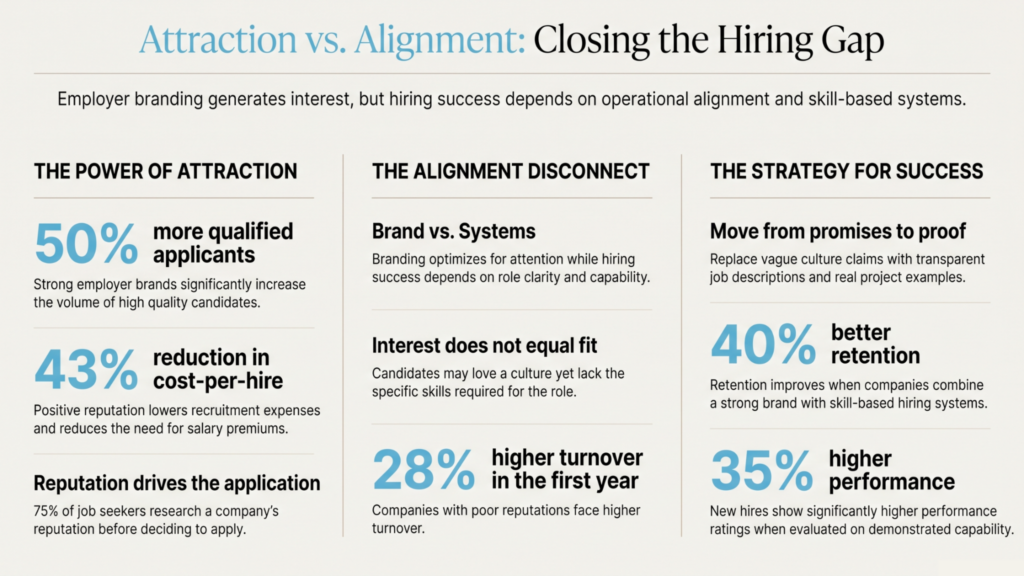
Research shows that 75% of job seekers research a company’s reputation before applying. Nearly 86% of candidates won’t apply to or continue working for a company with a bad reputation among former employees or the public.
Strong employer brands receive 50% more qualified applicants and can reduce cost-per-hire by up to 43%. Companies ranked as top places to work see twice as many applications per role compared to average employers.
This part is real: brand perception drives whether people apply.
Poor Employer Brands Increase Hiring Costs
Companies with weak employer brands pay the price in multiple ways. They need to offer 10% higher salaries on average to attract the same quality candidates. Their time-to-fill is 1-2 weeks longer. And they experience 28% higher turnover in the first year.
Negative brand perception creates a talent tax: you’re competing with one hand tied behind your back.
Social Media Shapes First Impressions
69% of candidates use social media to research potential employers. LinkedIn, Glassdoor, and Instagram have become primary channels where first impressions form.
Companies with active, authentic social media presences see measurably higher engagement with job postings. But authenticity matters, 82% of candidates say they can spot inauthentic employer branding.
Candidate Experience Affects Brand Perception
60% of candidates have had a poor candidate experience, and 72% of them share that experience online. Long application processes, slow responses, unclear job descriptions, and ghosting all damage the employer brand.
One bad experience can undo months of brand investment. And unlike traditional marketing, candidate experience is hard to spin.
The Part Employer Brand Statistics Don’t Explain
Here’s where it gets interesting: the brand explains why candidates apply. It does not explain why hires fail.
Strong Brands Still Make Weak Hires
Google, Amazon, and Microsoft, companies with some of the strongest employer brands in the world, still make hiring mistakes. They still hire people who underperform. They still experience culture fit issues. They still deal with early attrition.
Well-known companies mis-hire just as often as unknown ones. The difference is that they have more candidates to choose from, not better systems for choosing.
CloudHire’s internal analysis shows that Fortune 500 companies with top-tier employer brands have nearly identical quality-of-hire scores as mid-market companies with average brands when both use traditional resume-and-interview hiring processes.
The brand gets you, candidates. It doesn’t guarantee you pick the right ones.
Attraction Isn’t the Same as Alignment
Interest does not equal readiness, capability, or fit for the role.
Someone might be attracted to your company culture, your mission, your benefits, and still be completely wrong for the position you’re hiring for. They might lack the skills, the experience, or the working style the role requires.
Employer branding optimizes for attraction. Hiring success depends on alignment, matching specific people to specific roles based on actual capability.
Branding Can Hide Broken Hiring Systems
A polished employer brand can actually mask dysfunction. The company looks great from the outside, so candidates assume the hiring process will be professional, transparent, and fair.
Then they experience: vague job descriptions that don’t explain what the role actually entails, screening processes that filter arbitrarily based on keywords or pedigree, interviews that don’t assess relevant skills, and feedback that never comes or arrives months late.
The disconnect between brand promise and hiring reality creates deeper disappointment than no brand at all.
Employer Branding vs Hiring Reality
Let’s be clear about what each optimizes for:
Employer branding optimizes for:
- Attention and awareness
- Perception and reputation
- Application volume
- Cost-per-hire reduction
- Competitive positioning
Hiring success depends on:
- Role clarity and expectations
- Skill evidence and capability assessment
- Decision consistency across candidates
- Alignment between person and position
- Onboarding and ramp-up effectiveness
These aren’t the same thing. They don’t even measure the same outcomes.
Brand gets people in the door. Systems decide who succeeds.
What Employer Brand Statistics Reveal About Candidate Trust
Dig deeper into the employer brand data and you find something interesting: candidates are getting harder to convince.
Candidates Trust Proof More Than Promises
Culture claims on careers pages don’t carry the weight they used to. Candidates look for evidence: employee reviews, what people say anonymously, and how the company handles criticism.
“We value work-life balance” means nothing if reviews consistently mention 60-hour weeks. “We promote from within” rings hollow if former employees say they hit career ceilings.
Candidates are doing their homework. And they trust what they discover more than what you advertise.
Reviews Signal Risk, Not Just Reputation
Glassdoor isn’t primarily a marketing channel; it’s a warning system.
Candidates read reviews to identify red flags: toxic managers, broken promises, politics, and a lack of career growth. They’re not looking for perfect scores. They’re looking for patterns of problems they want to avoid.
This is why fake or incentivized positive reviews backfire. Candidates can spot them, and their presence signals that the company is trying to hide something.
“Great Culture” Messaging Is Losing Credibility
Everyone claims to have a great culture. The phrase has become meaningless.
What candidates want instead: clarity about expectations, transparency about challenges, honest information about how work actually happens.
They’d rather know upfront that the role requires travel 30% of the time than discover it three weeks in. They’d rather understand the team is rebuilding after turnover than get surprised by dysfunction.
Clarity beats cheerleading.
Why Employer Branding Alone No Longer Wins Talent
The employer branding playbook that worked five years ago is losing effectiveness.
Why? More information is available to candidates now than ever before. Glassdoor, Blind, Reddit, and LinkedIn are multiple channels where current and former employees share the unfiltered reality.
Poor hiring experiences travel fast. One candidate who ghosted after final interviews will tell ten friends. One employee who felt misled during hiring will write a detailed review.
Brand inconsistency erodes trust quickly. If your careers page promises one thing and the hiring experience delivers another, candidates notice. And they adjust their expectations for what working there will actually be like.
The insight: brand without execution creates disappointment at scale.
You’ve promised a great experience, attracted attention because of it, and then delivered something different. That’s worse than having no brand promise at all.
What High-Performing Companies Do Differently
The companies winning the talent war do something smart: they pair brand with operational excellence.
They don’t just market their culture; they show real work. Job descriptions include actual projects, real challenges, and specific problems the role will solve.
They hire based on demonstrated capability, not resume pedigree. Skills assessments, work samples, and structured interviews that actually test relevant abilities.
They reduce ambiguity early. Clear expectations about hours, travel, team structure, and growth paths. Candidates know what they’re signing up for.
In these companies, employer brand becomes a signal of how they operate, not a promise that might not hold up.
CloudHire’s internal analysis shows that companies combining strong employer brands with skill-based hiring see 40% better retention and 35% higher performance ratings in the first year compared to companies relying on brand alone.
Employer Brand Statistics Will Keep Changing But Hiring Outcomes Won’t Unless Systems Do
The next wave of employer brand statistics will show even more sophistication. More channels, more touchpoints, more ways to measure brand perception.
But unless companies fix how they hire, the outcomes won’t improve.
The next phase of employer branding isn’t louder messaging or better content marketing. It’s a tighter alignment between promise and reality.
It’s making sure your hiring process delivers the experience your brand promises. It’s ensuring that candidates who are attracted by your brand actually fit the roles you’re hiring for.
Final Thought: A Strong Employer Brand Attracts Attention A Strong Hiring System Earns Trust
Employer brand statistics don’t point to a marketing problem. They point to a design problem in hiring.
You can have the best employer brand in your industry and still struggle with hiring if your evaluation process is broken. You can attract thousands of candidates and still make bad hires if you’re screening based on weak signals.
The gap between brand promise and hiring reality is where trust gets lost. It’s where great candidates have bad experiences. It’s where companies with impressive reputations still fail to build strong teams.
That’s the gap CloudHire was built to close.
Not by making your brand look better, but by making your hiring process work better. By giving you the systems to turn brand attention into actual alignment between candidates and roles.
Because at the end of the day, employer branding gets you noticed. But hiring systems determine whether you win.
Frequently Asked Questions
What are employer brand statistics?
Employer brand statistics measure how reputation impacts hiring outcomes, including application volume, cost-per-hire, candidate research behavior, and employer branding ROI.
Why is employer branding important for hiring?
Strong employer brands attract 50% more qualified applicants, reduce cost-per-hire by up to 43%, and poor brands often require 10% higher salaries with 28% higher first-year turnover.
Can employer branding reduce hiring costs?
Yes. Strong brands lower cost-per-hire through higher application volume, lower salary premiums, and reduced turnover, but savings depend on strong evaluation systems.
Why do strong employer brands still struggle with hiring?
Because branding drives attraction, not alignment. Companies still face skill mismatches, poor role fit, and early attrition when evaluation relies on weak hiring signals.
How can companies improve employer brand credibility?
Improve credibility by matching brand promises with real candidate experience, clear communication, transparent expectations, and skill-based hiring practices.