Most false positive hires happen because companies judge performance before they see proof. The fix is not “better interviews,” it is a hiring system built around role-specific work samples, a 30-day proof plan, and early correction when evidence and promises do not match.
False positive hires are usually treated like a recruiting mistake. That is too small a frame. The real issue is that many hiring teams still confuse a good interview with a good hire, then act surprised when the job exposes the gap.
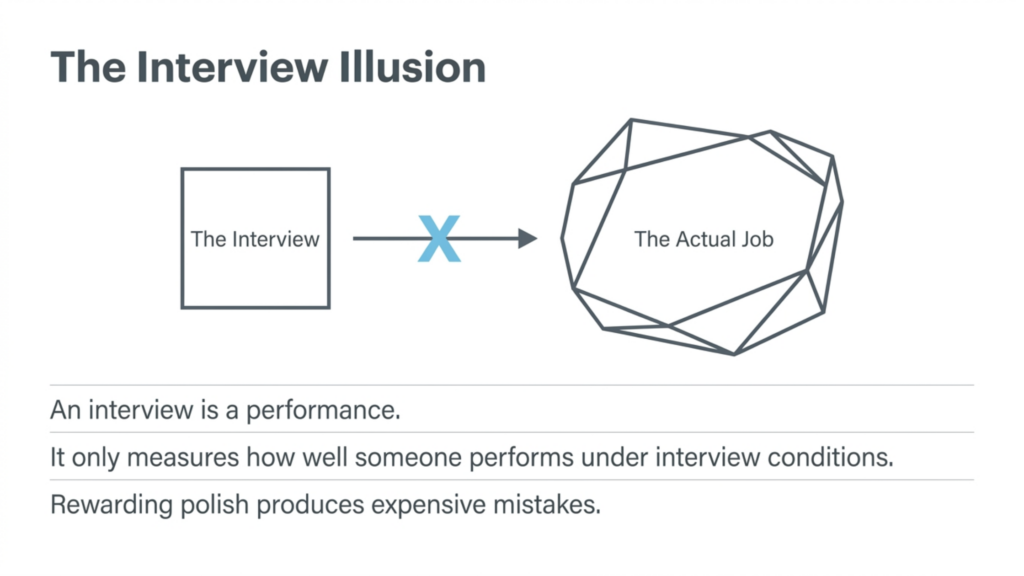
The truth is, an interview is a performance, not a guarantee. Candidates who are fluent, prepared, and polished can look stronger than people who are more capable in actual work. A hiring process that stops at charm, confidence, and resume credibility will keep producing expensive mistakes.
What the Market Keeps Missing
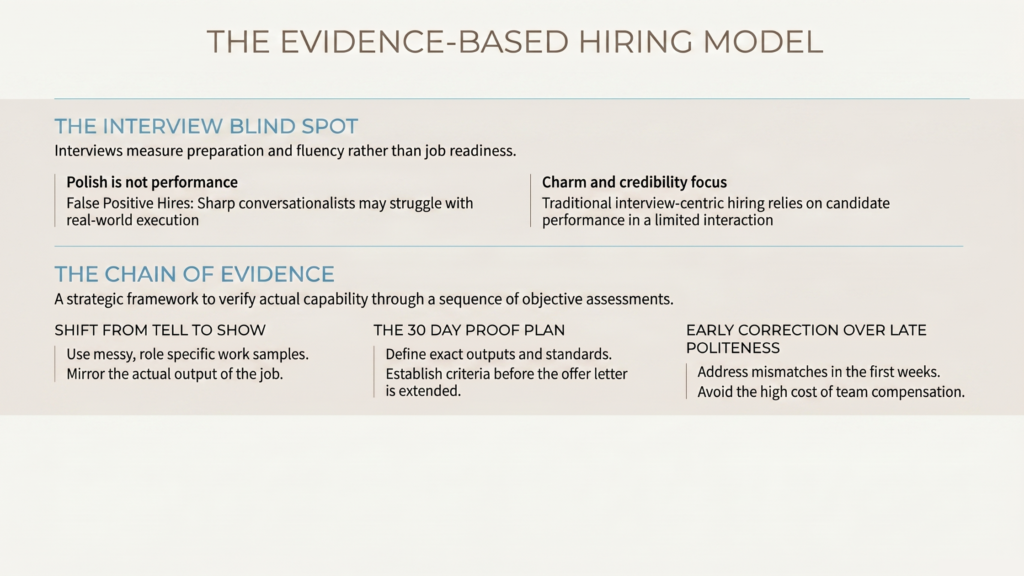
Most content on false positive hires repeats the same advice: ask deeper questions, use scorecards, check references, and define the role better. Those are useful, but they are not enough because they still assume the interview is the main event. In practice, the interview only tells you how well someone performs under interview conditions.
That is the blind spot. A candidate can prepare for common questions, memorize STAR-style answers, and sound unusually sharp in a one-hour conversation. Reddit discussions about hiring and interview experiences reflect how often candidates and observers notice this gap between polished interview behavior and actual job readiness. If your process rewards polish, you will keep selecting for polish.
A stronger hiring model starts with a different question: what must this person be able to produce in the first 30 days that proves the hire was right? Once you ask that, the entire process changes.
A Better Unit of Proof
The best way to reduce false positive hires is to move from “tell me” to “show me.” Not in a vague way, but in a work sample that mirrors the role’s real output.
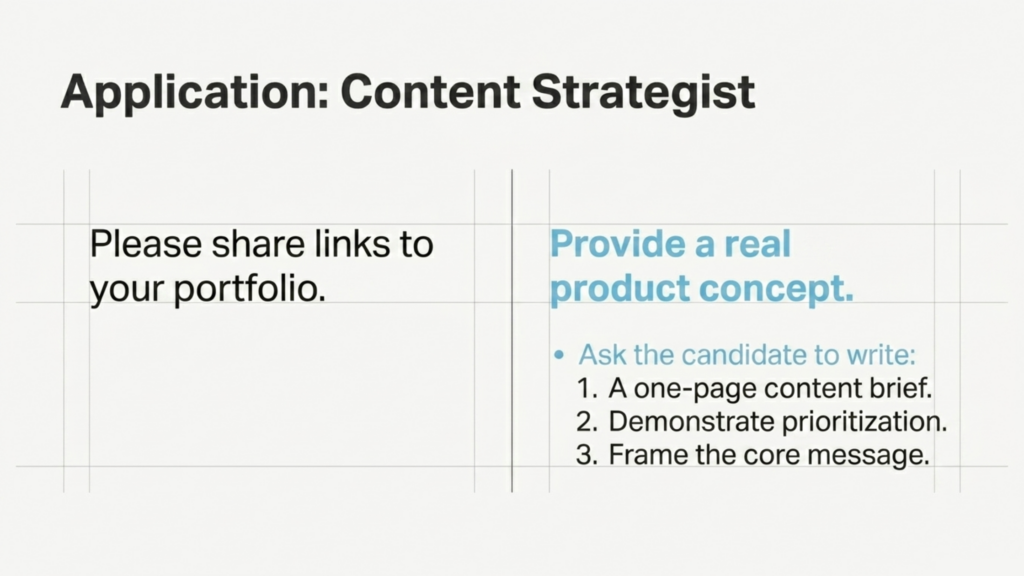
If you are hiring a customer success manager, do not just ask how they handle churn. Give them a messy renewal scenario and ask them to write the exact customer email, internal escalation note, and next-step plan they would use. If you are hiring a content strategist, do not stop at portfolio links. Ask for a one-page content brief based on a real product and let them show how they think, prioritize, and frame the message.
This is where many teams make a mistake: they use assessment as a checkpoint, not a mirror. A good work sample is not a test of trivia. It is a preview of the actual job. Spark Hire’s guidance on candidate fraud and cheating points in this direction too: the less your process depends on right-or-wrong answers, the harder it is for candidates to game it and the more clearly you see real-world judgment.
The 30-Day Proof Plan
The strongest correction to false positive hires is not a smarter interview. It is a 30-day proof plan that begins before the offer letter.
Start by defining three things:
- The exact output the person must create.
- The standard that output must meet.
- The point at which you will call the hire a mismatch.
That sounds obvious, but many teams never write it down. They hire for “ownership,” “communication,” or “adaptability,” then realize too late that those words were never translated into visible work.
Here is what this looks like in practice:
A startup hiring a junior recruiter might say the first 30-day proof is not “learn the ATS.” It is:
- Source 40 relevant candidates
- Produce outreach that gets at least a 20 percent reply rate
- Explain why the three shortlisted candidates were chosen
Now the company is not guessing. It is checking whether the hire can do the job.
A B2B content team might define the first proof as: produce one SEO brief, one draft article, and one revision cycle that reflects brand voice and search intent without heavy rescue from the manager. Again, the point is not perfection. The point is to verify whether the person can turn expectations into usable work.
Why This Matters After Hiring
The highest cost of a false positive hire is not salary. It is the time the rest of the team spends compensating for the gap. Once a weak hire is in place, strong employees start editing, rechecking, and covering. The hire stops being an individual problem and becomes a team task.
That is why early correction matters more than late politeness. Companies often know within weeks that something is off, but they keep hoping the person will “settle in.” That hope is expensive. If the first real work sample is weak, the first onboarding sprint is confusing, and the first few decisions require constant rescue, the evidence is already speaking.
A better company does not wait for the probation period to fail before acting. It sets checkpoints that make the mismatch visible earlier. That is not harsh. It is respectful to the team and honest to the hire.
How This Changes the Interview
Once the goal is proven, interviews become sharper and shorter. You do not need more rounds. You need better evidence.
Instead of asking broad questions like “How do you handle ambiguity?”, anchor the discussion in a real scenario from the role. Ask the candidate to walk through the actual tradeoffs they would make, the risks they would notice, and the first draft they would deliver. This is more revealing than abstract confidence because it forces the candidate to show decision-making, not just self-description.
You can still ask common questions, but they should not be the core of the process. Even the standard freshers’ interview questions floating around job forums and content sites are often too easy to rehearse, which is exactly why they can flatter weak readiness if used alone. The better move is to use those questions only as a warm-up, then immediately move into role-specific work.
The Real Shift
False positive hires are not fixed by making the interview “harder.” They are fixed by making the process more truthful. The more your process depends on general answers, the easier it is to hire well-spoken uncertainty. The more it depends on visible output, the harder it is to confuse performance with readiness.
That is the shift most hiring content misses. The goal is not to find candidates who can pass interviews. The goal is to build a system that can verify whether someone will create value once the interview is over.
That is also why the best teams do not treat hiring as a single event. They treat it as a chain of evidence: role definition, work sample, calibrated interview, 30-day proof, and early correction if the facts do not hold. When that chain is strong, false positive hires stop being mysterious.
They become visible. And once they are visible, they are fixable.
Better hiring comes from better evidence, not better interviews alone. CloudHire is designed to help teams evaluate real output through structured assessments and AI-supported interviews before committing to a hire.
Frequently Asked Questions
What is a false positive hire?
A false positive hire is someone who looks strong during screening and interviews but underperforms after joining. The mismatch usually comes from judging interview performance instead of job performance.
Why do false positive hires happen?
They happen when hiring teams rely too much on polished answers, resume claims, or gut feeling. The process often fails to verify whether the candidate can actually produce the work.
How is a false positive hire different from a bad hire?
A bad hire is the outcome. A false positive hire describes how the mistake happened: the candidate appeared right during hiring, then proved wrong once the job started.
What are the main signs of a false positive candidate?
Common signs include vague experience, overconfident but shallow answers, weak role-specific examples, and strong interview presence without proof of real output or repeatable results.
Why are false positive hires so costly?
They cost salary, onboarding time, team covering and helping their work, and lost productivity. They also distract managers and often force extra hiring cycles, which makes the mistake even more expensive.