TL;DR: A PhD student is still in the structured learning phase (coursework, exams, guided work), while a PhD candidate has cleared those requirements and is now expected to independently produce original research with more autonomy, responsibility, and career signaling power.
Everywhere you look in lab corridors or on department mailing lists, people use the words “PhD student” and “PhD candidate” as if they mean the same thing. They don’t. The distinction matters in everyday life (funding, teaching load, expectations), in career planning (what employers will read on your CV), and in emotional terms (how you think about time, autonomy, and responsibility). If you’ve ever asked “what is a PhD candidate vs student?” this article aims to give you a clear, sourced-by-experience answer: not a textbook definition, but the practical differences that change how you work, apply for roles, and plan life after the degree. And because the online world is full of confusion, this guide clarifies the phd candidate vs student debate in a way that actually helps you make decisions.
Two Stages of the Same Journey, But With Different Rules
At a basic level, a PhD student refers to anyone enrolled in a doctoral program. That label covers the entire arc: coursework, exams, research rotations, teaching assignments, and the early stages of thinking about a dissertation topic. By contrast, a PhD candidate (sometimes called ABD “all but dissertation”) is a narrower, milestone-based status: roughly, someone who has completed required coursework and qualifying exams and received formal departmental approval to focus primarily on dissertation research.
In practice, this transition changes almost everything about daily expectations. It’s the central reason the PhD candidate vs student distinction shapes both your work rhythm and the opportunities available to you.
When you move from student to candidate, the calendar shifts from structured deadlines (course deliverables, weekly labs, scheduled seminars) to a looser, self-driven timeline. That looseness is the reason being a candidate feels both liberating and terrifying: you no longer have the external scaffolding that enforced progress; success depends on your ability to set realistic goals, manage momentum, and negotiate resources with your advisor and committee.
In many programs, the wording is explicit: students take classes and pass qualifiers, candidates defend proposals, and are responsible for original research. This big identity shift is at the heart of the PhD candidate vs PhD student conversation and why the terminology matters when you talk to employers.
Funding, Responsibilities, and Visibility
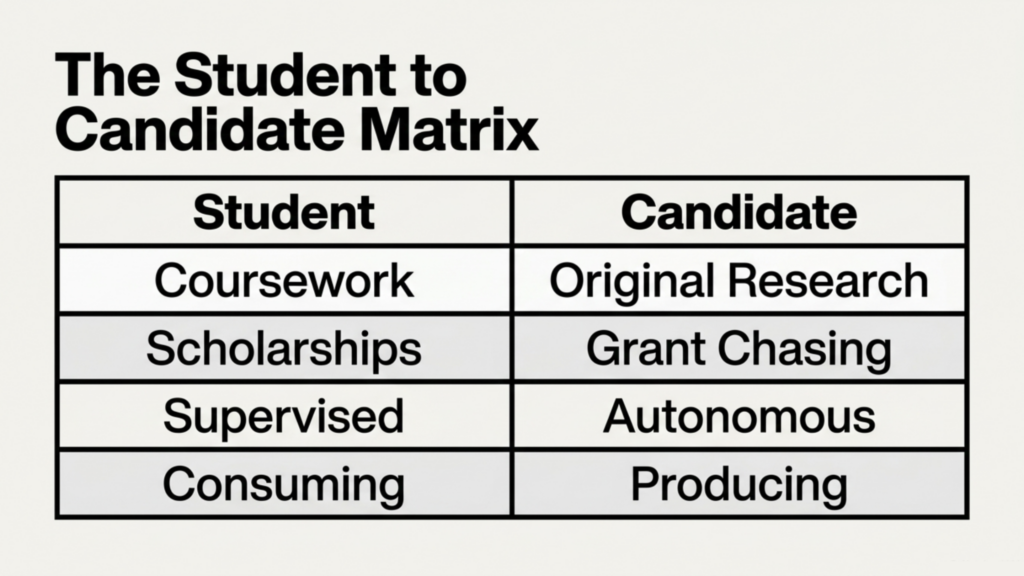
Funding is where the difference becomes tangible. Early in the PhD, students are commonly funded through scholarships, teaching assistantships, or rotating research assistantships. As they become candidates, funding often shifts to targeted research grants or longer-term lab funding; in well-funded labs, this can mean more predictable pay and fewer classroom hours, while in underfunded settings, it can translate into grant-chasing and precarious short-term contracts.
The change in status also changes responsibilities: candidates tend to take on mentoring roles, supervising undergraduates and junior grad students, and they often carry heavier expectations for publications, grant applications, and lab contributions.
Visibility matters too. Hiring managers and collaborators read “PhD candidate” and infer that the person is deep in a specific, defensible project. If you’re thinking about the US job market international students often navigate, candidate status becomes a signal of reliability and proven progress. It shows you understand timelines, output expectations, and Western academic deliverables, key for both postdoc committees and industry recruiters.
Work Product: From Coursework to Original Contribution
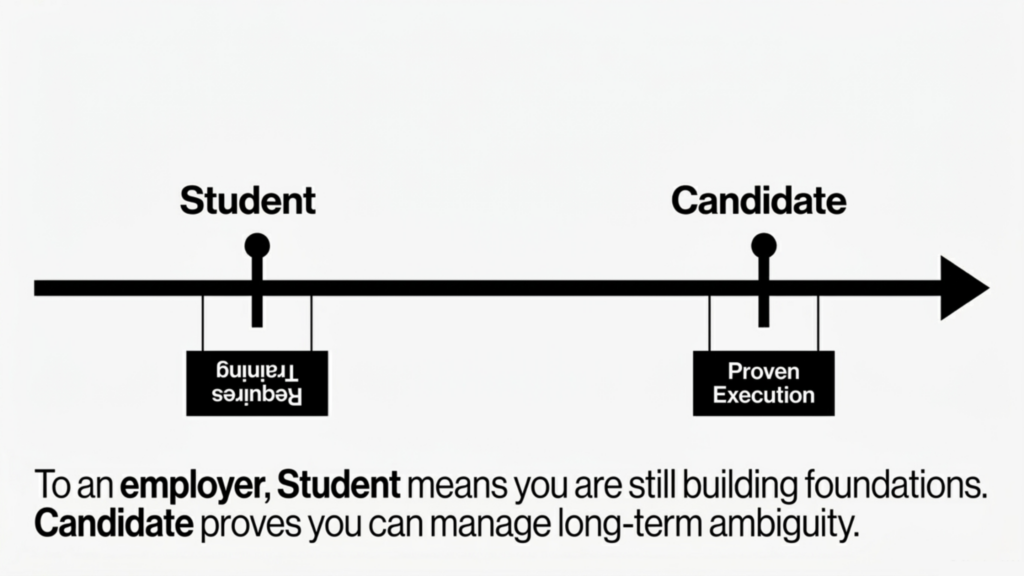
A PhD student’s outputs look different from a candidate’s. Early on, your “deliverables” are assignments, lab reports, and class presentations; later on, what matters are manuscripts, reproducible analyses, defensible dissertation chapters, and demonstrated independence.
This matters beyond academia. For first student jobs, internships, or entry-level research roles, employers lean toward candidates who can show measurable impact: think published methods, open-source code, or curated datasets. Even when you apply for remote jobs for college students with no experience, your PhD trajectory signals something valuable: the ability to learn independently, deliver outputs, and manage long-term projects.
The Emotional and Social Shift
What often goes unspoken is how the identity shift affects confidence, community, and mental health. As a student, you exist in a cohort structure; as a candidate, you often work alone, sometimes for months at a time. This is where many people misunderstand the PhD candidate vs student transition; it’s not just academic, it’s personal.
Isolation increases, expectations rise, and your self-worth can become tied to slow-moving research. Successful candidates counter this by forming writing groups, joining cross-lab collaborations, and building micro-communities. Mentoring relationships also evolve: advisors expect candidates to be proactive, not passive.
How the Distinction Affects Job Search Strategy
If you’re planning to move into industry or secure postdoc funding, how you present yourself matters. A PhD candidate label suggests you are nearing completion and capable of independent research. A PhD student’s label suggests you’re still building foundational skills.
For those navigating the US job market international students often face clarity on status, publication timelines, and expected defense dates is essential. Visa considerations, OPT windows, and hiring cycles also tie into your academic stage more than most programs acknowledge.
For first student jobs, emphasize hands-on technical skills, completion of complex projects, reproducible workflows, and real impact. If your title remains “PhD student” but your work resembles that of a candidate, describe your responsibilities in industry-friendly language.
This is also where a lot of candidates get stuck. They’ve done the work, but they’re still describing it in academic terms while employers are reading for outcomes. Platforms like CloudHire are built around this gap, translating research, projects, and outputs into signals that hiring teams actually recognize.
Not by changing your experience, but by reframing how it shows up.
Practical Differences in Daily Life: What Changes, Practically Speaking
Time allocation: students split time between classes and labs; candidates focus primarily on research and writing.
Deliverables: students have graded assignments; candidates produce manuscripts and grant drafts.
Meetings: students meet supervisors regularly; candidates coordinate committee milestones.
Mentoring: candidates often guide undergraduates and junior students.
Funding pressure: candidates can face grant-linked renewals; students usually have semester-based support.
Understanding these shifts makes the phd candidate vs student transition more predictable, especially if you want to time publications or prepare for internships, part-time roles, or even remote jobs college students that help build industry experience during your PhD.
Common Myths and Mistakes
Several myths create confusion:
- Being a candidate does not guarantee employment.
- Candidates still need mentors; independence doesn’t mean isolation.
- Students can publish early.
- International students are judged heavily on clear indicators of progress.
If you’re juggling research with earning opportunities, even remote jobs for high school students or lightweight freelance roles can help develop communication skills, data literacy, and project management, all things hiring managers love.
How to Signal Your Status and Readiness
Use explicit language on your CV:
“PhD candidate (expected defense: May 2026)” is stronger than “PhD student.”
List publications, preprints, conference posters, code repositories, and chapter summaries. International candidates should include visa and availability details. For first student jobs, surface your most relevant technical achievements first.
Final Advice: Plan the Transition Like a Small Startup
Treat the moment you become a candidate as a product pivot. Map deliverables, plan your dissertation chapters like a roadmap, run “sprints” toward publishable units, keep mentors engaged, and create a portfolio that translates academic results into industry signals.
If you still wonder what is a PhD candidate vs student is, think of it as the shift from structured learning to accountable production. One stage teaches you how to research; the next stage expects you to produce research that others rely on. That shift changes funding, expectations, and how the world perceives you, so make it visible, intentional, and useful.
If you’re thinking about how your work translates outside academia, don’t leave it to the last minute. CloudHire helps turn your projects and research into clear, outcome-based signals, and matches that evidence to roles where it actually fits. It’s a more direct way to show what you can do, not just what your title says.
Frequently Asked Questions
What do you call a PhD candidate?
A PhD candidate is someone who has finished all required coursework and exams for their doctorate and is now focused on research and writing their dissertation. Before this, they were called a “PhD student.”
Are PhD candidates divided on whether they are students or employees?
Yes, PhD candidates often debate whether they are still students (because they learn and are enrolled in a program) or employees (because they do research, teach, or work for the university). Many feel like both, and their status may depend on country, funding, or job duties.
What is meant by doctoral candidate?
A doctoral candidate is a person pursuing any doctorate (PhD, EdD, etc.) who has completed all coursework and passed exams, and who is now working mainly on their dissertation or doctoral project. “Doctoral candidate” is a broad term that covers anyone in this final research and writing phase, not just those in PhD programs.