TL;DR: What candidates call “bad hiring experiences” are rarely exceptions; they are consistent patterns of control, opacity, and disregard that show up before day one.
Toxic culture does not begin after an offer letter is signed. In many organizations, it appears much earlier, embedded quietly within hiring and recruitment processes. While toxic workplace culture is often discussed in the context of employees and teams, the hiring stage is where many of the most damaging patterns first surface. For candidates, recruitment is the earliest and most revealing interaction with an organization’s values, power structures, and ethical standards.
In hiring, toxicity is often less visible but more systemic. It shows up in backend decisions, inconsistent communication, biased screening, intimidating interviews, and processes that prioritize control over fairness. Because these issues occur before formal employment, they are easier for organizations to dismiss and harder for candidates to challenge. Yet their impact is significant, shaping employer reputation, talent outcomes, and long-term trust.
Toxic Hiring Red Flags: How to Spot a Bad Company Before You Join
One of the clearest signs of toxic culture in recruitment is the absence of respect and transparency. Candidates may be left in the dark about timelines, evaluation criteria, or even whether a role truly exists. Communication becomes one-directional and transactional, reinforcing a power imbalance where candidates feel disposable rather than valued.
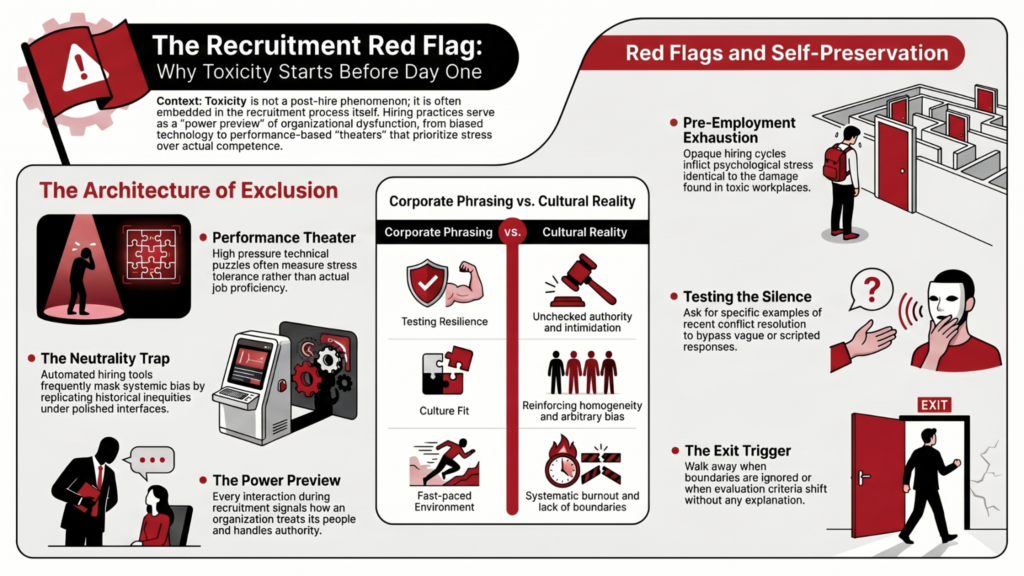
Research consistently highlights poor communication, dominance, intimidation, and lack of mutual respect as core traits of toxic organizational cultures, and recruitment processes often reflect these traits in concentrated form. When recruiters or hiring managers operate with unchecked authority, candidates may experience dismissive behavior, misleading information, or pressure tactics framed as “testing resilience” or “culture fit.”
These experiences do not stay contained. Candidates talk. Negative hiring experiences spread quickly through professional networks, online forums, and social platforms, eroding employer brand and making it harder to attract strong talent over time.
A Systems View of Toxic Hiring (Quick Diagnostic Framework)
Do you want to go beyond surface-level red flags? This framework breaks down how toxic hiring actually operates beneath the process.
| Indicator of Toxicity | Underlying Power Dynamic | Psychological Cost to Candidate | Institutional Consequence | Technological Bias Mechanism | Strategic Counter-Question | Shift in Perspective (Inferred) |
| Unchecked interviewer authority or intellectual superiority tactics | Dominance-based hierarchies where interviewers exert control by framing aggression as high standards | Chronic self-doubt and emotional exhaustion from the arbitrary evaluation | Normalization of unethical behavior internally and permanent damage to the employer’s credibility | Training algorithms on biased historical data that screens out candidates via irrelevant proxies like language patterns | Walk me through how your team recently resolved a conflict to observe their actual interpersonal values | The recruitment phase is not a preamble to employment but a direct manifestation of how the company commodifies human capital |
| Mid-process fluctuations in role scope or compensation criteria | Unilateral shifting of goalposts that reinforces a transactional imbalance where the candidate is viewed as disposable | Acute stress and anxiety stemming from systemic lack of transparency and predictability | Reduced talent pool quality as highly capable individuals self-select out of opaque sectors | Automated systems that preserve toxic dynamics under a polished surface without ethical human accountability | What happened to the previous person in this role to reveal if there is a pattern of high attrition? | Hidden backend inconsistencies are intentional structural filters designed to test compliance rather than competence |
| Disrespectful behavior excused as culture fit or testing resilience | Institutional gaslighting where boundary violations are rebranded as positive organizational traits | Loss of professional trust and feelings of being treated as a metric rather than a human | Attraction of misalignment and disengagement, leading to high long-term attrition costs | Gatekeeping of exclusion through opaque hiring platforms that appear neutral while amplifying existing inequities | How do you specifically measure success in this role to expose vague or unrealistic expectations? | An interview is a diagnostic window into the firm’s shadow culture; dysfunction at the entry point is rarely a localized issue |
How Do You Spot Toxic Culture During Interviews?
Interviews are often where hiring-related toxicity becomes most visible. While nerves are expected, consistently stressful or disrespectful interview environments are not accidental they are signals.
Some common warning signs candidates encounter include:
- Interviewers arriving unprepared or contradicting each other about role expectations
- Aggressive questioning framed as intellectual superiority rather than skill assessment
- Dismissive responses to clarifying questions or boundary-setting
- Sudden changes in role scope, compensation, or evaluation criteria mid-process
Traditional technical interviews are especially prone to these issues. High-pressure, puzzle-heavy formats often prioritize performance under stress rather than real-world competence. When interviewers lack training in objective evaluation, assessments become arbitrary, reinforcing bias and inconsistency.
Tools designed to bring structure, such as systems that generate skill-focused interview questions, can help introduce fairness, but only when used correctly. Without proper interviewer training or ethical intent, even structured systems can be misapplied, preserving the same toxic dynamics under a more polished surface.
Bias in Hiring Tools: When Technology Reinforces Toxicity
Bias is one of the most damaging and difficult-to-detect elements of toxic hiring culture, especially as organizations adopt AI-driven recruitment tools. While platforms that analyze resumes and tailor interview processes aim to reduce inefficiency and subjectivity, they also introduce new risks.
If hiring algorithms are trained on biased historical data, they can silently replicate and even amplify existing inequities. Qualified candidates may be screened out based on proxies unrelated to job performance, such as language patterns, educational background, or career gaps, creating systemic barriers that are invisible to both candidates and recruiters.
This form of toxicity is particularly harmful because it appears neutral on the surface. Without transparency, accountability, and continuous auditing, automated hiring systems can become gatekeepers of exclusion rather than tools of fairness. Ethical hiring requires organizations to actively question how decisions are made, not just whether they are fast.
What Damages Does Toxic Hiring Do to Candidates?
The effects of toxic recruitment extend well beyond inconvenience or frustration. For many candidates, especially those navigating competitive or unstable job markets, repeated exposure to unfair or disrespectful hiring practices takes a psychological toll.
Candidates may experience:
- Chronic stress and anxiety from unclear or shifting expectations
- A growing sense of self-doubt after repeated arbitrary rejections
- Emotional exhaustion from prolonged, opaque hiring cycles
- Loss of trust in certain industries or employers altogether
These impacts mirror those seen in toxic workplaces, despite candidates never officially joining the organization. Over time, this discourages capable individuals from pursuing roles in specific sectors or companies, shrinking the talent pool and reinforcing homogeneity.
How Can Recruiters Fix Toxic Hiring Practices Now?
Addressing toxic culture in hiring requires more than surface-level process tweaks. It demands a structural and ethical reset of how recruitment decisions are made and communicated.
At a minimum, organizations need to focus on three core areas:
Ethical use of hiring technology
AI-driven tools must be tested rigorously, audited continuously, and designed with clear accountability. Recruiters should understand how decisions are generated and be able to explain them transparently to candidates.
Structured and respectful evaluation
Interview processes should be consistent, skill-relevant, and designed to reduce stress rather than amplify it. This includes training interviewers on unconscious bias, respectful communication, and objective assessment methods.
Transparency and feedback
Candidates deserve clarity about timelines, expectations, and outcomes. Even when an offer is not extended, constructive feedback helps preserve dignity and trust, reinforcing a fair and professional employer image.
When these elements are treated as essential, not optional, recruitment becomes not just scalable, but credible.
When Should You Walk Away From a Toxic Hiring Process?
Not every hiring process deserves your persistence. Candidates often sense toxicity early but continue out of hope or sunk-cost thinking. Walking away can be a form of self-protection.
It may be time to disengage when:
- Disrespectful behavior is excused as “company culture.”
- Boundaries are repeatedly ignored during interviews
- Evaluation criteria keep changing without explanation
- Communication consistently lacks honesty or accountability
A hiring process is a preview of how power operates inside an organization. When that preview reveals dysfunction, control, or disregard for people, it rarely improves after joining.
Why Toxic Hiring Culture Hurts Organizations Too
While candidates bear the immediate emotional cost, organizations ultimately pay the long-term price. Toxic hiring practices repel high-quality talent, increase attrition risk, and weaken employer credibility. Over time, they also normalize unethical behavior internally, reinforcing the same cultural issues that hiring was meant to solve.
Recruitment is not just about filling roles, it is about signaling values. Organizations that treat hiring as a transactional filter rather than a human system inevitably attract misalignment, disengagement, and reputational damage.
Building a Healthier Recruitment Culture
The hiring process is the first signal of how a company operates. When that signal is built on opacity, control, or inconsistency, it’s rarely limited to recruitment, it reflects the system behind it.
At CloudHire, the focus is on bringing structure, clarity, and accountability back into hiring, not by increasing application volume, but by improving how candidates are evaluated, matched, and understood in context.
If you’ve experienced the kind of hiring processes described above, you already know the difference a better system would make.
Frequently Asked Questions:
What are red flags of toxic hiring in job postings?
Spot these gut-check warnings:
- Vague duties, “wear many hats,” no salary.
- Unrealistic asks: “entry-level” needs 5+ years.
- Same role reposted endlessly.
- “Fast-paced startup” code for burnout.
Why do toxic recruiters ghost candidates?
Fear, overload, or bad process. They cast wide nets, panic when someone bites, then vanish. It wastes your time and erodes trust. Real pros communicate even “no” beats silence.
What questions expose toxic hiring culture?
Ask these to test:
- “What happened to the last person in this role?”
- “How do you measure success here?”
- “Walk me through a recent team conflict resolution.”
- “Why is this role open?”
Vague answers = red flag.