TL;DR: 48% of 2025 graduates feel unprepared to apply for entry-level jobs. Employers budget $4,500 per new hire in remedial training. But the job readiness gap is not one problem; it’s three. And the reason most candidates can’t close it isn’t a lack of skills. It’s that they’re preparing for the hiring event instead of the job itself. Real skill assessment maps where the gap actually is. This piece shows you how to run it, close it, and walk into interviews from a fundamentally different position.
The Statistic Nobody Has Inverted
In one of our 2025 surveys, 800 HR leaders and 800 recent graduates were surveyed. We found that: 77% of graduates said they learned more in their first six months on the job than during their entire undergraduate education.
Every analysis of this data concluded the same thing: academia is failing graduates.
Here’s the inversion nobody ran: If 77% of graduates say six months of work teaches them more than four years of college, the readiness gap closes fast once people are in a real environment doing real work.
The gap is not permanent. It’s not evidence of a fundamental capability deficit. It’s evidence that academic preparation and professional readiness are different things, trained in different environments and measured against different standards.
That distinction is everything. Because if the gap closes fast in a real environment, the question becomes: how do you simulate the real environment before you’re in it? How do you compress that six-month learning curve into your preparation phase, so you walk in ready rather than arriving to learn?
The answer is real skill assessment against the actual standard of the role, not the certification, not the credential, not the interview prep. The job itself.
Why Candidates Prepare for the Wrong Target
There are two distinct preparation targets in any job search:
Target A is getting hired. Optimizing the resume, sharpening interview answers, building a LinkedIn presence, collecting endorsements, and practicing STAR stories. All legitimate, all necessary.
Target B is doing the job. Understanding how the work actually functions in practice. Knowing what a good output looks like in the role. Being able to demonstrate capability against the real tasks the employer will assign in the first 90 days.
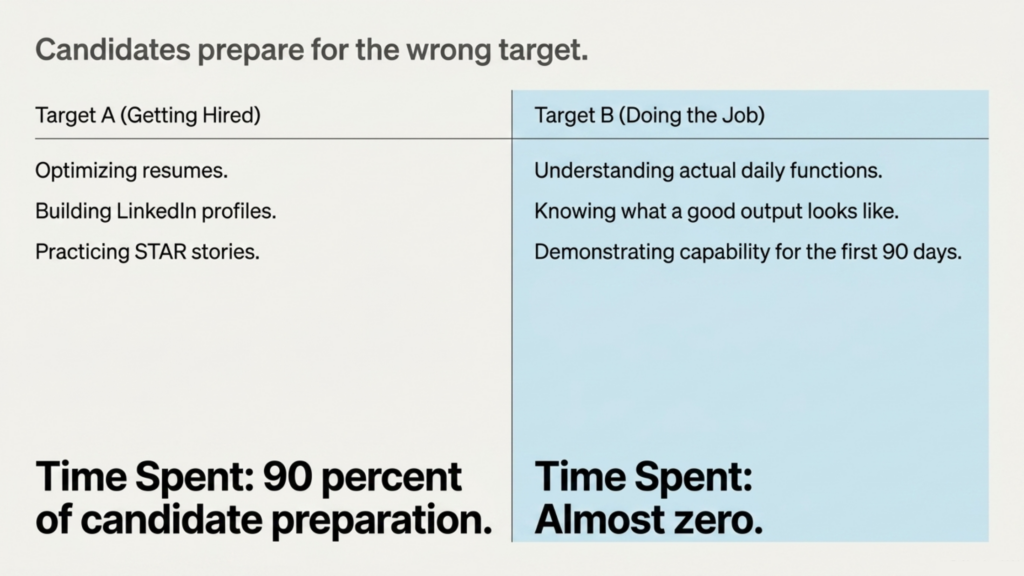
Most candidates spend 90% of their preparation on Target A and almost none on Target B. The job readiness gap is largely the distance between the two targets.
This matters because skilled interviewers and the assessments increasingly used alongside them are specifically trying to detect whether a candidate has prepared for Target B or only Target A. A candidate who has researched the company, rehearsed their answers, and optimized their resume can pass the early screening stages. But the moment the interview moves into technical demonstration, case study, or work sample territory, the preparation for Target A provides almost no cover.
- Only 30% of 2025 graduates secured full-time jobs in their field.
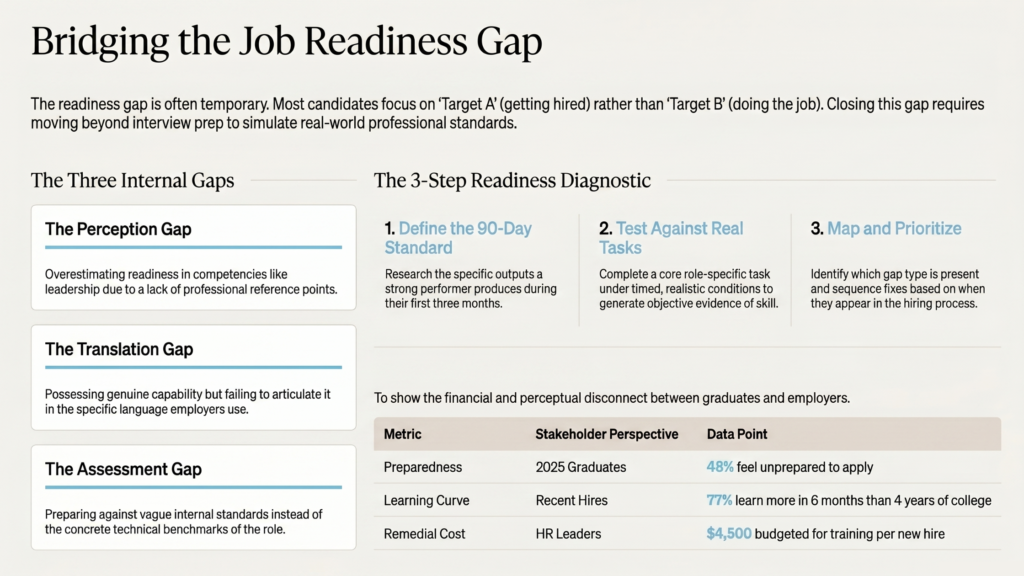
- 48% said they felt unprepared to even apply for entry-level positions.
- 56% of those unprepared graduates cited job-specific skills as their biggest gap skills that the degree did not provide, and interview preparation alone cannot create.
Job-specific skills live at Target B. And closing the gap to Target B requires a different type of preparation than most candidates have ever done.
The Three Gaps Inside the Job Readiness Gap
The job readiness gap is not one problem. Before you can close it, you need to know which of the three versions you’re dealing with.
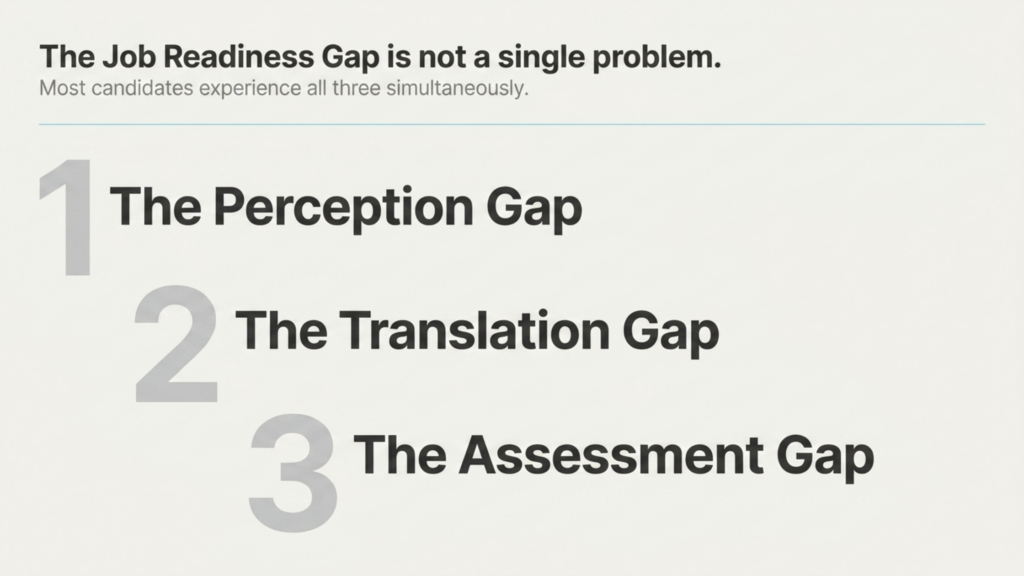
The Perception Gap
You overestimate your readiness in competencies where you have no professional reference point. In leadership and professionalism, the two competencies shaped most by real workplace exposure, students overestimate their proficiency versus employer perception by nearly 30 percentage points. The fix here is calibration through external feedback, not more confidence.
The Translation Gap
You have real experience that you cannot connect to the competencies employers are measuring. Academic projects, extracurricular roles, and part-time work often contain genuine evidence of capability that candidates can’t articulate in the language employers are listening for. The fix is not more experience; it’s a better translation of the experience you already have.
The Assessment Gap
You don’t know what “ready” means in concrete, testable terms. You’re preparing against a vague internal standard (“I think I’m decent at data analysis”) rather than the specific benchmark of the role you’re targeting (“this role requires intermediate SQL and the ability to build a reporting dashboard from raw data”). Without the benchmark, you can’t know where the gap is or measure when you’ve closed it. The fix is a real skill assessment against the employer’s actual standard, not your own sense of readiness.
Most candidates have all three operating simultaneously. Identifying which is largest for your specific target role is what makes the difference between generic preparation and a targeted one.
The $4,500 Clue
HR leaders estimate they could save approximately $4,500 per new hire in training costs if graduates arrived job-ready. This number has been cited primarily as evidence of a systemic problem.
Look at it differently: if companies budget $4,500 per hire for remedial onboarding investment, there’s a specific and consistent gap they’re expecting to close. Understanding what that gap typically contains gives you a precise readiness target because the difference between the hire who required that investment and the hire who didn’t is exactly the job readiness gap.
In practice, that remedial investment typically covers: role-specific technical skills that aren’t formally taught, professional communication in a real organizational context (which is structurally different from academic communication), understanding how the function connects to the business (how marketing affects revenue, how an analyst’s output actually drives decisions), and basic professional behavior under real accountability conditions.
These are all learnable. Most of them are simulatable before you’re hired, if you know what you’re trying to simulate.
Running the Real Skill Assessment for Job Readiness
The diagnostic that maps your actual gap rather than your felt sense of it has four practical steps.
Step 1: Define the role’s actual first-90-day standard
Pull a job description for a specific target role. Go past the requirements list and ask: What would a strong performer in this role actually produce in their first 90 days?
- Glassdoor reviews from current or recent employees in that role often contain this information explicitly.
- LinkedIn posts from hiring managers and team leads in the function frequently describe what good entry-level work looks like.
- Industry communities discuss it openly.
The goal is to understand the output standard, not just the input requirements.
Step 2: Test yourself against one specific task from that standard
Pick one concrete task the role would require and attempt it under realistic conditions. If the role involves data analysis, find a relevant public dataset and build the analysis you think the role would ask for. If the role involves writing, produce the type of content the function would actually create. If the role involves client-facing communication, draft the kind of message a junior in that role would typically send. Do this without reference materials wherever possible, in a timed session.
The output of this step is evidence, not a feeling. You’ll know immediately whether your capability is at the level the role requires, below it, or in some cases above it.
Step 3: Map the gap honestly against the three types
After running the task, review your output against examples of strong work in that role (publicly available case studies, published outputs, examples from professionals in the field). Where your output differs, identify which gap type is operating. Is the gap in the underlying skill itself (assessment gap)? Is it in how you described or positioned your approach (translation gap)? Is it in your calibration of what “good” looks like in a professional context (perception gap)?
This mapping tells you exactly what to work on and prevents the most common mistake: treating a translation gap with skill-building when what’s actually needed is better articulation of existing capability.
Step 4: Close the highest-impact gap before you apply
Not all gaps are equal in how much they affect hiring outcomes. A missing technical sub-skill that will appear in the first screening round is of higher priority than a translation gap that only surfaces in late-stage interviews. Sequence your readiness work by where in the hiring process each gap will first appear, not by which gap feels most comfortable to work on.
Where CloudHire Fits
“At CloudHire, the work we do with candidates on job readiness begins with exactly this diagnostic sequence, not a generic skills audit, but a role-specific readiness map built against the actual standard of the roles they’re targeting.” – Success Team, CloudHire
The reason this approach is different from traditional interview preparation is the target. Interview prep builds confidence in the hiring event. Readiness mapping builds actual capability for the role, which then carries through naturally into every part of the hiring process.
From there, the support becomes practical. Candidates refine how their experience is presented so it reflects real, testable skills in a format that hiring systems and recruiters can evaluate quickly. They are matched with roles that align with their demonstrated capability, rather than applying broadly to roles that only partially fit. And they prepare for interview environments, including structured and video-based formats, in a way that reflects how they will actually be assessed.
When candidates go through this process before the search begins, two things consistently change. The applications they send and the autoapply are more precisely targeted because they understand clearly which roles they’re genuinely ready for and which require a defined gap closure first. And when they sit in interviews, their answers have a different quality, specific, grounded, confident in the way that only comes from having tested the skill rather than rehearsed a description of it.
The job readiness gap is real. It’s also smaller and faster to close than most candidates assume, because what many discover in their first months on the job can be partially compressed into a focused readiness process before day one.
You don’t need to wait for the job to become ready for it.
FAQs
How do I know if I have a job readiness gap or just interview anxiety?
These feel similar from the inside but have completely different sources. Interview anxiety is a performance problem where you have the capability but struggle to demonstrate it under pressure. A job readiness gap is a capability problem; the skill itself needs development. The clearest diagnostic: can you complete a representative task from the target role to an acceptable standard when you’re alone, at your own pace, with no evaluator watching? If yes and you still struggle in interviews, that’s anxiety. If you struggle with the task itself, that’s a readiness gap.
I’m changing careers. Does the job readiness gap concept apply differently for me?
Yes, and it’s more complex because you’re likely carrying a translation gap (real transferable skills packaged in the wrong language) alongside an assessment gap (missing specific domain knowledge from the new field). Career changers who close the gap fastest focus on two things: identifying the two or three core competencies from their previous career that transfer directly, and running the readiness diagnostic on the one or two role-specific skills the new field actually requires. The mistake is trying to close every gap simultaneously; the priority is the competency tested earliest in the hiring process.
How long does it realistically take to close a job readiness gap?
It depends entirely on the gap type. A translation gap where the capability exists but the articulation is poor can be closed in one to two weeks of focused work. An assessment gap in a technical sub-skill (basic SQL, specific software, a quantitative method) typically closes in four to eight weeks of deliberate practice at the level the role actually requires, not just surface exposure. A perception gap closes most slowly because it requires external feedback and real-context exposure, not independent study. The fastest path is always identifying the gap type first, which is what the real skill assessment diagnostic produces.
Will doing this make me less likely to apply to jobs I should actually go for?
The risk is real and worth naming. Some candidates run this diagnostic, find a gap, and become more hesitant rather than more strategic. The frame that prevents this: the purpose of the diagnostic is not to decide whether you’re good enough to apply. It’s to decide what you need to do between now and the interview to be ready for it. A gap identified is a gap with a closure plan. That’s a more powerful position than applying without knowing the gap exists.
I’ve been in the workforce for several years. Is the job readiness gap concept relevant to me?
Significantly, especially given AI’s pace of change. 42% of employees expect their role to change significantly due to AI within the next year, yet 34% feel unprepared for those changes. The readiness gap for experienced professionals is often a competency gap, as competencies that were current two years ago and have since been partially displaced by new tools, methods, or expectations. The real skill assessment diagnostic is, if anything, more useful for experienced professionals because the gap is more subtle and harder to self-detect without testing against the current standard.