TL;DR: The best careers for work-life balance are not necessarily the easiest jobs. They are roles built around predictable schedules, healthier boundaries, sustainable workloads, and output-focused cultures instead of constant availability. Careers in fields like data analytics, cybersecurity, healthcare support, HR, cloud infrastructure, and remote-first knowledge work increasingly offer strong salaries alongside flexibility and lower burnout risk. The key is evaluating not just the title or salary, but the actual work structure, team expectations, overtime culture, and long-term sustainability of the role.
For years, work-life balance was treated like a secondary perk rather than a serious career factor. Higher salaries and faster promotions often came with an unspoken expectation of constant availability.
That tradeoff is now being questioned more aggressively across industries. As burnout rates rise and remote work reshapes expectations around time and productivity, professionals are paying closer attention to careers that offer long-term sustainability alongside financial stability.
The best careers for work-life balance are not defined by doing less work. They are usually structured around clearer boundaries, healthier workloads, predictable schedules, and performance systems that reward output instead of constant responsiveness.
How Careers for Work Life Balance Became Essential
Work-life balance once meant a rigid 9-to-5 ending promptly at five. Then technology and shifting values quietly changed everything. Employers discovered that predictable schedules retained talent better than perks alone. Workers learned that rested minds produced sharper results.
As burnout rates climbed past 70%, demand for the best careers for work-life balance surged. Suddenly, roles with clear endings mattered more. Hygienists scheduling four-day workweeks filled positions faster; developers embracing async remote work stayed longer.
This evolution opened two pathways: one for individuals seeking sustainability, another for companies prioritizing output over optics. The shift proves permanent, driven by three realities:
- Rising mental health awareness is pushing boundaries in contracts.
- Remote tools enabling true flexibility without productivity loss.
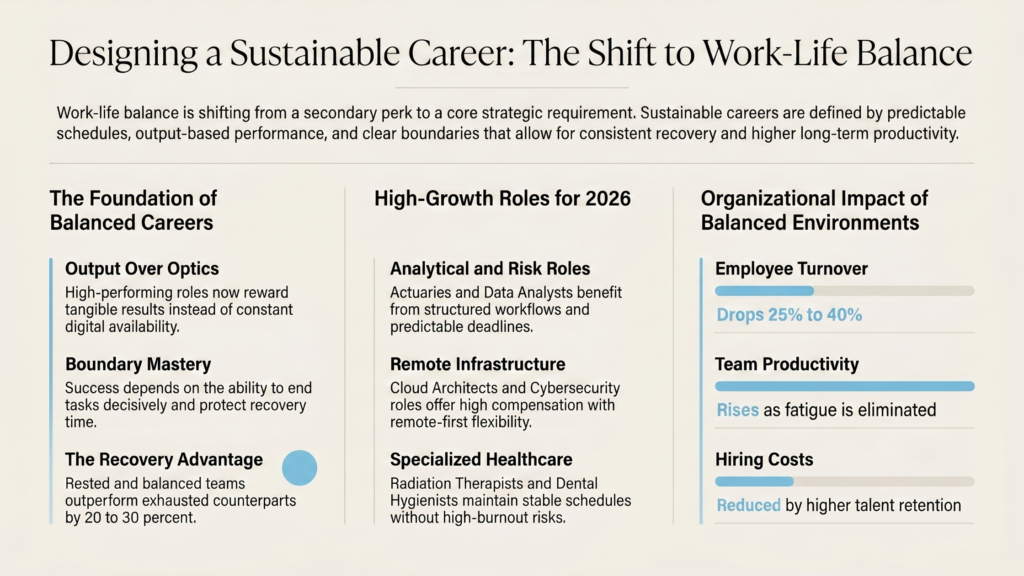
- Data showing balanced teams outperform exhausted ones by 20-30%.
Through this, high-paying jobs and good work-life balance evolved from a luxury to a smart strategy.
What Working in a Work Life Balance Career Actually Looks Like
Unlike high-pressure fields demanding weekend replies, the best careers for work life balance center on contained effort and recovery. Days follow natural arcs, focused mornings, tapered afternoons, evenings reclaimed.
A typical rhythm often includes:
- Morning blocks for deep work when energy peaks highest.
- Midday transitions handling collaboration or clients predictably.
- Afternoon wind-downs, tying loose ends without spillover.
- Evenings and weekends are protected by design, not negotiation.
Yet beyond schedules, sustainable careers depend on whether people can consistently recover outside work without carrying constant mental spillover into evenings and weekends. Successful professionals in these fields treat boundaries as fuel, like the data analyst closing Tableau at four, then coaching soccer, returning sharper tomorrow.
Why Companies Invest in Work Life Balance Careers
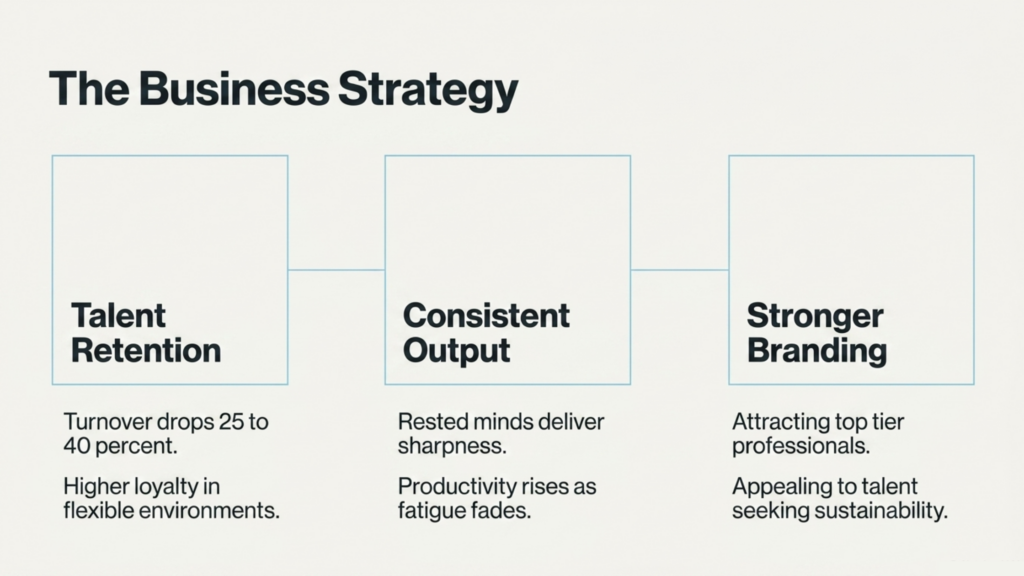
Behind every thriving career for work life balance lies an employer strategy. Businesses realized endless availability breeds turnover costing 1.5x salary. Roles enabling recharge widened talent pools and loyalty.
Universities and clinics now prioritize predictable shifts, knowing rested staff deliver consistency. These teams understand seasonal peaks like tax time for accountants without a year-round grind. Centralized high-stress models often fail here.
This approach yields clear gains:
- Turnover drops 25-40% in flexible environments.
- Productivity rises as fatigue fades.
- Branding attracts top talent seeking sustainability.
In essence, jobs with good work life balance give organizations steady output, a balance that traditional overtime cultures rarely achieve.
Best High Paying Jobs With Good Work Life Balance in 2026
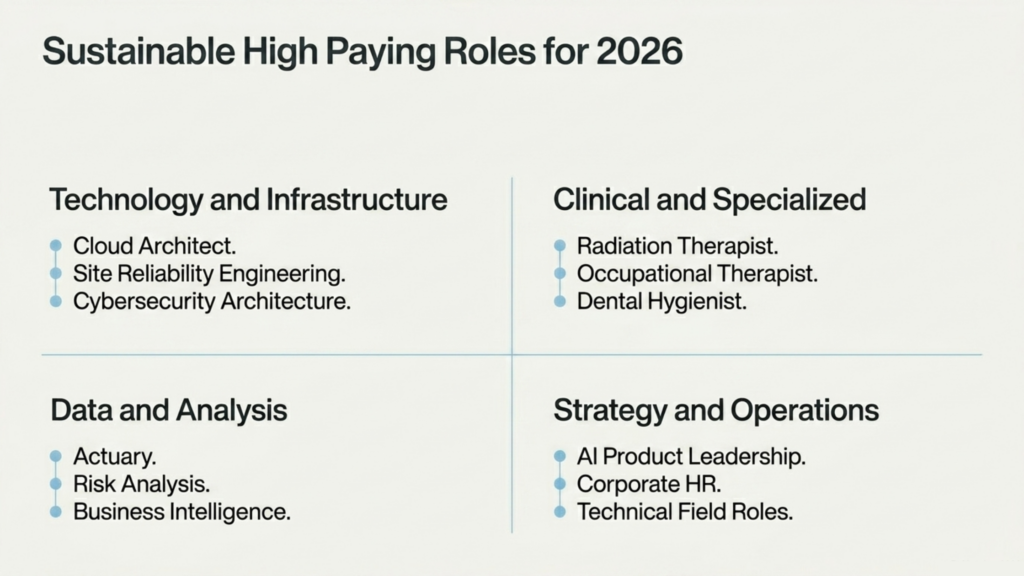
According tour internal hiring and retention trends, several careers consistently combine strong compensation with healthier long-term work patterns:
- Actuary and Risk Analysis Roles – Structured analytical work, predictable deadlines, and strong compensation growth without constant after-hours escalation.
- Radiation Therapist and Specialized Clinical Roles – Stable scheduling and clearly defined patient workloads compared to many high-burnout healthcare functions.
- Cloud Architect, DevOps, and Site Reliability Engineering Roles – High compensation with increasing flexibility in remote-first infrastructure teams.
- Product Management and AI Product Leadership – Strategic ownership roles that increasingly prioritize asynchronous collaboration over constant operational urgency.
- Cybersecurity and Security Architecture – Strong demand, high salary ceilings, and growing flexibility in remote enterprise environments.
- Business Intelligence and Data Analytics (not “Data Scientist = 80h-week”) – Output-focused analytical work that often provides more sustainable hours than high-pressure research or trading functions.
- Corporate HR and People Operations (not “HR-BP-who-handles-all-campus-fairs”) – Structured organizational roles with predictable workflows in mature companies.
- Environmental, Surveying, and Technical Field Roles – Careers combining stability, autonomy, and lower digital overload compared to always-online office work.
- Remote-First “Anywhere” Roles (Biotech, SaaS, AI-Research Adjacent) – Companies designed around asynchronous collaboration often create healthier long-term work patterns than traditional office cultures.
Skills That Define Success in Balanced Careers
Purpose endures, but execution adapts. The top best careers for work life balance demand boundary mastery, self-management, and output focus over presence.
Professionals sharpen essentials like:
- Boundary clarity: Ending tasks decisively, trusting tomorrow handles the rest.
- Peak energy alignment: Scheduling deep work for personal high-focus windows.
- Async communication: Sharing updates without real-time demands.
- Recovery investment: Protecting sleep and movement as performance tools.
Great performers in careers, flexible hours, low stress blend discipline with humanity, they log off knowing impact endures, turning evenings into renewal.
Why Balanced Careers Aren’t Temporary They’re Enduring Paths
Many view the best careers for work life balance as short-term escapes, yet leaders build decades here. Over time, they evolve into mastery, blending impact and ease.
Professionals handle growth like:
- Scaling client loads without hour creep.
- Mentoring juniors through structured handoffs.
- Negotiating boundaries in promotions.
- Adapting tools to life phases (parenthood, hobbies).
When skills merge output with sustainability, irreplaceability follows, bridging personal wholeness with professional value. Those entering work life balance careers, remote, see them as lifelong crafts, not pit stops.
The Emotional Rhythm of Sustainable Work
Sustained careers carry quiet emotional work guilt over “easy” days, pressure to prove worth.
Best careers for work life balance demand resilience:
- Trusting boundaries yields better results long-term.
- Sustaining motivation through intrinsic rewards.
- Nurturing connections beyond office walls.
Top performers master emotional steadiness, viewing rest as a strategy, allowing professionals to perform consistently without relying on constant urgency or overwork. Kindness to self becomes the ultimate skill.
How Balanced Career Pros Build Lasting Impact
People who thrive in the best careers for work-life balance rarely chase visibility at first. Their influence grows quietly, shaped by consistency rather than urgency. Because they are not constantly exhausted, they notice patterns others miss. They refine systems, document what works, and share insight from a place of calm authority.
Over time, this steadiness turns into credibility. A professional who consistently delivers without burning out becomes someone others want to learn from. They may share a short post about how asynchronous work improved focus, or explain how predictable schedules improved output without longer hours. These moments resonate because they feel lived, not performative.
What starts as personal sustainability slowly becomes collective value. Colleagues adopt similar rhythms. Teams replicate boundary-respecting workflows. In some cases, these professionals are invited to mentor, speak, or shape policy not because they worked harder, but because they worked sustainably.
In this way, careers built around balance do more than protect individual well-being. They quietly shift expectations, proving that meaningful impact does not require constant sacrifice. Influence grows not through noise, but through example.
Challenges in Pursuing Work-Life Balance Careers
Choosing a work life balance career does not remove tension; it simply changes its shape. The pressure no longer comes from overwork alone, but from defending boundaries in environments that may not fully respect them yet.
Skepticism often appears early. Balanced roles can be misunderstood as less ambitious or less serious, especially in cultures still shaped by long-hours thinking. Even well-intentioned managers may test limits unintentionally, sending late messages or expecting instant responses.
There is also an internal challenge. When work becomes calmer, some professionals struggle with guilt. Rest can feel undeserved in a world that equates exhaustion with value. Without constant urgency, people must redefine what productivity means to them personally.
Those who succeed learn that balance is not passive. It requires conscious decisions, clear communication, and occasional correction. They protect focus time. They normalize logging off. They surround themselves with peers who share similar values.
Work-life balance careers thrive not because challenges disappear, but because individuals learn to meet them with clarity instead of compliance.
The Path Forward for Work Life Balance Careers
The future of work is not simply faster or more automated. It is more selective. As technology absorbs routine tasks, human effort is shifting toward judgment, creativity, and care areas that cannot be sustained under constant strain.
This shift strengthens the relevance of the best careers with good work-life balance. Roles that already respect recovery and focus are better positioned to adapt. Professionals in these fields evolve alongside tools, using automation to protect time rather than extend workdays.
Over the coming years, balance will become a design principle, not a perk. Organizations will compete on predictability, autonomy, and respect for personal rhythms. Individuals who have already learned to work within healthy limits will lead this transition naturally.
The path forward is not about escaping effort. It is about aligning effort with longevity. Careers that leave room for life will define what sustainable success looks like next, not as a trend, but as a standard.
How to Evaluate Whether a Career Truly Supports Work-Life Balance”
Many roles advertise flexibility without actually supporting balance in practice. Before accepting a role, professionals should evaluate:
- Whether after-hours communication is expected
- How performance is measured: output or availability
- Whether teams work asynchronously or require constant responsiveness
- Typical overtime patterns during busy seasons
- Whether managers visibly respect vacations and time off
This is also why many candidates now prioritize platforms like CloudHire that help evaluate role fit, work structure, and team expectations alongside compensation. A role may look attractive on paper, but it still creates long-term burnout if the underlying culture rewards constant availability.
A role’s culture often matters more than its title. Two people with the same job can experience completely different levels of balance depending on leadership expectations and team norms.
Final Thoughts: Why Balanced Careers Redefine Professional Freedom
Amid work’s evolution, the best jobs with the best work-life balance anchor possibility. They affirm that digital tools serve humanity’s heartbeat.
At peak, professionals craft lives where contribution meets ease, aligning skill with space to thrive.
Over time, careers built around sustainable work patterns tend to produce stronger long-term performance, retention, and personal stability. One balanced choice ripples endlessly. These careers show that long-term professional success does not have to come at the expense of personal well-being.
Frequently Asked Questions
What are the best careers for work life balance?
Top careers include occupational therapist, dental hygienist, web developer, data analyst, librarian, and HR specialist. These roles often offer flexible hours, remote options, predictable schedules, and low overtime, with median salaries from $60k–$120k.
What government or stable jobs have great work life balance?
Librarian, statistician, and government analyst roles offer fixed hours, strong benefits, and low overtime. Median salaries $70k–$105k with excellent job security and minimal on-call demands.
Are healthcare jobs good for work life balance?
Yes, occupational therapist ($98k), dental hygienist ($80k+), and dietitian ($70k) top lists for school/clinic hours, part-time options, and summers off in education settings.
What is work life balance?
Work-life balance is the state where you manage work demands alongside personal life, family, health, hobbies, and rest. So neither overwhelms the other. It means having enough time and energy for both without constant stress or burnout.