TL;DR:
Most employee retention strategies fail because they focus on keeping employees after problems appear instead of fixing the hiring misalignment that caused those problems in the first place. Perks, engagement programs, and wellness initiatives cannot solve role mismatch, unclear expectations, or poor hiring accuracy. Sustainable retention comes from hiring people into roles where their skills, expectations, growth paths, and day-to-day work are genuinely aligned from the start. The companies with the strongest retention usually are not trying harder to retain people; they are hiring more accurately in the first place.
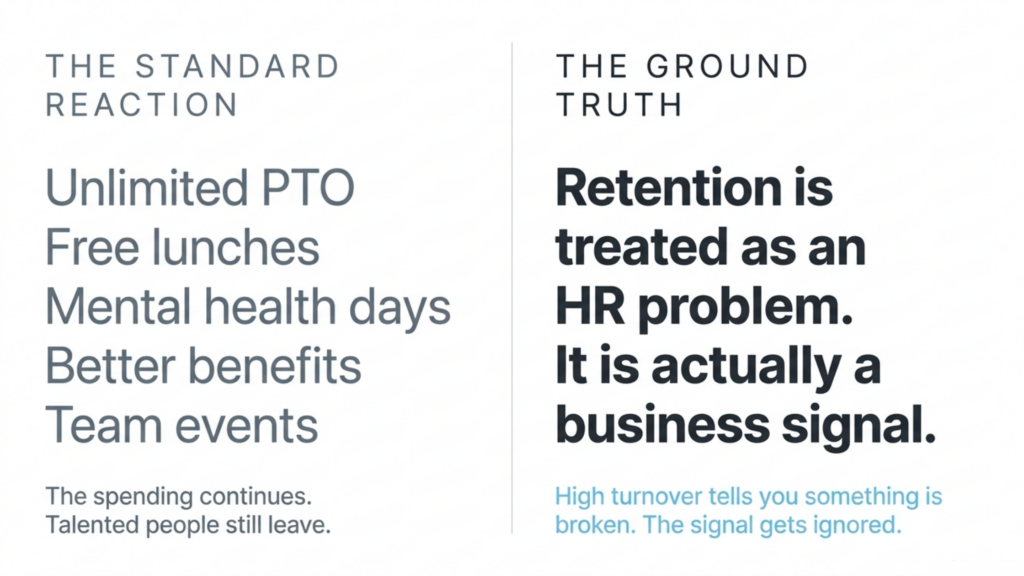
Here’s what most companies won’t admit: retention is treated as an HR problem when it’s actually a business signal.
High turnover tells you something is broken. But instead of diagnosing what, companies launch retention programs: better benefits, more team events, engagement surveys, and stay interviews.
The spending continues while the signal gets ignored.
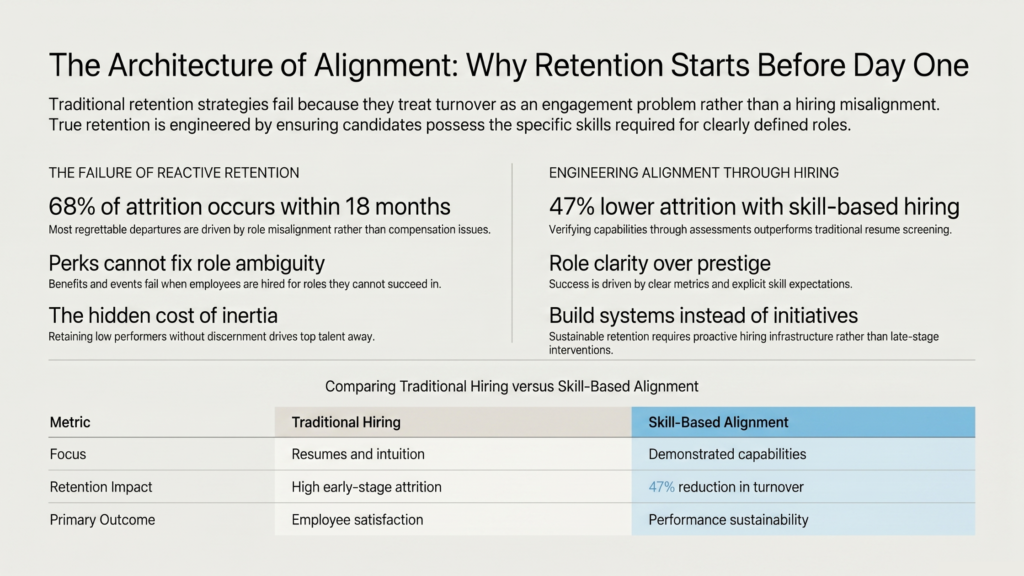
Companies invest in perks while ignoring role misalignment. They add unlimited PTO, free lunches, mental health days, and then wonder why talented people still leave. The perks aren’t the problem. The problem is that people were hired for roles they can’t succeed in or don’t want.
Why don’t engagement programs fix regretful hires? Because engagement measures how people feel, not whether they’re in the right role. You can be engaged and misaligned. You can enjoy your team and still recognize that the work doesn’t fit your capabilities or career goals.
There’s also a hidden cost of retaining the wrong people. Not everyone who stays should stay. Some low performers remain because they’re comfortable or lack better options. Meanwhile, your best people leave because they see mediocrity being retained.
Retention without discernment is just inertia.
Why Employees Are Really Leaving (It’s Not What Exit Interviews Say)
Exit interviews rarely reveal the real reasons people leave.
Departing employees give diplomatic answers: “pursuing a new opportunity,” “ready for a change,” “nothing wrong with the company.” They’re not going to burn bridges by saying what they actually think.
So what are the real reasons?
Role ambiguity and skill mismatch – The job description said one thing. The interview suggested another. The actual work turned out to be something else entirely. People stay when they can use their strengths. They leave when the role doesn’t fit their capabilities.
Performance expectations changing post-hire – What you were hired to do shifts without explanation. Suddenly, you’re responsible for things that weren’t in the role scope. Or the standards changed, and no one told you until your performance review.
Growth paths promised but structurally impossible – “We promote from within” sounds great until you realize there’s no clear path to advancement. Or promotion criteria are vague and subjectively applied. Or you see colleagues with more tenure but no upward movement.
Managers inheriting poor hiring decisions – Your manager didn’t hire you. They inherited you. And now they’re trying to manage around a skills gap or role mismatch they had no part in creating. The relationship starts with misalignment baked in.
CloudHire’s internal analysis shows that 68% of regrettable attrition happens within the first 18 months, and the primary driver is role misalignment, not compensation or work-life balance.
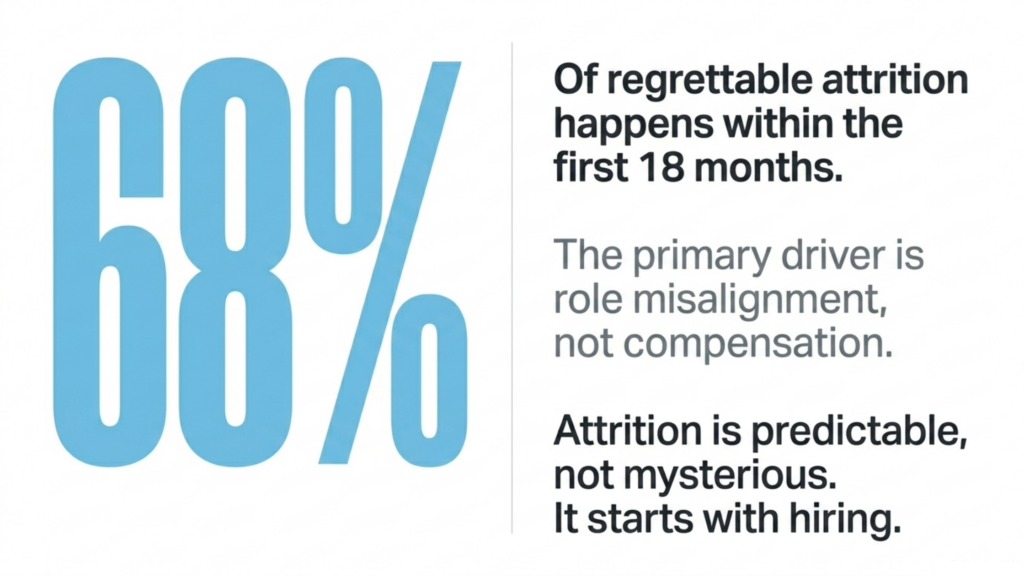
Attrition is predictable, not mysterious. It starts with hiring.
What Employee Retention Strategies Usually Get Wrong
Most retention strategies are built on flawed assumptions.
Retention as a reaction, not a design principle – Companies wait until turnover spikes, then launch initiatives. They’re fixing symptoms, not preventing problems. Real retention is designed into hiring and onboarding, not bolted on later.
One-size-fits-all strategies across very different roles – Engineering retention looks different from sales retention. What keeps a senior leader engaged won’t keep an entry-level specialist engaged. But companies roll out universal programs that miss what actually matters for each role.
Over-investing in late-stage fixes instead of early accuracy – Retention bonuses, counter-offers, stay interviews- these are expensive interventions that happen after someone’s already mentally checked out. The ROI is terrible compared to hiring accurately in the first place.
Measuring satisfaction instead of sustainability – Engagement surveys track how happy people are, not whether they’re set up for long-term success. You can have high engagement scores and high attrition if people enjoy the culture but can’t grow in their roles.
Understanding what is employee retention strategy means recognizing that it’s not about reactive programs, it’s about proactive systems.
Reframing Employee Retention as a Hiring Outcome
Here’s the shift: retention starts before day one.
The moment you post a job description, you’re beginning the retention process. Are you clear about what the role actually involves? Are you assessing for skills that predict success? Are you setting accurate expectations about growth, workload, and team dynamics?
Why does clarity beat motivation? Because motivated people in the wrong roles still leave. They’ll be enthusiastic, work hard, and then realize the role doesn’t match their strengths or career goals. Clarity about the role, expectations, and growth path creates alignment that motivation alone can’t.
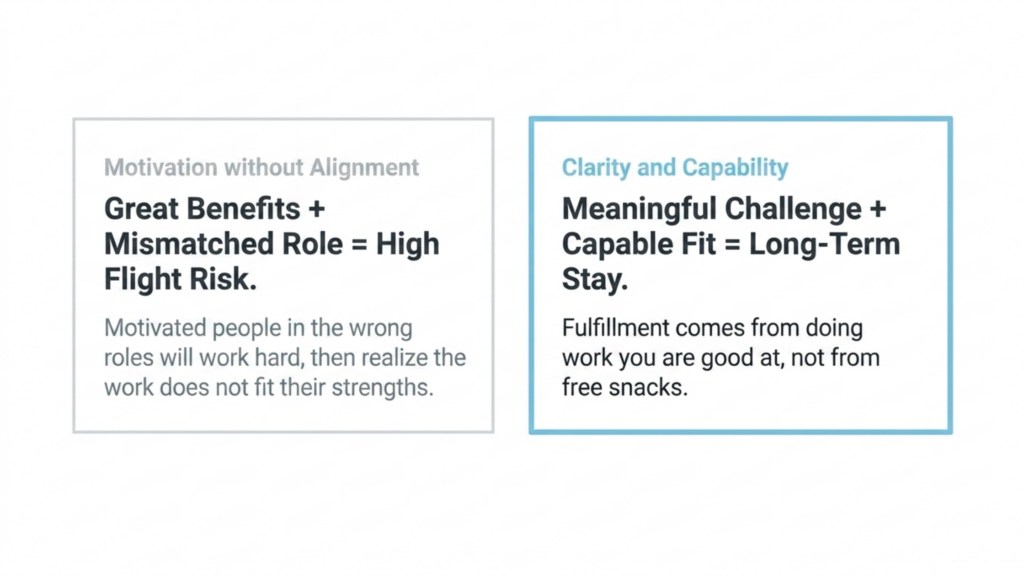
How does skill-role alignment outperform perks? Simple: someone in a role that uses their capabilities and offers meaningful challenges will stay longer than someone with great benefits in a mismatched role. Fulfillment comes from doing work you’re good at and that matters, not from free snacks.
The link between predictable performance and long-term stay is direct. When people know what’s expected, can meet those expectations, and see themselves progressing, they stay. When expectations are unclear or constantly shifting, they leave.
Retention is engineered through hiring accuracy, not managed through retention programs.
The Real Pillars of Sustainable Employee Retention
Let’s get specific about what actually works.
Role Clarity Over Role Prestige
People don’t need impressive job titles. They need clear success metrics. What does good performance look like in this role? They need explicit skill expectations, what capabilities are required, and what will we help you develop?
When roles are clear from the start, people can assess fit honestly. Ambiguity during hiring creates misalignment that becomes attrition later.
Fair Growth Paths, Not Vague Promises
The best employee retention strategies include skill-based progression advancement tied to demonstrable capability, not tenure or politics. They offer transparent mobility people know what it takes to move up or laterally, and they see others doing it.
“Great growth opportunities” mean nothing if employees can’t see the path or don’t know what’s required.
Manager Enablement, Not Manager Blame
Managers are retention sustainers, not saviors. They can’t compensate for poor hiring decisions or unclear role definitions. But they can maintain retention when the foundation is solid.
Enable managers with clear role expectations, objective performance criteria, and support for difficult conversations. Don’t blame them for attrition rooted in hiring mistakes they didn’t make.
Psychological Safety Backed by Structure
Consistency beats charisma. Teams need psychological safety, the ability to speak up, take risks, and admit mistakes without fear. But that safety can’t depend on one great manager. It needs to be built into how work is structured, how feedback is given, and how decisions are made.
Why Traditional Retention Strategies Plateau After 6–12 Months
Here’s what companies notice but don’t always say out loud:
Engagement scores rising while attrition stays flat – Employees report higher satisfaction on surveys, but turnover doesn’t decrease. Why? Because engagement programs make people feel better about a role that still doesn’t fit them.
Burnout returning despite wellness programs – Meditation apps and mental health days help, but they don’t fix workload misalignment or chronic role ambiguity. People burn out when they’re in the wrong role, not just when they’re busy.
High performers leaving quietly – Your best people don’t make a fuss. They just start interviewing elsewhere. By the time you realize they’re disengaged, they’ve already accepted another offer.
HR stuck firefighting symptoms – Every exit interview reveals problems. HR makes recommendations. Some get implemented. Attrition continues. The cycle repeats because the root cause of hiring accuracy isn’t being addressed.
The Retention Lever Most Companies Ignore: Hiring Accuracy
Let’s name the leverage point most retention strategies miss entirely.
Mis-hires compound faster than disengagement – One person in the wrong role creates drag on the entire team. Projects slow down. Others compensate. Frustration builds. Now you have a retention risk that extends beyond the one mis-hire.
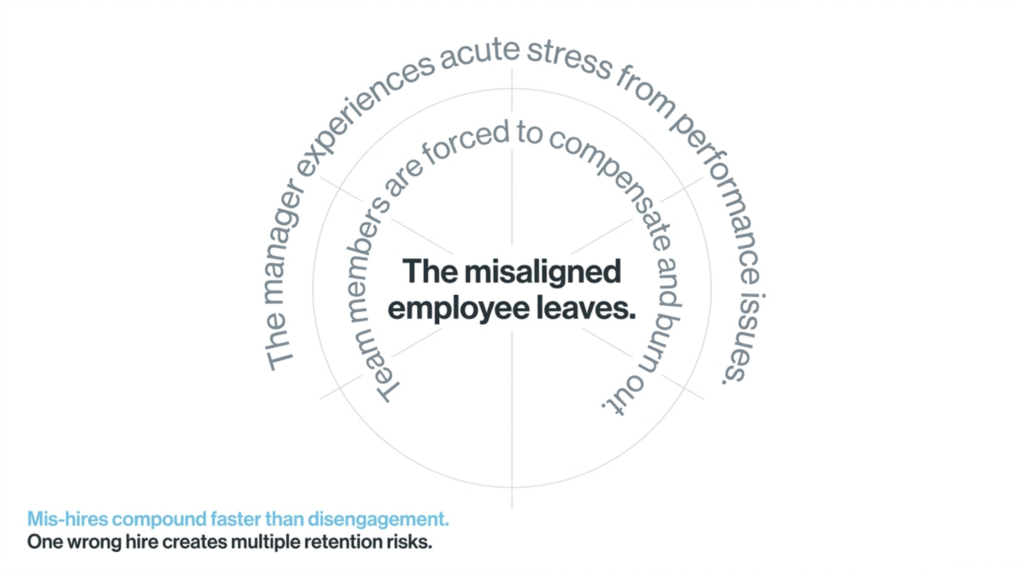
One wrong hire creates multiple retention risks – The person who realizes they’re misaligned will leave. The team members who had to work around their gaps may leave, too. The manager dealing with the performance issues experiences stress that affects their retention.
Teams don’t leave companies they leave chronic misfit – People can handle a lot: tight deadlines, difficult customers, changing priorities. What they can’t handle long-term is working with colleagues who shouldn’t be in their roles or being in a role that doesn’t match their own capabilities.
Our internal data show that companies with skill-based hiring see 47% lower regrettable attrition than those using traditional resume-and-interview processes.
How Skill-Based Hiring Changes the Retention Equation
When hiring shifts from credentials to capabilities, retention dynamics change.
Skills over resumes – Instead of hiring based on where someone worked or what degree they have, you hire based on what they can actually do. This creates immediate role alignment.
Evidence over gut feel – Structured assessments and work samples show whether someone can perform the job, not just talk about performing it. Fewer surprises post-hire means fewer early exits.
Predictable performance expectations – When you hire someone based on demonstrated skills, both sides know exactly what to expect. The candidate knows what they’ll be doing. You know they can do it.
Fewer “surprises” post-hire – The biggest driver of early attrition is discovering the role isn’t what you thought it was. Skill-based hiring eliminates most of these surprises by creating transparency from the start.
For those wondering how to calculate employee retention rate, the formula is: (Number of employees at end of period – Number of employees who left) / Number of employees at start of period × 100. But what matters more than the calculation is understanding what drives the number.
From Retention Programs to Retention Systems
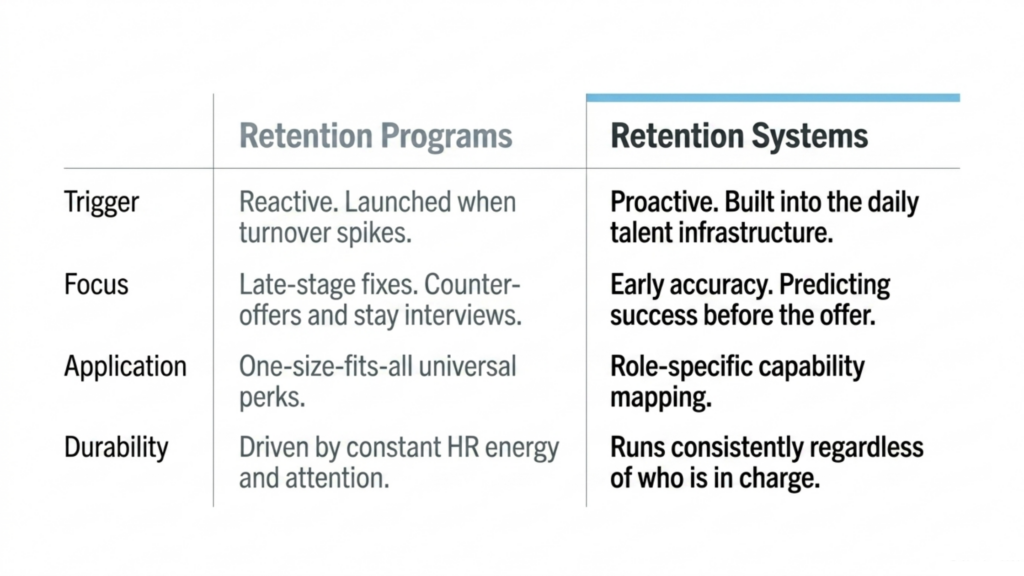
The future of employee engagement and retention strategies isn’t better programs, it’s better systems.
Why systems outlast initiatives – Programs require constant energy and attention. Systems run consistently regardless of who’s in charge or what else is happening. A well-designed hiring system produces better retention outcomes than any number of stay interviews.
How retention becomes scalable – You can’t personally convince every employee to stay. But you can build hiring and development systems that create the conditions for people to want to stay.
HR moving from reactive to strategic – Instead of running retention programs when attrition spikes, HR builds talent infrastructure that prevents attrition systematically.
The Future of Employee Retention Strategies
Where is retention headed?
Skills-based organizations – As companies move toward skills-based talent management, retention will increasingly depend on whether people can use and develop their capabilities, not just whether they’re happy.
Distributed teams demanding fairness – Remote work makes retention more transparent. If your best remote employees leave while weaker in-office employees stay, people notice. Fair systems matter more than ever.
AI increasing the cost of bad hires – As AI handles routine work, human contribution becomes more valuable. Mis-hires and early attrition become more expensive. The pressure to hire accurately and retain those you hire intensifies.
Retention shifting upstream permanently – The question won’t be “how do we retain this person?” It will be “Did we hire them for the right role with clear expectations?” Retention moves from late-stage intervention to early-stage design.
Final Thought: You Can’t Retain What You Never Aligned
Let’s end where we started: with the uncomfortable truth.
Retention isn’t about convincing people to stay. It’s not about better perks, more engagement programs, or persuasive managers.
Retention is about alignment. Did you hire the right person for the right role? Were expectations clear? Does the work match their capabilities? Can they grow in meaningful ways?
When alignment exists, retention happens naturally. When alignment is missing, no amount of programs will fix it.
And alignment is a hiring problem first. You can’t retain what you never aligned.
That’s not pessimistic, it’s practical. It means retention is within your control. Not through reactive programs, but through better hiring systems that create clarity, verify capability, and set accurate expectations from day one.
That’s how retention shifts from expensive crisis management to sustainable organizational design.
Frequently Asked Questions
What is the biggest reason employees leave companies?
In many cases, employees leave because of role misalignment, unclear expectations, limited growth visibility, or poor manager support, not just compensation. Most turnover problems start much earlier than the exit interview.
Why do employee retention strategies often fail?
Many retention strategies focus on perks and engagement after disengagement has already started. If hiring accuracy and role fit are weak from the beginning, retention programs usually only delay attrition rather than prevent it.
How does skill-based hiring improve retention?
Skill-based hiring improves retention by matching people to roles based on demonstrated capability instead of resumes alone. This reduces performance surprises, improves role alignment, and creates clearer expectations from day one.
What is a sustainable employee retention strategy?
A sustainable retention strategy combines accurate hiring, clear role expectations, fair growth paths, manager support, and consistent performance standards. Long-term retention usually comes from alignment, not incentives alone.