How fresher recruitment actually works and what TCS, Infosys, and Wipro are really looking for when they put you in that room
TL;DR: Fresher hiring at most IT companies is not a knowledge test. It’s a trainability screening. The entire game changes when you understand what signal companies are running, not just what questions they ask. This article breaks down the actual filter, the real questions freshers report being asked, and how to prep for the thing being measured, not the thing everyone tells you to prepare for.
At CloudHire, we work closely with students and early-career candidates on interview preparation, resume positioning, and application strategy, which gives us a strong view into where fresher candidates tend to get filtered out and what actually improves outcomes.
The Interview Is a Proxy, Not a Test
Let’s start with something nobody in the fresher prep space says out loud: the companies interviewing you already know you don’t have real work experience. They’re not expecting you to walk in knowing everything. What they’re doing is running a specific, deliberate signal check and most freshers prepare for the wrong signal entirely.
Infosys, for instance, has been public about what it calls learnability as its primary hiring criterion for entry-level candidates, the capacity to pick up new knowledge from unfamiliar situations and apply it elsewhere. TCS structures its National Qualifier Test across multiple tiers, deliberately designed to filter on aptitude and problem-solving process, not just technical recall. Wipro’s interview panel, as reported across thousands of candidate experiences on Glassdoor, repeatedly emphasizes conceptual understanding over depth.
What this tells you is that the interview is not asking: how much do you know?
It’s asking: how fast can we make you useful?
That is a fundamentally different question and it demands a completely different preparation strategy.
The Prep Advice Loop That Isn’t Working
The standard fresher prep content cycle goes like this: build your resume, learn Data Structures and Algorithms (DSA), practice Object Oriented Programming (OOPs), work on communication, apply on portals, and network on LinkedIn. This is not wrong advice. It’s just advice that’s been so thoroughly genericized it’s lost its usefulness.
The real problem isn’t that freshers don’t know what to prepare. It’s that they prepare things in the wrong order, for the wrong weight, toward the wrong signal.
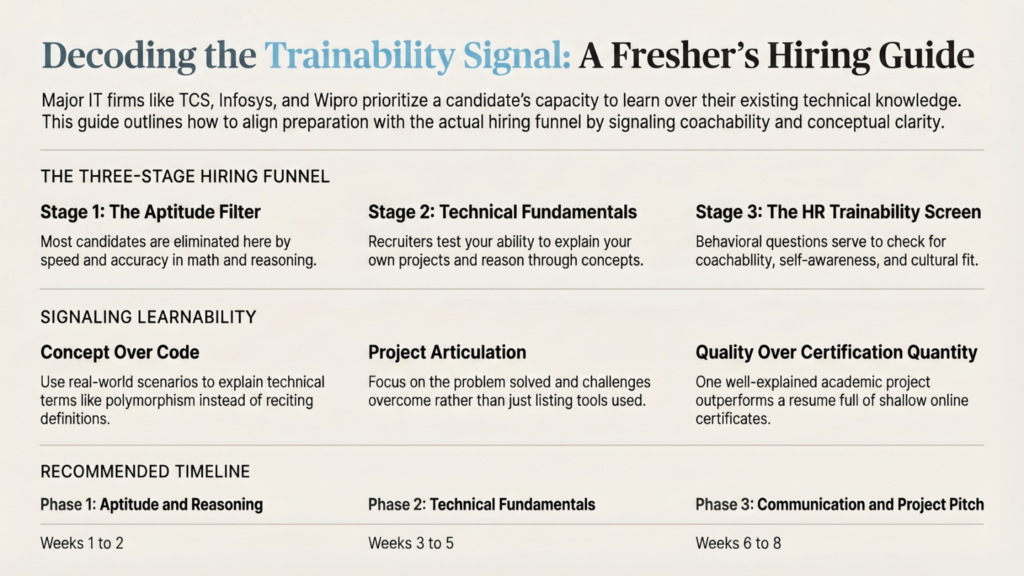
Here’s what the actual hiring funnel at most mass recruiters looks like:
Stage 1 → Online Aptitude Test (Quantitative, Logical, Verbal, Basic Programming Logic) This is where the majority of candidates are eliminated, not by technical knowledge, but by speed and accuracy on math-and-reasoning problems that have nothing to do with their major. Most freshers show up having spent 60+ hours on data structures and 3 hours on aptitude prep. The ratio is completely inverted.
Stage 2 → Technical Interview (OOPs, DBMS, OS, project walkthrough) By this stage, the bar is not “impress me with depth.” It’s “Can you explain your own project clearly?” Recruiters at this level are checking whether you understand what you built, can reason through a basic concept, and respond well when pushed on something you don’t know.
Stage 3 → HR Round (Communication, attitude, relocatability, career intent) The HR round is almost entirely a trainability screen in disguise. Questions about strengths and weaknesses, about why you want to join this company, about how you handle mistakes, every one of these is checking for coachability, self-awareness, and cultural fit. Not personality but trainability.
If you map your prep time to this funnel, weeks 1–2 should go to aptitude. Weeks 3–5 to technical fundamentals. Weeks 6–8 to communication and project articulation. Most freshers do the opposite.
What Freshers Are Actually Being Asked
Based on CloudHire’s internal analysis, it was reported that actual interview questions across Top panels in recent cycles:
Technical Round What Came Up Repeatedly
“Explain polymorphism with a real-world example, not a code example.”
Answer framework: Most freshers jump to code. The stronger answer is a scenario. A remote control that operates different devices (TV, AC, fan) with a single button press, same interface, different behavior. That’s polymorphism. Speak the concept, then offer to back it with code if needed.
“What is the difference between a primary key and a unique key?”
Answer framework: Both enforce uniqueness. A primary key cannot be NULL and there can only be one per table. A unique key can have one NULL value and a table can have multiple. The distinction matters in how foreign keys reference them.
“Write a query to find the second-highest salary from an employee table.”
Answer framework: SELECT MAX(salary) FROM employees WHERE salary < (SELECT MAX(salary) FROM employees); know this cold. Interviewers often follow up by asking about the DENSE_RANK() approach, which is worth knowing.
“Walk me through your final year project.”
Answer framework: This is not a technical question. It’s a trainability screen. The recruiter wants to know: Did you understand what you built? Can you communicate it simply? What went wrong and how did you handle it? Treat this like a product pitch problem, solution, your role, and result.
HR Round – What Actually Comes Up
“Where do you see yourself in five years?”
Answer framework: Don’t say “in a senior position at your company.” That’s a scripted non-answer. A better response acknowledges the learning curve ahead: “I want to spend the first two years genuinely understanding how enterprise-level projects work, the client communication, the code review process, and the team dynamics. After that, I’d like to grow toward a role where I can mentor newer joiners.” This shows self-awareness about the learning phase and signals you’re not entitled to your trajectory.
“Tell me about a time you failed.”
Answer framework: Pick something real and small. “During my third-year project, I missed a dependency conflict that crashed our demo two hours before the presentation. I had to rebuild the environment from scratch.” Then, crucially, explain what you changed after. The failure isn’t the point. The adjustment is.
“Why do you want to join this company specifically?”
Answer framework: Generic answers like “great work culture” get filtered out immediately. Research one real thing. For Infosys, it’s the Mysore training campus and InfyTQ. For TCS, it’s the NQT tiering system mention that you’re aiming for the Digital or Prime track, not just the Ninja role. Specificity reads as preparation, and preparation reads as trainability.
The Credentialing Trap Nobody Warns You About
There’s a quiet epidemic among freshers right now: the belief that more certifications equal a stronger candidacy. Coursera badges, Udemy completions and LinkedIn Learning certificates gathered in quantities that take up half a resume page.
Here’s the honest read: a single well-explained academic project that you can speak about confidently will outperform six certifications you can’t tie to a real outcome. Cloudhire’s internal research reports the same pattern: candidates with impressive certification stacks who can’t answer a follow-up question about anything listed on them.
A certificate says you completed something. Your ability to explain what you learned from it, apply it, or connect it to a real problem is what creates an impression. One deep thing beats five shallow things every time at the fresher stage.
The One Translation Most Freshers Miss
The most common mistake freshers make is describing their academic projects in academic language to a professional recruiter.
“I built a library management system using Python and MySQL for my final year project.”
That sentence contains no signal. It doesn’t tell the recruiter what problem you were trying to solve, what you specifically contributed, what broke along the way, or what you’d do differently.
Try this framing instead: “Our project was solving a real problem at our college library, where books were being misplaced and there was no way to check real-time availability. I handled the database design and the checkout/return logic. We ran into an issue with concurrent access that I had to debug. It was small, but it taught me more about data integrity than any textbook section.”
Same project. Completely different signal. The second version sounds like someone who actually thought about what they were building, which is exactly the trainability signal interviewers are trying to surface.
What This Changes About How You Prep
If the test is trainability, not completeness, then prep stops being about how much you can cover and starts being about how clearly you can demonstrate your own thinking. This means:
Practicing out loud matters more than reading notes. Recruiters don’t hear your notes. They hear your reasoning.
For students still building that foundation, tools like an AI Resume Generator, Auto Apply support, or an Internship Accelerator can help reduce the time spent on application logistics so more energy goes into aptitude, project articulation, and interview readiness.
Knowing the why behind a concept matters more than memorizing the what. Being able to say “the reason OOPs uses encapsulation is to prevent one part of a system from accidentally affecting another part” is more valuable than reciting the textbook definition.
Being honest about gaps, with a plan, matters more than faking confidence. Interviewers at the fresher stage are experienced enough to spot bluffing immediately. Saying “I haven’t worked with that specific framework, but I’ve used something structurally similar. Here’s how I’d approach learning it” is a trainability signal. Pretending you know it isn’t.
Your first job isn’t the final destination. It’s the training ground. The companies recruiting freshers know this. They’re not looking for a finished product. They’re looking for someone they can build. The faster you internalize that the interview is a conversation about your learning capacity, not your current knowledge, the more naturally you’ll be able to answer every question they put in front of you.
For students who want structured support across resumes, applications, internships, and interview prep, CloudHire can help turn this preparation framework into a more consistent process.
Frequently Asked Questions
“Trainability” – what recruiters actually test?
Can you learn fast? “Explain polymorphism real-world” > code dump. Project failures + fixes show coachability better than perfect syntax.
Why 92% fail TCS NQT aptitude first?
Speed trumps depth. Quantitative (profit-loss, time-work) + logical (data sufficiency, blood relations) = 70% weight. Prep 60:40 aptitude: DSA ratio or get filtered.
Infosys “learnability” – what signals pass?
Real-world concept ties. “Polymorphism = remote controlling TV/AC (same interface, different action).” Code optional. Shows thinking > recall.
Project walk-through: 78% bomb here – fix?
STAR for code. Situation (library chaos) → Task (your DB) → Action (concurrent fix) → Result (90% faster checkouts). Practice 4-min pitch.