Everyone knows the advice. Communicate better. Build trust. Create psychological safety. Align on values.
None of it survives contact with real work.
Why “Teamwork Advice” Rarely Survives Real Work
The workshop feels great. Everyone agrees that communication matters and trust is fundamental. People nod during the slides about shared purpose.
Then Monday happens.
The project kicks off and no one knows who makes the final call. Two people think they own the same deliverable. Someone’s “helping” in a way that actually creates more work. Feedback gets delivered three weeks late or not at all.
The problem isn’t that the advice is wrong. It’s that it’s addressing symptoms, not causes.
Workshops don’t survive pressure because workshops can’t fix unclear roles. Values don’t survive misaligned incentives because values aren’t enforced with consequences. Culture collapses when no one knows what they’re supposed to be doing or how success gets measured.
Most content on how to build a team treats dysfunction as a people problem. It’s actually a design problem.
TL;DR What Actually Builds a Successful Team
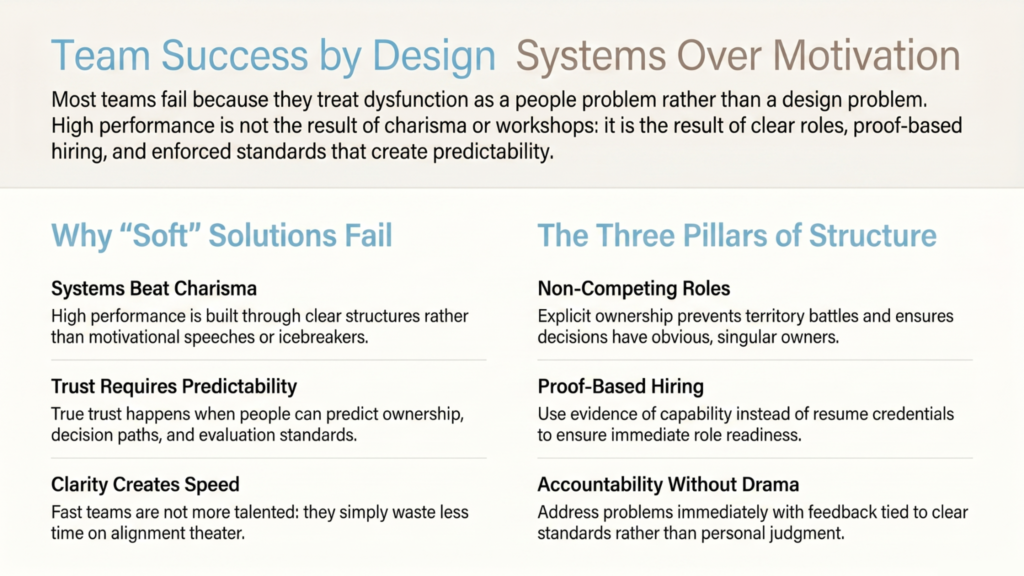
Most teams don’t fail because of poor communication or weak trust. They fail because hiring, role clarity, and expectations are broken from day one. High-performance teams are built through systems, not charisma or motivational speeches. Trust isn’t something you create through icebreakers.
it’s what happens when people can predict who owns what, how decisions get made, and what good work looks like. The real difference between teams that work and teams that struggle comes down to clarity: clear roles that don’t compete, clear standards that get enforced, and clear accountability without drama. CloudHire fixes team failure at the source by replacing resume-based guessing with skill-based hiring that creates instant role clarity and predictable performance.
What a Successful Team Actually Means (Beyond Feel-Good Metrics)
Ask someone what makes a successful team and you’ll hear: great communication, high morale, strong collaboration.
These are nice. They’re also not the point.
Output Beats Energy Every Time
Strong teams aren’t defined by how people feel in meetings. They’re defined by what they produce.
A successful team isn’t one where everyone gets along all the time. It’s one where:
Work gets done reliably without constant escalation. People know who owns what and don’t need to ask permission for every decision. The quality of output is consistent because standards are clear and enforced.
You can have a team with great energy that ships nothing. You can have a team with tension that ships consistently. One of these is a successful team. The other is a nice place to hang out.
High-Performance Teams Aren’t Faster, They’re Clearer
Speed is what people notice about high-performance teams. But speed is the result, not the method.
Fast teams aren’t moving faster because they’re more motivated or talented. They’re faster because they’re clearer.
They know exactly what problem they’re solving. They know who makes which decisions. They know what “done” looks like before they start. They don’t waste time on clarity theater endless meetings to align on things that should have been clear from the beginning.
Clarity creates speed. Chaos creates the appearance of urgency.
Why Most Teams Break Down (Even With Good People)
You can hire smart, capable people and still end up with a broken team. It happens all the time.
Hiring for “Talent” Instead of Role Readiness
Companies hire “talented people” and figure they’ll sort out the details later.
This creates teams where three people think they’re the strategic lead. Where ownership is assumed but never assigned. Where everyone’s helping but no one’s accountable.
The problem starts in hiring. When you hire based on impressive resumes and strong interviews instead of clear role requirements, you get:
Overlapping ownership that turns into political battles over territory. Decision-making that depends on who’s loudest or most senior, not who has the best information. Silent underperformance because no one’s quite sure what anyone was supposed to deliver anyway.
Talent doesn’t predict team success. Role clarity does.
Trust Can’t Exist Without Predictability
Everyone talks about building trust in teams. Fewer people talk about what trust actually requires.
Trust isn’t created through vulnerability exercises or team lunches. Those might make people more comfortable, but comfort isn’t trust.
Trust is what happens when people can predict:
Who owns what decision? How work gets evaluated and what good looks like. Those problems will be addressed instead of ignored.
When these things are unclear, trust is impossible. You can’t trust a system you can’t predict. And you can’t predict a system where roles shift, standards are vague, and feedback is random.
This is why team-building activities don’t fix broken teams. You’re asking people to trust each other in a system that’s fundamentally unpredictable.
The Real Building Blocks of a Successful Team
Successful teams aren’t built on inspiration. They’re built on structure.
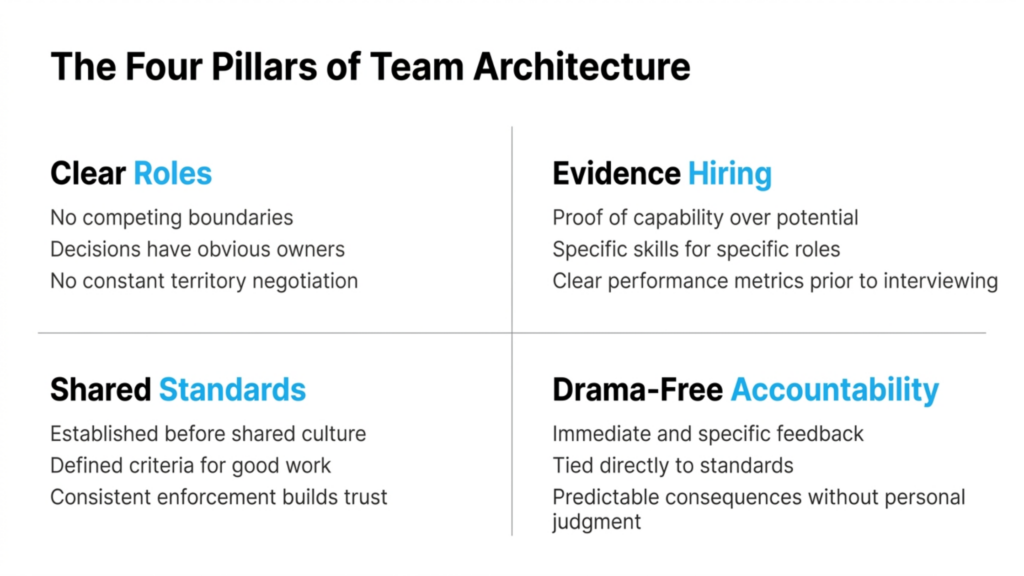
1. Clear Roles That Don’t Compete
Role ambiguity destroys teams faster than almost anything else.
When two strong performers both think they own the same area, conflict is guaranteed. It doesn’t matter how mature or collaborative they are. The structure is broken.
Clear roles mean:
Each person knows what they own and where their responsibility ends. Decisions have obvious owners instead of requiring consensus by default. People can do their job without constantly negotiating territory.
This isn’t about rigidity. It’s about knowing where the lines are so you can move quickly within them.
2. Hiring Based on Proof, Not Potential
Resumes tell you where someone worked. Interviews tell you how they present. Neither tells you if they can actually do the job you need done.
Successful teams hire based on evidence of capability, not proxies for it.
That means assessing actual skills for the actual role, not hiring “smart people” and hoping they figure it out. It means knowing what good performance looks like before you start interviewing, not after someone’s already been on the team for six months.
When you hire based on proof, you get:
People who can contribute immediately, instead of needing months to ramp up. Fewer surprises about capability after the offer is signed. Less political jockeying because performance is measurable.
3. Shared Standards Before Shared Culture
Culture is what people point to when they don’t want to talk about standards.
“We have a great culture” often means “we’re nice to each other but don’t hold anyone accountable.”
Successful teams build shared standards first. What does good work look like? How do we make decisions? What happens when someone misses a deadline or delivers poor quality?
Culture emerges after standards are enforced, not before. When everyone knows what’s expected and sees those expectations applied consistently, trust builds. When standards are vague or selectively enforced, culture becomes politics.
4. Accountability Without Drama
Teams fail when feedback is delayed, vague, or weaponized.
Accountability without drama means:
Problems are addressed when they happen, not in a performance review three months later. Feedback is specific and tied to clear standards, not personal judgment. Consequences are predictable and applied consistently.
This isn’t about being harsh. It’s about being clear. Most people want to know how they’re doing and what needs to change. What they can’t work with is ambiguity.
How to Build a High-Performance Team as You Scale
Small teams can run on informal agreements and personal relationships. That breaks as you grow.
Why Teams Break When Headcount Grows
Early teams get away with a lot of sloppiness because everyone’s in the same room.
Then you hire your tenth person, or twentieth, and suddenly:
Informal processes collapse because not everyone knows the unwritten rules. Early hires become bottlenecks because all decisions flow through them. Speed starts masking inefficiency because you’re adding people instead of fixing systems.
Scaling reveals every structural weakness you had from the beginning.
The Shift From “Everyone Helps” to “Everyone Owns”
Successful scaling requires a mindset shift.
Early on, “everyone helps with everything” works. People jump in where needed. Roles are fluid.
As you grow, this becomes chaos. Successful teams make the transition to clear ownership:
Each function has an obvious owner. Help is still encouraged, but ownership never moves without explicit handoff. People are hired for specific roles, not general capability.
Teams that don’t make this shift end up with diluted accountability and constant confusion about who’s responsible for what.
Can You Fix a Struggling Team Or Is It Already Broken?
Not every team can be saved. Some are past the point of repair.
Signs a Team Is Fixable
A struggling team can turn around if:
Roles can be clarified and people are willing to accept those boundaries. Leadership is open to changing how they hire and evaluate performance. Honest performance conversations are possible without defensiveness or retaliation.
If these conditions exist, you have something to work with. The structure can be fixed, and behavior will follow.
Signs You’re Managing Symptoms, Not Causes
Some warning signs that the team is fundamentally broken:
Repeated restructures that never fix the underlying problems. Constant urgency with no clear priorities, everything’s important, nothing gets finished. High output but low confidence in what’s being built.
If you’re here, you’re probably not fixing the team. You’re managing its decline.
Why Hiring Is Where Team Success Is Won or Lost
Most team problems trace back to hiring.
Most Team Problems Are Hiring Problems in Disguise
When a team isn’t working, look at how it was built.
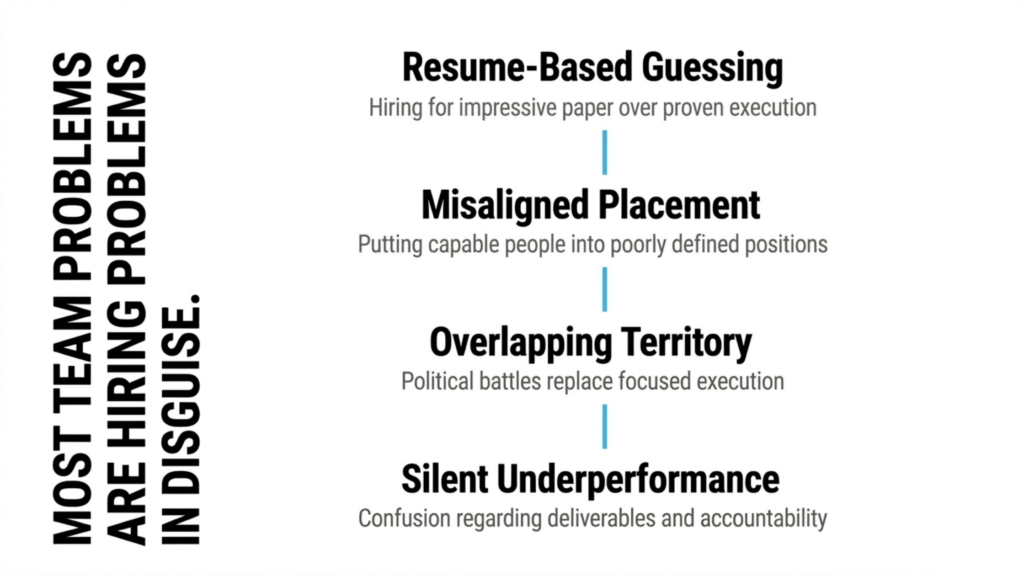
Poor role definition means you hired someone talented but misaligned. Resume-based decisions mean you hired someone who looked good on paper but can’t do the actual work. Speed-over-signal hiring means you filled a seat instead of finding the right person.
Every one of these creates friction that compounds over time.
The person who seemed great in interviews but can’t execute. The strong performer in the wrong role who’s now frustrated and underperforming. The team that looks impressive on LinkedIn but can’t ship.
You Can’t Build Trust on Guesswork
Teams struggle when early hires are misaligned because trust requires predictability.
If you don’t know whether someone can actually do the job, you end up managing them differently. Micromanaging or avoiding hard conversations, or working around them instead of with them.
None of that builds a successful team. It builds a team that’s constantly compensating for its own weaknesses.
Final Thought Successful Teams Aren’t Built Through Motivation
Here’s what doesn’t build successful teams:
Better meetings. Stronger slogans. More collaboration sessions.
Here’s what does:
The right people are hired for the right roles. Expectations that are clear from day one. Trust earned through consistent, predictable behavior.
That’s not a leadership problem. That’s a systems problem.
And systems can be fixed.
How CloudHire Helps You Build Successful Teams From Day One
Traditional hiring makes team-building harder than it needs to be.
- CloudHire changes the starting conditions.
- Skill-Based Hiring Creates Instant Role Clarity
- Teams Built on Evidence Scale Better
Less Guessing. Fewer Fixes. Stronger Teams.
CloudHire isn’t a hiring tool. It’s a team design system. It fixes the earliest point of team failure: how the team gets formed. When you start with the right people in the right roles with clear expectations, most “teamwork problems” never happen.
You’re not building trust through workshops. You’re building it through clarity.
Frequently Asked Questions
How do you build a successful team from scratch?
Start with clear role definitions before you hire anyone. Know what success looks like for each position and hire based on proof of capability, not resume credentials. Set standards early and enforce them consistently. Most team dysfunction comes from vague roles and misaligned hiring; fix those first, and culture follows.
What makes a high-performance team different?
High-performance teams aren’t faster because they’re more talented, they’re faster because they’re clearer. They know who owns what, how decisions get made, and what good work looks like. They spend less time on alignment theater and more time executing because the structure supports speed.
How do you build trust in a team quickly?
You don’t. Trust is built through predictability over time. Focus on creating clear roles, consistent standards, and reliable accountability. Trust is the result of a system people can predict, not a feeling you create through exercises.
Why do good teams fail over time?
Good teams fail when they don’t scale their systems as they grow. What worked at five people breaks at twenty. Informal processes collapse, early hires become bottlenecks, and role clarity disappears. Teams that don’t formalize ownership and standards as they scale will struggle no matter how strong they were at the start.