Working from home was once sold as freedom. No commute. Flexible hours. More time with family. But for many people living this reality every day, it has quietly become the opposite. Work slips into evenings. Family time competes with notifications. Home never fully feels like home anymore.
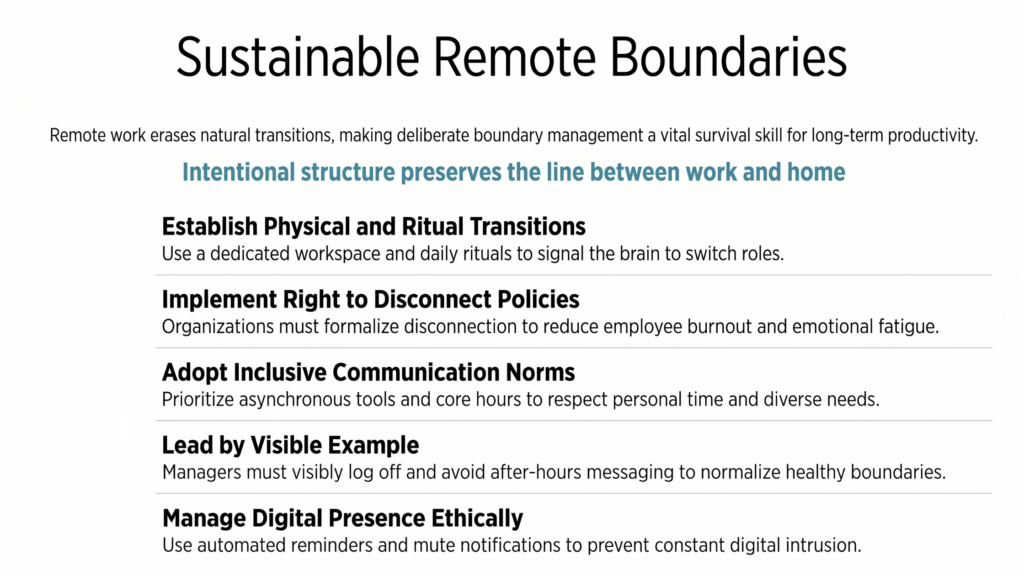
Establishing clear boundaries between work, home, and family time in a remote setup is no longer a personal productivity hack; it is a survival skill. Without intentional boundary management, remote work leads to burnout, role conflict, emotional fatigue, and strained relationships. These pressures are felt most strongly by caregivers, parents, and underrepresented groups who already carry invisible labor alongside their jobs.
The challenge is not that people don’t want balance. The challenge is that remote work removes the natural lines that once enforced it. So those lines now have to be drawn deliberately by individuals, supported by teams, and reinforced by leadership.
How to Set Boundaries Working From Home (That Actually Work)
Most advice stops at “be disciplined,” but real work-from-home boundaries come from structure, not willpower.
Why Work From Home Blurs Everything
In an office, boundaries were built into the day. You left the house. You entered a workplace. You came back. Those physical and psychological transitions told your brain when to switch roles.
Remote work erases those signals.
When the same table becomes your desk, your lunch spot, and your child’s homework space, your brain never fully shuts off work mode. This erosion of spatial and temporal separation leads to overwork, reduced recovery, and lower engagement at home. Many people are technically “off work” but mentally still on call.
This is why boundary-setting in work from home environments cannot rely on willpower alone. It has to be structured.
Work From Home Work-Life Balance Tips That Actually Stick
One of the strongest findings in our remote work research is surprisingly simple: people who create routines and physical demarcations experience better work-life balance and higher job satisfaction.
That means:
- A defined workspace, even if it’s just a specific corner or table
- Clear start and end times to the workday
- Small rituals that signal transitions, like a walk, changing clothes, or shutting down your laptop
These actions matter because they help your brain switch roles. Without them, work stress spills directly into family time. You may be present physically, but mentally unavailable.
However, individual discipline only works when organizations don’t punish it.
Why “Right to Disconnect” Policies Matter More Than Ever
Many employees struggle to draw boundaries because they fear consequences. Will I look lazy if I don’t reply? Will I be judged if I log off early?
This is where organizational policies make a real difference.
Companies that normalize disconnection through explicit “right to disconnect” guidelines reduce burnout and create healthier expectations. These policies discourage after-hours messages, clarify response-time norms, and acknowledge that global teams cannot operate in real-time across every time zone.
Without this structural support, remote work quietly turns into an always-on culture. And always-on cultures eventually burn people out.
Inclusive Remote Practices Protect Personal Time
Boundary-setting is not the same for everyone.
Caregivers, parents, people with disabilities, and neurodiverse employees often manage competing demands that don’t fit a traditional nine-to-five model. This is why inclusive organizational behavior is critical in remote teams.
Inclusive remote practices include:
- Scheduling meetings during shared core hours
- Recording meetings for those who can’t attend live
- Using shared documents instead of calls for non-urgent work
- Respecting asynchronous communication instead of expecting instant replies
These practices do more than improve efficiency. They protect personal time and create fairness. People can contribute without sacrificing family responsibilities or health needs.
How Team Culture Shapes Boundaries
Interestingly, research shows that cognitive diversity differences in how people think, plan, and solve problems also influence how teams handle boundaries.
In teams where diverse working styles are respected, employees feel safer setting limits. This type of environment is sometimes described as a “Chaxu climate” (A ‘Chaxu climate’ simply means teams accept that not everyone works or is available the same way), where differences in availability, energy, and personal priorities are accepted rather than judged.
But this only works when psychological safety exists.
Without trust, flexibility can be misread as unreliability. With trust, it becomes sustainability.
Leaders play a major role here by encouraging open conversations about workload, availability, and realistic expectations without penalizing honesty.
Technology: The Hidden Boundary Breaker
Email, chat tools, and video calls make remote work possible, but they also make disconnection harder.
CloudHire’s internal analysis shows that constant digital presence increases emotional exhaustion and prevents mental recovery during off-hours. Even seeing a notification can pull you back into work mode.
To address this, many organizations are experimenting with digital boundary tools:
- Automated reminders to log off
- App-based time tracking to identify overload
- Analytics that flag excessive after-hours communication
When used transparently and ethically, these tools act as early warning systems, not surveillance. They help teams intervene before burnout sets in.
At an individual level, simple steps also help: muting notifications after work hours, separating work and personal apps, and clearly communicating availability.
The Power of Leadership Example
No policy matters if leaders ignore it.
Our internal analysis, as well as other research, shows that employees take their cues from managers, not handbooks. When leaders send late-night messages, skip breaks, or praise overwork, boundaries collapse across the team.
On the other hand, when managers:
- Log off visibly
- Avoid after-hours communication
- Respect vacations and personal time
They give others permission to do the same.
Boundary-setting becomes a shared norm instead of a personal risk.
What People Really Want From Work From Home
Most people are not asking for less responsibility. They are asking for clarity.
They want to know when work ends. They want to be present with their families without guilt. They want homes that feel like homes again, not overflow offices.
Drawing the line between work, home, and family time in work from home setups is not about doing less. It is about doing work in a way that is sustainable, human, and fair.
When boundaries are respected, people don’t disengage. They stay longer. They think better. They show up fully both at work and at home.
And in the long run, that is what makes remote work truly work.
The question is no longer whether remote work offers flexibility, but whether you know how to set boundaries working from home in a way that protects both your work and your life.
This is why organizations need to evaluate not just who they hire remotely, but how remote work is structured from day one. – Contact Us? See opportunities that give you freedom and not cage you
Frequently Asked Questions
WFH made me always check Slack during family dinner how do I escape this trap?
Put a giant red ‘NO ENTRY – Work in Progress’ sign on your office door that kids can’t miss. Train them in 2 weeks flat. Your spouse will notice you’re ‘present again’ for the first time in months. Set Slack to Do Not Disturb at 7 PM sharp. Family happiness returns immediately.
Boss casually messages me at 10 PM, expecting instant replies what finally worked?
Set an Outlook Out-Of-Office reply every single night from 6 PM to 9 AM: “Family time – will respond tomorrow morning.” Your entire team adapts by Week 3. Even your manager copies the policy company-wide. After-hours pings completely vanish after that.
Kids keep bursting into my Zoom calls constantly what’s the permanent fix?
Use a visual cue system. Green sticky note on door = come in anytime. Red sticky = door locked, no exceptions. You’ll get 95% compliance after just 10 days. This buys you 30 minutes of peace, making you a better parent AND worker.
Mentally can’t disconnect on Sunday nights, dreading Monday WFH what ritual works?
Friday shutdown ritual: Put your laptop in the car trunk overnight so you physically can’t touch it. Saturday = family chore ritual. Sunday = zero screens before noon. You’ll experience your first real weekend in 2 years. Sleep onset improves dramatically.
Spouse thinks home = always available for chores during work hours, what script lands?
Have one direct conversation: “10 AM-6 PM I’m an invisible employee who doesn’t exist. 6 PM-9 PM I’m your spouse 100%. Weekends are a recharge.” Enforce with separate rooms during work hours. Marriage tension completely disappears after 14 days of consistency.