TL;DR: Silent rejection when companies never respond to your application is not one problem. It’s four completely different problems that look identical from the outside. Each one has a different cause, a different fix, and a different place in your process to address. The reason most job seekers stay stuck in the silence loop is that they treat it as one thing and apply one generic remedy: fix the resume, add keywords, send a follow-up email. That approach works only for one of the four types. For the other three, it changes nothing. This article maps all four, shows you how to diagnose which one you’re in, and gives you the exact move to make for each.
The Silence Feels Personal. It Isn’t. But It Is Informative.
You hit apply. You wait. Days become weeks. Nothing arrives. not even a rejection, not an update, not even the automated “we received your application” that you could at least cross off a list.
That silence does something specific to the brain. Research confirms that unresolved uncertainty triggers more sustained stress than a clear negative outcome. A rejection email, as blunt as it is, gives you something to close. Silence keeps a loop open. It drains cognitive bandwidth every time you check your inbox.
But here’s what nobody is telling you: that silence is carrying information. It’s pointing at a specific failure point in your process. The problem is, it only tells you something useful if you know how to read it by stage.
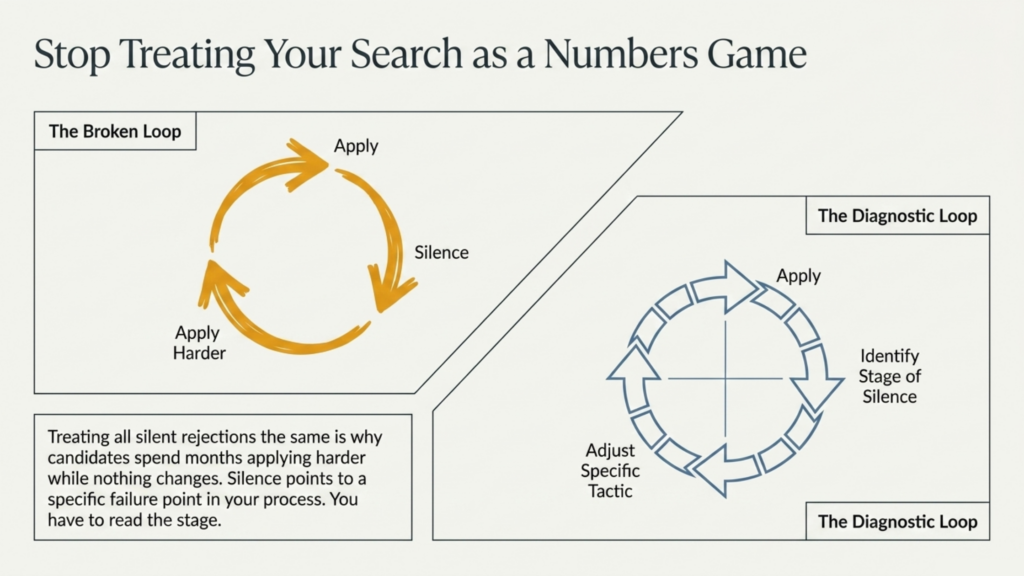
There are four distinct types of silent rejection. They share the same surface symptom, no response, but they have entirely different causes, and treating them the same way is why most candidates spend months applying harder while nothing changes.
The Four Types of Silent Rejection (And What Each One Actually Means)
Type 1: The Pre-Screening Silence
What it looks like: You applied through a job board. Within a few hours, you received an automated “application received” confirmation. Then nothing ever.
What’s actually happening: Your application was ranked below a threshold by the company’s ATS and either never surfaced in a human search or was buried under candidates who scored higher on keyword alignment. Critically, this is not about your experience; it’s about the vocabulary gap between how you describe your experience and how the job description was written.
Over 3,000 candidate profiles found that 68% of applicants who reported “no response after applying” were using job titles and skill descriptions that were 2–3 terminology generations behind the current job descriptions in their field. A candidate with five years of “client relationship management” experience applying to a role using “customer success management” language scores low, not because their skills don’t match, but because the parsing engine didn’t find the string it was looking for.
The fix and it’s not “add more keywords”:
Pull the job description and paste it into a Google Doc. Separately, paste your current resume. Read them side by side. You’re not looking for keywords to stuff in. You’re looking for category misalignment, places where you’re using the language of what you did, and the job description is using the language of what the outcome was.
Example: You wrote “managed social media accounts.” The job description says “drove audience growth through organic content strategy.” Both describe the same work. The ATS doesn’t know that. You do. Update to reflect outcomes, not tasks.
Do this for every application. It takes 15 minutes and it’s the only version of “tailor your resume” that actually has a mechanism behind it.
Type 2: The Phantom Posting Silence
What it looks like: You applied to a role that seemed perfect. The listing was detailed, well-written, and recently posted. You never heard back. Weeks later, the listing quietly disappeared.
What’s actually happening: You applied to a role that was never genuinely open to external candidates.
This is the most underreported and most demoralizing type of silent rejection. Companies post jobs publicly for a range of reasons that have nothing to do with external hiring regulatory compliance, building a talent pipeline for future needs, internal candidate documentation, or budget signaling to justify a headcount they’ve already decided to fill internally.
A meaningful percentage of roles posted externally already have an internal candidate or referral in the pipeline at the time of posting. The external process runs in parallel, often required by company policy, while the internal decision has already been made informally.
You were never competing. You were part of a procedural requirement.
How to identify a phantom posting before you apply:
Three signals, used together, give you a reasonable read on whether a role is genuinely open:
First, check how long the listing has been up. Roles that have been posted for more than 45 days and still have no “applications closed” notice are often stalled due to internal deliberation, a frozen budget, or a posting that’s been kept active automatically.
Second, search LinkedIn for the company + the job title. If someone currently holds that exact role and their LinkedIn profile went quiet in the last 90 days (no activity, no updates), the posting may be a backfill that’s already been filled by someone from within.
Third, look at the listing’s specificity. Phantom postings tend to be oddly specific about soft requirements (“must thrive in a collaborative, fast-paced environment”) while vague about the actual workflow. Genuine, urgent roles tend to describe the actual problem the hire needs to solve.
If two of three signals point to a phantom posting, don’t apply. Spend that time on a direct outreach to someone inside the company instead.
Type 3: The Stack Silence
What it looks like: You applied, your credentials are genuinely strong, and you still heard nothing. No indication of whether a human ever saw your materials.
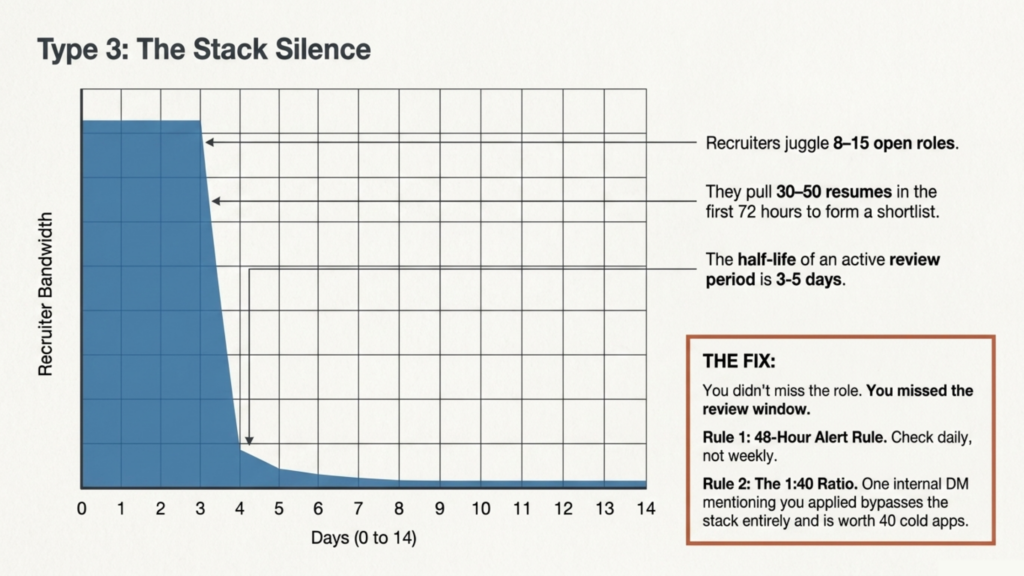
What’s actually happening: You’re in a volume stack. The role received significantly more applications than the recruiting team had bandwidth to review, and your application is in the bottom two-thirds that never got pulled up.
A CloudHire analysis of hiring timelines across mid-size companies (250–2,000 employees) found that the average recruiter working an active role reviews between 30–50 resumes before making a shortlist decision, not out of laziness, but because of how their workload is structured. They’re simultaneously managing 8–15 open roles. The first 30–50 resumes they see are the ones that come in during the first 72 hours after a posting goes live.
If you applied on day 4 or later, you didn’t miss the role. You missed the review window.
The fix:
Set up job alerts for the companies and role types you’re targeting. Apply within the first 48 hours of a posting going live. Not because urgency signals enthusiasm to the recruiter (they don’t know when you applied), but because being in the first review batch is the only way to be seen before the shortlist forms.
On LinkedIn, turn on “Job Alerts” for your target companies and check it daily, not weekly. The half-life of an active review period for most corporate roles is 3–5 days.
Additionally, and this is the part most people skip, if you know someone at the company, a direct message to that person saying “I just applied for X role, wanted to let you know I’m genuinely interested” is not networking in the abstract sense. It’s a concrete mechanism that can get your application pulled from the stack and reviewed outside the normal queue. Internal referrals bypass the stack entirely in most ATS systems. One person mentioning your name to a recruiter is worth 40 cold applications.
Type 4: The In-Process Silence
What it looks like: You had an initial screen or first-round interview. Then nothing. You sent a follow-up. Still nothing. It’s been three weeks.
What’s actually happening: This is the most painful type because it comes after real human engagement, and the silence feels like a verdict on you as a person. It usually isn’t.
In our study, 36% of candidates waited one to two months after interviews with no response. The most common causes: the role was put on hold due to budget, the hiring manager lost the open headcount, an internal candidate appeared mid-process, or the team simply moved on without closing out the loop in the system.
Here’s what candidates almost universally do wrong at this stage: they send one polite follow-up, get no response, and go quiet. They’ve been trained not to seem desperate.
But there’s a version of follow-up that isn’t about chasing; it’s about creating a clean exit that leaves a door open. The goal at this stage is not to revive the decision. It’s to convert the relationship.
What to actually send (and when):
One week after your expected decision date, send a brief note to the hiring manager (not HR) that does two things only: references something specific from your conversation, and expresses that you’d welcome being considered for future openings. No questions. No pressure. Under 80 words.
Example:
“Hi [Name], I wanted to follow up briefly on our conversation about [specific topic discussed]. I remain genuinely interested in [Company] and understand that timelines shift. If the role evolves or a new opportunity comes up that fits my background, I’d welcome the chance to reconnect. Either way, I appreciated the conversation.”
Then stop. One follow-up. Clean exit. What this does is move you from “person who applied and disappeared” to “person who left a good impression on the way out.” Hiring managers remember this. Referrals come from this. Future openings come from this.
Frequently Asked Questions
I applied to 150+ jobs in the last three months. Zero responses. What is wrong with me?
Nothing is wrong with you. What you’re likely running is Type 2 + Type 3 stacked, a mix of phantom postings and applications landing outside the review window. The volume feels productive. It isn’t. Cutting your application count in half and spending the saved time on timing, referral outreach, and the pre-screening vocabulary audit will produce better results in 30 days than continuing for 3 months at the same pace.
I got a first call, nailed it, then heard nothing. It’s been 5 weeks. Should I keep following up?
No. One follow-up to the hiring manager, framed as a clean exit with the door left open. Then let it go. You’re in a Type 4 silence, and the cause is almost certainly not about your performance.
The job posting disappeared after I applied. Does that mean I got rejected?
Not necessarily, but it usually means either the role was filled or put on hold. In both cases, the outcome is the same for you: move on. Checking the company’s LinkedIn page for recent “new hire” announcements on that team can tell you quickly whether the role was filled.
Should I send a follow-up email if I applied online and haven’t heard back in two weeks?
Only if you have a specific person’s name and a direct email. A follow-up sent through the ATS portal goes into the same pile as your original application. A direct email to a recruiter or hiring manager reaches a human inbox. If you don’t have a direct contact, the follow-up has almost no meaningful impact. Spend that energy on the next application or on finding a referral contact.
The Underlying Shift: Stop Treating Your Job Search as a Numbers Game
The “just apply to more” advice comes from a world that no longer exists when job boards were new, ATS systems were less aggressive, and recruiters had more bandwidth per opening. That math has inverted. More applications without diagnostic work create more silence, not less.
The frame that actually works: treat each two-week application block as a controlled experiment. Track not just applications sent, but which stage each one went silent at. If everything goes silent at Type 1 (pre-screening), your vocabulary alignment is the problem. If silence is clustering at Type 3 (the stack), your timing and referral strategy are the problem. If you’re consistently getting to Type 4 (post-interview silence), your resume and first impression are working; the issue is likely positioning or role fit at a later stage.
Silence stops being demoralizing the moment it becomes diagnostic. It’s not a verdict on your worth. It’s a compass pointing at one specific thing that needs to change.
Read the silence. Then fix the right thing.
CloudHire focuses on the part most candidates never see: how your profile is interpreted, surfaced, and evaluated inside real hiring systems, so you’re not guessing what went wrong, you’re fixing the exact point where it breaks. – Book a demo