Why every “skills employers want” list is causing more harm than good, and a sequenced, practical alternative built from what’s actually missing in the market
TL;DR Employers in 2026 want AI literacy, analytical thinking, communication, and adaptability, but that list has 15 items and no hierarchy, so most people learn nothing useful. The real scarcity, according to our internal analysis, is not AI coding; it’s stakeholder communication and industry context. This piece gives you a sequenced skill-building order, tells you what proof looks like for each, and answers the real questions candidates are actually asking.
The List That’s Making Things Worse
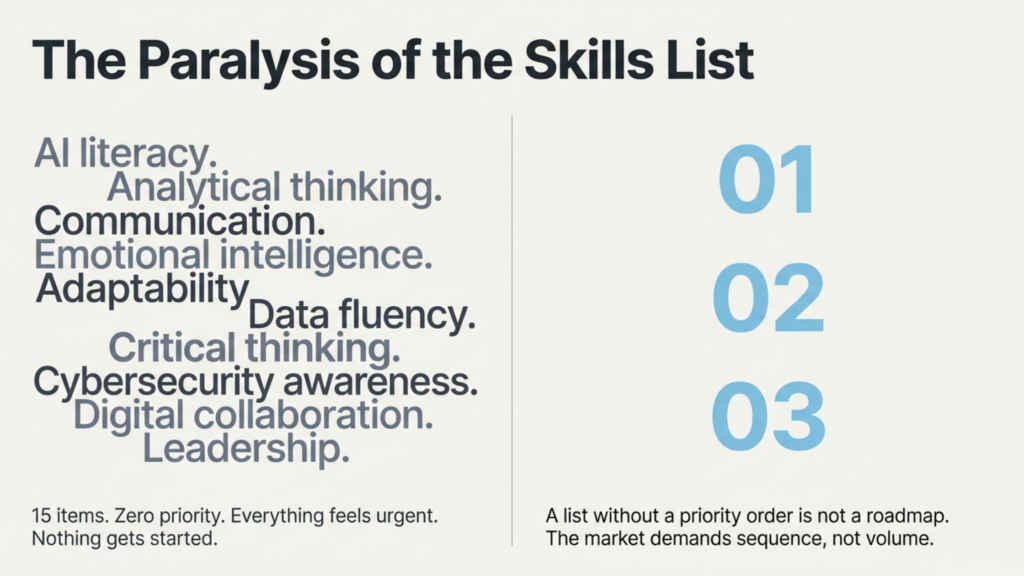
Every article about skills in 2026 gives you a list. AI literacy. Analytical thinking. Communication. Emotional intelligence. Adaptability. Data fluency. Critical thinking. Cybersecurity awareness. Digital collaboration. Leadership.
Most lists run to ten or fifteen items. Some are longer.
And then they tell you to build all of them. Usually with a single sentence of advice for each: “practice using AI tools,” “take on stretch projects,” “work on your active listening.”
Here’s the problem: a list without a priority order is not a roadmap. It’s a source of paralysis. When everything is urgent, nothing gets started. The candidates most hurt by this content pattern are the ones who open ten browser tabs on upskilling, make a list of skills to develop, sign up for two courses, and then three months later have completed neither.
The question “What skills do employers actually want?” deserves a better answer than another list. It deserves a sequencing logic: which skill do you build first, what does proof of that skill look like, and how do you move to the next one without losing momentum?
What the Data Actually Shows (Not the Headline Version)
Before sequencing, it’s worth reading the actual data rather than its press release version.
LinkedIn’s 2026 Skills on the Rise report, based on year-over-year growth in skill acquisition and hiring success across its platform, identified eight skill categories rising fastest in the US. AI engineering and implementation topped the list. But the second and third fastest-growing categories were operational efficiency (logistics, process optimization) and executive and stakeholder communication (public speaking, relationship development). Leadership and people management, business revenue growth, and risk compliance management followed close behind.
The World Economic Forum’s Future of Jobs Report 2025, which surveyed over 1,000 companies representing 14 million workers across 55 economies, found that 63% of employers cite the skills gap as their primary barrier to business transformation. The single biggest differentiator between growing and declining jobs, when they measured both importance and proficiency requirements, was resilience, flexibility, and agility, not AI engineering.
Two-thirds of managers say their recent hires’ biggest gap wasn’t technical skills. It was industry experience and context.
The pattern is consistent. AI skills are real and rising. But the actual scarcity of the skills that employers are struggling hardest to find and that correlate most directly with hiring success are communication, context, and adaptability. The headline is AI. The reality is messier and more human.
The Skill Sequence That Makes Sense
Given this pattern, here is a prioritized build order that works across most roles and career stages. Not a list or a sequence, with reasoning and proof formats for each.
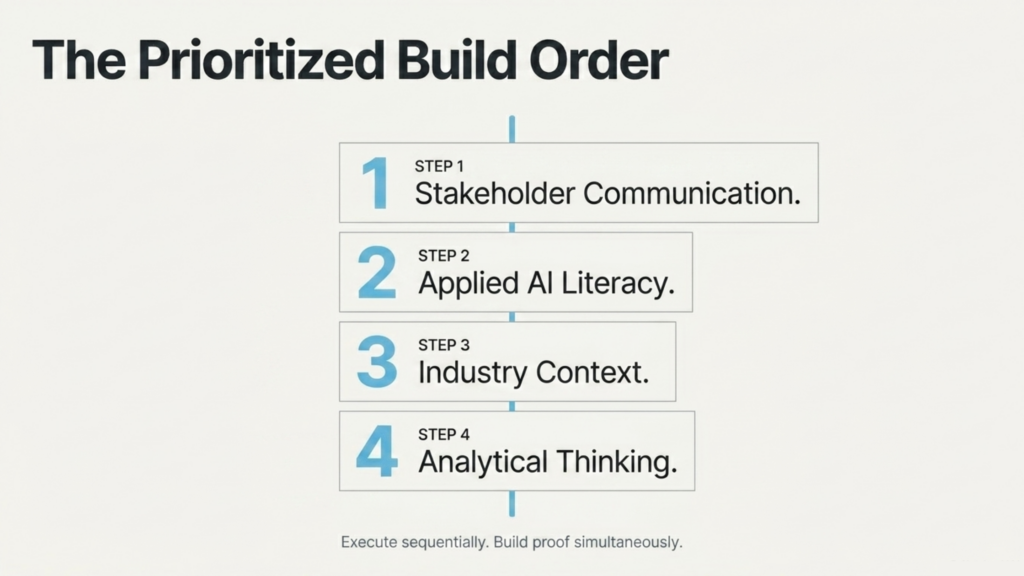
Stage 1: Stakeholder Communication – Build This First, Regardless of Role
This is the skill that LinkedIn’s 2026 data shows rising as fast as AI engineering, that 77% of hiring managers say is the top predictor of a new hire’s success, and that two-thirds of managers say their hires are missing most often. And it’s the skill almost everyone underestimates because it sounds soft and obvious.
Stakeholder communication in 2026 doesn’t mean “being a good talker.” It means being able to take complex information, a dataset, a technical system, or an ambiguous situation and translate it clearly to an audience that doesn’t share your background. It means being able to write a message that gets a decision made rather than a thread that keeps spiraling. It means knowing how to structure a five-minute update to a manager so they leave the meeting with what they need to act.
What proof looks like: In an interview, the hiring manager asking “walk me through a project you worked on” is directly testing this skill.
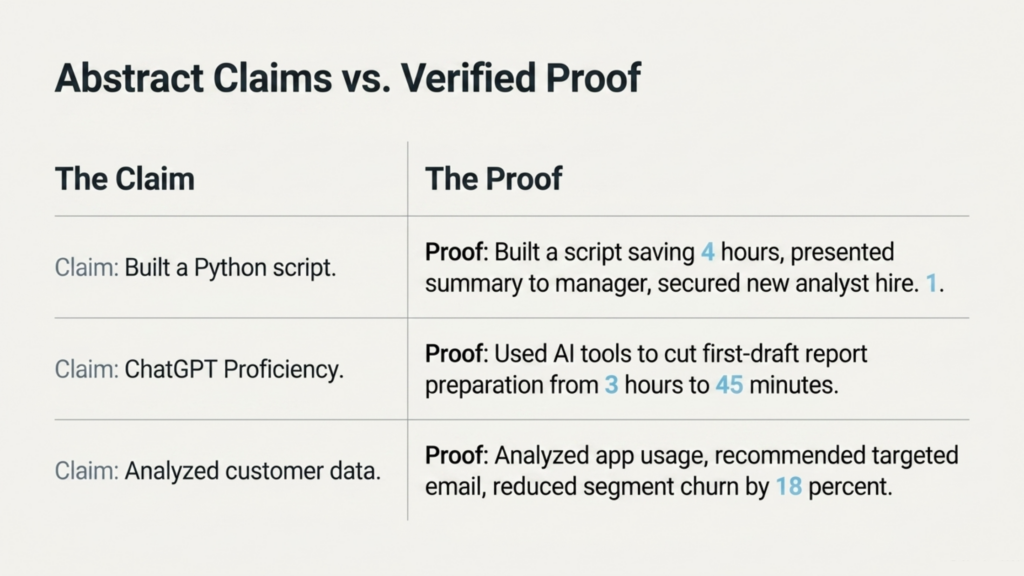
The candidate who says, “I built a Python script that automated our reporting,” signals technical ability.
The candidate who says, “I noticed our team was spending four hours a week on a manual report, identified the redundancy, built a script to automate it, and then put together a one-page summary for my manager showing the time saved, which they used to justify hiring an additional analyst,” that candidate is demonstrating stakeholder communication on top of the technical work. Same project. Completely different signal.
On a resume, this shows up through active verbs that involve audiences: “presented,” “briefed,” “documented,” “coordinated,” and “aligned.” Metrics that involve communication outcomes: “reduced stakeholder review cycles by 40%,” “created documentation used by 12 team members.” The presence of these signals is how a recruiter reads communication skills before an interview begins.
The build: Pick one communication format you currently avoid and do it intentionally once per week for six weeks. If you avoid writing, write a weekly summary of your work. If you avoid presentations, request one slot in a team meeting. The skill builds through repetition in real contexts, not through a course on “business communication.”
Stage 2: Applied AI Literacy – Specific, Not Generic
“Learn AI” is useless advice without specification. What it means depends entirely on your role.
Our internal analysis on what employers actually want in AI literacy (January 2026) landed on this: the competitive edge is not knowing how to build AI systems, it’s being able to use AI as a thinking partner to solve real problems faster than a colleague who doesn’t. The most valuable AI skill in 2026 is “building trust,” meaning the ability to validate AI output, recognize when it’s wrong, and apply it in ways that are accountable.
For a non-technical professional, applied AI literacy means: knowing which tool is right for which task, being able to write prompts that return useful outputs rather than generic ones, and being able to critically assess what the AI gives back rather than accepting it wholesale. Professionals using AI tools effectively save up to 10 hours per week. That’s the practical bar, not LangChain or PyTorch.
What proof looks like: CloudHire’s internal analysis shows a consistent question pattern:
“I know ChatGPT, but how do I show AI skills on my resume without it looking like I just Googled things?”
The answer is output-first framing. Instead of listing “ChatGPT proficiency” as a skill, describe a result: “Used AI tools to reduce first-draft report preparation from 3 hours to 45 minutes, with a structured review process for accuracy.” That’s proof. Tool name without outcome is noise.
The build: Pick one repetitive task in your current work or studies. Use an AI tool to assist with it for two weeks. Document the time saved, the accuracy rate, and the review process. That documentation becomes the proof artifact. It’s not about certification, it’s about having a story you can tell with a specific result attached.
Stage 3: Industry Context – The Invisible Edge
This is the gap that 66% of hiring managers flagged as the primary deficiency in new hires, and the one that almost no article on employer skills mentions because it doesn’t fit neatly into a “develop this skill” framework.
Industry context is your accumulated understanding of how work actually functions in your specific field: what the real constraints are, what solutions have been tried and failed, who the stakeholders are, what the measurement systems look like, and what the regulatory environment requires. It’s the knowledge that feels like common sense to a five-year veteran and is completely invisible to someone brand new.
For a fresher, the honest reality is that industry context takes time to build, but it builds faster when you’re intentional about it.
- Reading industry newsletters instead of general productivity content.
- Following practitioners on LinkedIn rather than thought leaders.
- Building a mental model of how the industry makes money and where the pain points are.
What proof looks like: In an interview, the industry context shows up through specificity. The candidate who asks, “I noticed in your last earnings call you mentioned pressure on margin is that driving the automation push for this role?” is demonstrating industry awareness that almost no other candidate will bring. The candidate who knows what the company’s actual competitors are and what’s shifting in their market signals they’ve thought beyond the job description.
CloudHire’s analysis also captures this as a consistent hiring manager complaint: “Most candidates talk about skills in the abstract. Almost none can tie their skills to an actual problem our industry has right now.” That gap is industry context, and it’s genuinely rare, which makes it disproportionately valuable.
The build: Spend 20 minutes three times per week reading industry-specific content from a trade publication, an analyst report, or a company’s investor materials for the industry you’re targeting. After four weeks, write a one-paragraph summary of the three biggest shifts in that industry. That summary becomes a conversation starter you can use in any interview.
Stage 4: Analytical Thinking – With a Result Attached
We found that 7 in 10 companies consider analytical thinking essential. Nearly 90% of employers look for evidence of it on resumes. It’s the most cited skill in employer surveys and, as a result, the most abused term in candidate self-description.
Every candidate says they’re analytical. Almost none can demonstrate it in a way that’s memorable.
Analytical thinking in an employer’s mind means: you saw a problem that wasn’t obvious, you gathered and interpreted information about it, you formed a conclusion, and you took or recommended an action that produced a result. That’s the full pattern, not just “I’m good at analyzing data.”
What proof looks like: The STAR method (Situation, Task, Action, Result) exists for behavioral questions, but the reason analytical thinking questions demand it isn’t just structural. It’s because the result is what separates someone who performed analysis from someone who influenced an outcome.
“I analyzed our customer data” is not proof of analytical thinking.
“I analyzed our customer data, found that 40% of churn was concentrated in customers who hadn’t used the mobile app in their first 30 days, and recommended a triggered onboarding email that reduced churn in that segment by 18% over the next quarter.” That’s proof.
The build: Identify one decision you’ve been involved in at school, in an internship, or in a project where you used data or observation to reach a conclusion. Write the story in four sentences: what was the situation, what information did you gather, what did you conclude, and what happened as a result. Practice saying it in two minutes. That’s the proof artifact for analytical thinking.
Frequently Asked Questions
Is getting an AI certification actually worth it, or is it just a checkbox?
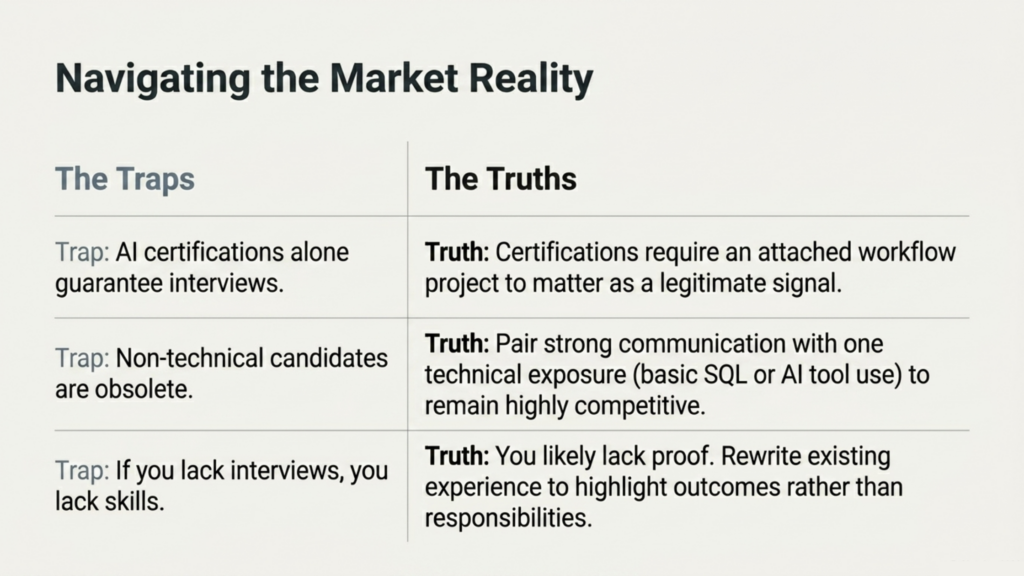
For most non-technical roles, a certification alone without demonstrated application is a checkbox. What compounds it into something valuable is the project you build during or after the certification, something you can point to and describe. A Coursera badge for “AI for Everyone” plus “I built a prompt workflow that cut my team’s weekly reporting time in half” is a legitimate signal. The badge alone is resume noise.
I have good communication skills but no technical skills. Am I still hireable in 2026?
More than you’d think and in more roles. Our 2026 data shows executive and stakeholder communication rising at the same rate as AI engineering. Operations, project management, account management, people management, and business development roles all have strong demand for communication-led profiles. The lever to pull is pairing strong communication with one specific technical exposure, not deep technical expertise, but enough to credibly operate in technical conversations. Basic SQL, basic data visualization, and basic AI tool use one of these, combined with strong communication, is a highly competitive profile in mid-market and enterprise environments.
Do employers in India actually care about soft skills, or is it still just DSA and technical rounds?
For mass recruiters (TCS, Infosys, Wipro), the first filter is aptitude and basic technical, but the interview rounds that actually advance candidates consistently reward communication clarity, structured thinking, and cultural fit signals. For product companies and startups, soft skills are weighted far more explicitly. The shift toward skills-based hiring is happening at different speeds, but the trend is consistent even in the Indian market. LinkedIn’s India-specific data shows communication and people management skills rising in parallel with technical skills in hiring success metrics.
I’ve been applying for months with the same resume. What skill am I actually missing?
According to our pattern analysis, in the majority of cases where a technically qualified candidate isn’t getting interviews, the deficit is not a missing skill; it’s a missing proof of skill. The resume lists capabilities without outcomes. The skill section says “strong communicator” without a single example of communication that mattered. The most impactful intervention is not learning another skill; it’s rewriting existing experience to reflect results, not responsibilities.
The Sequence, Summarized
Stage 1: Stakeholder communication – Build it through practice in real situations, prove it through outcomes-language on your resume, and structured stories in interviews.
Stage 2: Applied AI literacy – Pick one tool, build one result, document it. Specific beats generic every time.
Stage 3: Industry context – Build it through targeted reading, prove it through interview specificity that signals genuine awareness of what the company is navigating.
Stage 4: Analytical thinking – Find one real decision you influenced, structure the story with a result attached, and be able to tell it in two minutes.
That’s four skills, not fifteen! Four sequenced, with proof formats built in. This is a plan you can execute in three months, not a list you can feel guilty about for a year.