TL;DR: Most candidates don’t fail because they lack skills. They fail because they misjudge their actual skill level before a live assessment starts. Employers are hiring more for demonstrated ability now, but many candidates still rely on resume language, course completions, or vague self-confidence. A real skill assessment helps you benchmark your abilities against the standard a role actually tests for, so you can apply smarter, prepare better, and avoid unpleasant surprises in interviews.
The Problem With Self-Assessment
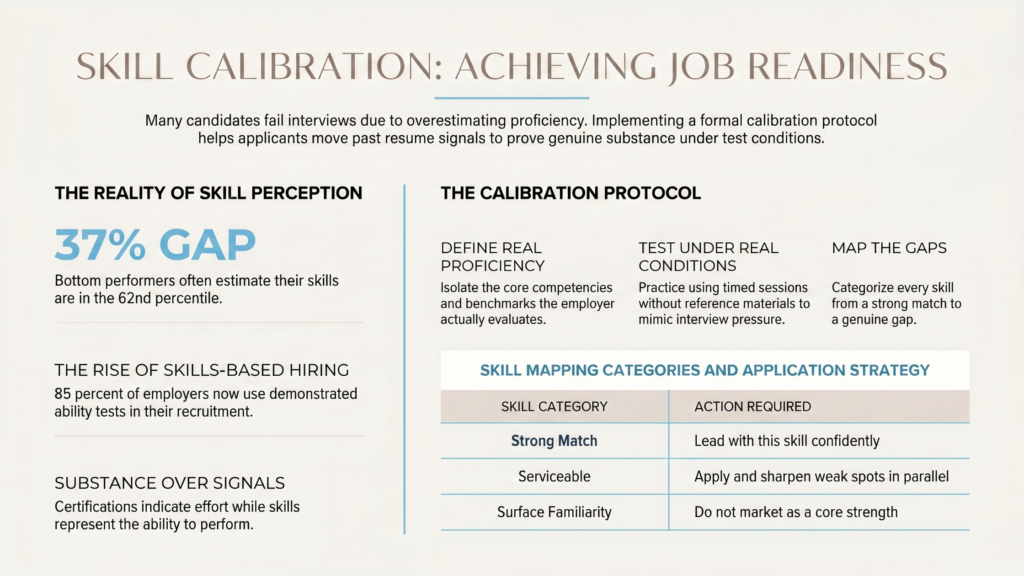
Here’s the number that should change how every candidate approaches a job search: in Dunning and Kruger’s original research, people in the bottom performance quartile estimated they were performing in the 62nd percentile. In other words, they did not just guess wrong. They genuinely believed they were above average because they lacked the ability to see their own gaps.
The correlation coefficient between actual performance and self-assessed performance was −0.590-0.590−0.590, which shows a strong negative relationship: the weaker the performance, the more inflated the self-rating.
Now bring that into a job search.
A candidate applies for a data analyst role and lists SQL on their resume because they have used it, completed a course, and feel comfortable with the basics. They pass the resume screen and reach the interview stage. Then the live assessment includes window functions, subqueries, and optimization logic that they have not used in a year.
Under interview pressure, with cortisol high and recall weakened, they underperform.
That is not unusual. It is what happens when candidates skip the one step employers cannot do for them: an honest skill assessment before the process starts.
Why Certifications Are Making This Worse
The skills-based hiring movement was supposed to reduce dependence on degrees and shift attention toward what people can actually do.
That shift is real. Our internal analysis reports that 85% of employers now use some form of skills-based assessment in hiring, up from 57% in 2022. McKinsey has also found that skills-based hiring is far more predictive of job performance than education credentials alone.
But candidates have responded by collecting a new kind of credential: certifications.
Coursera badges, LinkedIn Learning completions, and Udemy certificates can all signal effort. They do not automatically prove readiness under test conditions.
A 12-hour Python course means you were exposed to Python. It does not mean you can debug unfamiliar code, write efficient logic under time pressure, or apply the skill in a live assessment.
That gap matters.
We in Cloudhire noted this pattern was that, while many companies talk about skills-based hiring, actual hiring practices are often still influenced by credential signals. In many cases, the employer has not fully moved away from checking signals. They have simply shifted from degrees to certifications.
The distinction is simple:
- The certification is the signal.
- The skill is the substance.
- A real skill assessment tests the substance.
What a Real Skill Assessment Is
A real skill assessment is not “Do I feel confident?”
It is: “Can I perform at the level this role actually requires, under the same conditions the employer is likely to use?”
That means benchmarking yourself against the role, not against your own memory or assumptions.
The Calibration Protocol
Running an honest skill assessment on yourself requires a process. Reflection alone is not enough, because the same biases that distort your confidence can distort your self-review.
Step 1: Define the Real Proficiency Level
Start with the job description and isolate the three to five skills that will likely be tested.
Do not focus on every requirement. Focus on the core competencies the employer will actually evaluate in interviews or assessments.
For each skill, find a benchmark:
- What does intermediate SQL really require?
- What does a strong analytical thinking response look like?
- What does “strong stakeholder communication” mean in practice for this role level?
Candidates often self-assess against a vague internal standard. The only standard that matters is the employer’s standard.
You can usually find clues through:
- Interview reviews on Glassdoor.
- Sample assessment questions.
- Public interview guides.
- Role-specific benchmarks from professional bodies or industry frameworks.
Step 2: Test Yourself Under Real Conditions
Now test yourself against that benchmark, not your memory of the skill.
Use conditions that mimic the actual hiring process:
- Timed.
- Without reference material.
- In one sitting.
- At the level the role demands.
Examples:
- For technical skills, use LeetCode, HackerRank, or domain-specific assessment platforms.
- For analytical thinking, solve a case study from scratch and compare your output to a strong model answer.
- For communication, record yourself answering a behavioral question and review it using structured interview criteria.
The goal is not to “feel ready.” The goal is to collect evidence.
Step 3: Map the Gaps Honestly
After testing, sort each skill into one of four categories.
- Strong match: You perform at or above the benchmark.
- Serviceable with rough edges: You have the foundation, but specific sub-skills need work.
- Surface familiarity: You know the language, but not at the level the test requires.
- Genuine gap: You do not yet meet the standard required for the role.
This step changes the job search strategy.
If a skill is a strong match, you can lead with it confidently.
If it is serviceable, you can apply and sharpen the weak spots in parallel.
If it is only surface familiarity, do not market it as a core strength.
If it is a genuine gap, close it before applying or reconsider whether the role is the right target right now.
Step 4: Get External Calibration Where Self-Scoring Is Weak
Some skills can be scored objectively. Others cannot.
Technical skills often have right and wrong answers. Communication, leadership judgment, and analytical reasoning are more subjective.
That is where outside feedback matters.
If possible, ask someone with direct experience in the role or hiring process to review your output against a professional standard. That gives you a more accurate view than working in a vacuum.
What these Changes in Practice
The result of a real skill assessment is not just a list of courses to take. It is a clearer picture of where you actually stand.
That changes your job search in practical ways:
- You apply to roles that match your current level.
- You avoid overselling skills that will collapse in a live test.
- You prioritize prep time where it will have the most impact.
- You enter interviews with a more grounded kind of confidence.
That last point matters more than people think.
Real confidence is not pretending to know more than you do. It is knowing exactly what you can do, what you cannot yet do, and where the gaps are.
Why This Matters Before You Apply
Most candidates don’t pause to ask a critical question early enough: how to assess their skills before an interview.
Instead, they jump straight into applications, hoping their current understanding of their abilities is accurate. But without a clear way to measure it, that confidence is often untested.
If you’re trying to figure out how to know if you are ready for a job, the answer isn’t more applications; it’s better calibration. A proper skill assessment for job interview preparation means understanding what the role will actually test and where you currently stand against that bar.
This is where many candidates struggle. They don’t have a clear method for how to measure skill level in a way that reflects real hiring conditions.
CloudHire is built around this exact gap. Instead of encouraging more applications, the focus is on helping candidates understand how their skills map to real roles through structured evaluation and clearer role alignment. If you’re curious about CloudHire skill assessment, how it CloudHire.ai works? The core idea is simple: match candidates based on demonstrated ability, not just self-reported skills.
When this kind of calibration happens early, before applications go out, the entire search becomes sharper.
Applications become more targeted.
Preparation becomes more focused.
And the assessment stage stops feeling like a trap.
Many candidates apply for months with little traction, only to realize later that their primary listed skill was performing two levels below what the roles required. Not because they lied, but because they never tested themselves against the actual standard.
Once that gap is identified and closed, results tend to change quickly.
Honest Truth
Most candidates know, at some level, that their self-assessment is approximate.
They list skills they are fairly comfortable with, hope the assessment does not go too deep, and adjust after the interview if needed.
Sometimes that works.
But when it does, it often leads to a role where the candidate is underprepared on day one.
A real skill assessment, done before the search, against real benchmarks and real conditions, gives you a better starting point.
You know what you can actually do.
You know what the employer is likely to test.
And you know which gaps still need attention.
That is a serious advantage in a market where many candidates are competing for the same role and only a small percentage reach an interview.
The people who know exactly what they can do and can prove it when asked are not lucky.
They are prepared.
Final Takeaway
If you want to improve your hiring outcomes, stop asking only, “What skills do I have?”
Start asking:
- What level does this role actually require?
- Can I prove I meet that level under test conditions?
- Which skills are real strengths, and which are only familiar on the surface?
That is the difference between hoping you are ready and knowing you are.
Frequently Asked Questions
How does Dunning-Kruger effect impact job interviews?
The Dunning-Kruger effect causes low performers to overestimate their skills (e.g., bottom 25% rating themselves 62nd percentile) and high performers to underestimate. In interviews, this leads to surprises: overconfident candidates bomb live tests they thought they’d ace, while strong ones undersell themselves. To counter it, use objective benchmarks and mock assessments to calibrate your self-view accurately before applying.
Should I list skills on my resume if I’m not 100% proficient?
Yes, but be strategic lead with proven strengths (back them up in interviews) and frame others honestly (e.g., “Familiar with Python via projects; strengthening advanced debugging”). Overselling surface familiarity risks failing assessments. A pre-application skill audit ensures your resume reflects testable reality, boosting credibility.
How long does it take to close a skill gap for a job?
It varies: 2-4 weeks for polishing serviceable skills (e.g., SQL subqueries via daily HackerRank), 1-3 months for surface familiarity (structured practice + projects), longer for genuine gaps (full courses + real-world application). Track progress weekly with benchmarks. Target 80%+ proficiency before applying to avoid rejection loops.
Can AI tools help with real skill assessment?
Yes, tools like CloudHire.ai, LinkedIn’s Skills Assessments, or ChatGPT for mock case feedback speed things up. Upload your code/practice output for analysis, or simulate interviews. But they’re supplements combine with human calibration and timed practice for accuracy, as AI misses nuanced judgment like cultural fit.