Why the standard job search approach is structurally designed to exhaust you and the specific system that changes the math
Application fatigue comes from running a high-volume, low-return strategy on the worst-converting channels while rebuilding the same materials from scratch every time. It’s not a mental health crisis to manage; it’s an operational inefficiency to fix. The data shows tailored applications outperform generic ones by 115%, Google Jobs delivers 3x LinkedIn’s response rate, and recruiter-sourced candidates are 8x more likely to be hired. None of this requires more willpower. It requires a different system.
The Advice Isn’t Helping
Every article about application fatigue arrives at the same place: take breaks, set a schedule, celebrate small wins, quality over quantity, lean on your community, stay patient.
It’s not wrong advice. But it’s treating a strategy problem as an emotional problem, which is why reading it doesn’t fix anything.
Here’s what’s actually happening when a candidate hits application fatigue: they’re running a high-effort, low-return operation, on the wrong channels, with no infrastructure, for weeks or months on end. The exhaustion is real, but its source is not insufficient resilience. It’s an approach that structurally guarantees more work per outcome than the market requires.
The fix isn’t psychological reframing. It’s a system redesign.
The Volume Paradox Nobody Resolves
Here’s the contradiction that sits at the center of every fatigue conversation, never addressed directly:
Every article tells candidates to focus on quality over quantity, fewer applications, and more tailoring. Every data report simultaneously shows that most candidates need significant application volume before landing an offer. The most common path to an offer involves a range from targeted searches of 10–20 applications to, for a meaningful subset of candidates, 100 or more and tech job seekers needed an average of 294 applications per offer.
So, which is it, volume or quality?
The answer is that this is a false binary, and accepting it as a real choice is the first thing that keeps candidates stuck.
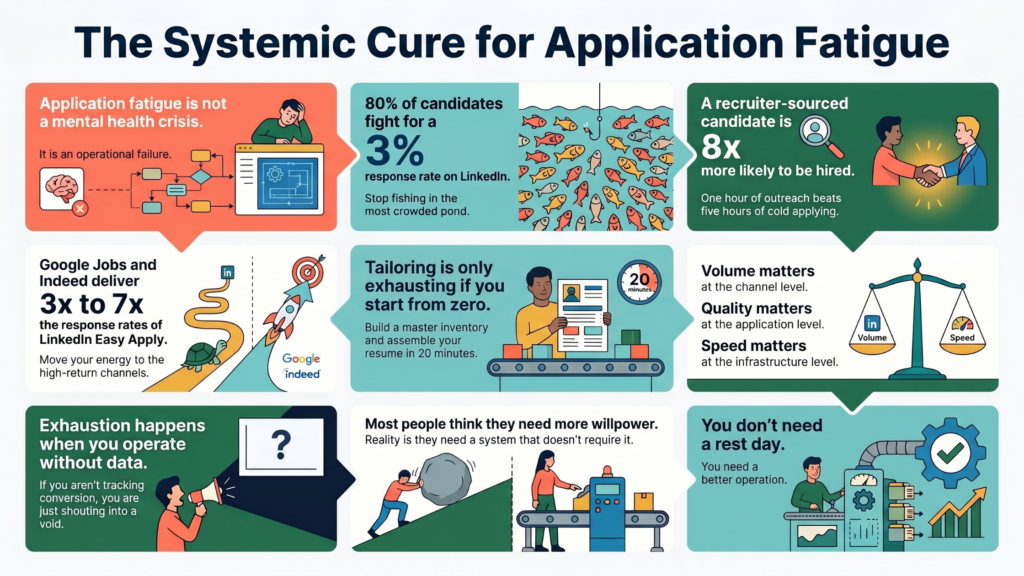
The actual resolution: volume matters at the channel level, quality matters at the application level, and speed matters at the infrastructure level. These three things are not in conflict. They require different decisions at different points in the process, and conflating all three into a single “how many applications should I send today” question is where the confusion and the fatigue start.
The Channel Problem: Where 80% of Candidates Spend Time for 3% Returns
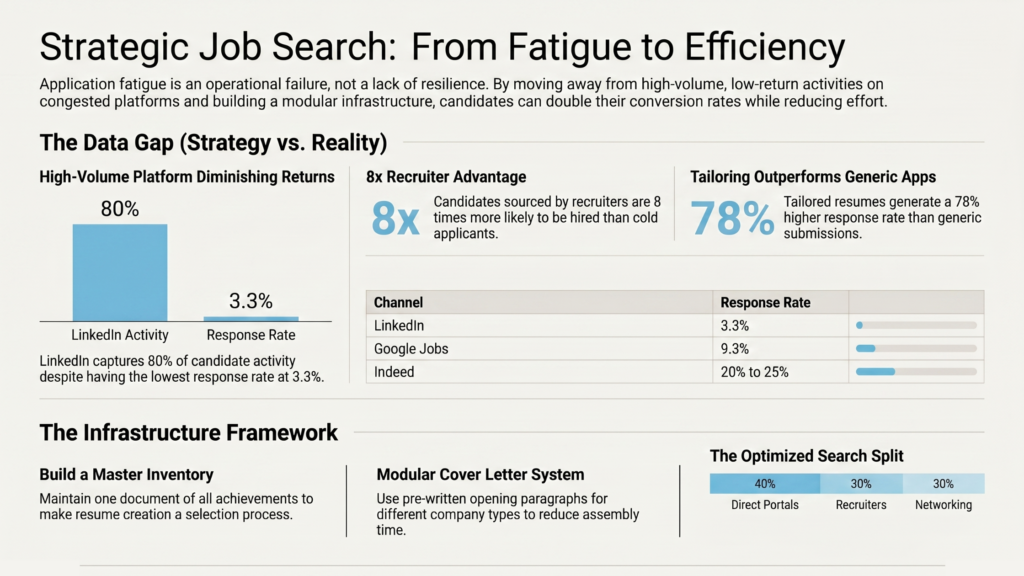
CloudHire’s Q2 2025 dataset, covering 461,000 tracked applications, found that LinkedIn captured nearly 80% of job saves, the overwhelming majority of where candidates focused their search activity. The platform processed around 11,000 applications per minute in 2025.
LinkedIn’s average response rate: 3.3%.
Google Jobs, which captured a tiny fraction of candidate attention, delivered a 9.3% response rate nearly three times higher. Indeed, averaging 20–25% response rates. Industry-specific or niche boards consistently outperform general boards on callback rates.
Candidates are concentrating 80% of their energy in a channel with a 3% response rate and wondering why they’re exhausted. The math of 3% means that to get 10 interview callbacks, you need 333 applications submitted on LinkedIn alone. At 45 minutes of tailoring per application, that’s 250 hours of work to generate 10 conversations. The fatigue is not mysterious.
What to do with this:
Shift channel weighting before adjusting application volume. If you’re currently spending 80% of your search time on LinkedIn Easy Apply, restructure to something closer to 40% LinkedIn (but off the Easy Apply queue, direct applications through company portals), 30% Indeed and Google Jobs (where response rates are materially higher), and 30% recruiter contact and referral activation.
The reason most candidates don’t do this: LinkedIn feels comprehensive and familiar. The job listings are visible. The apply button is right there. But visible and convenient is not the same as effective, and in this case, the most visible channel is also the most congested and lowest-converting one in the stack.
The 8x Factor Nobody Talks About
Our internal research on how candidates actually get hired surfaced a number that should change how every fatigued job seeker thinks about their time: candidates sourced by recruiters are 8x more likely to be hired than candidates who apply through job boards cold.
Eight times
This is not a marginal improvement. It’s a different category of opportunity. Yet almost every application fatigue article treats outbound recruiter engagement as a supplementary activity (“try networking!”) rather than what the data suggests it is: the highest-return hour you can spend in a job search.
This is also where most candidates hit a wall. Knowing recruiter pipelines matter doesn’t automatically give you access to them.
CloudHire is built around this gap, connecting candidates directly into recruiter-led hiring flows instead of relying only on cold applications. It doesn’t replace your search, but it changes the odds on the highest-converting channel.
The operational translation of this data:
One hour spent sending targeted outreach to five relevant recruiters on LinkedIn with a specific, non-generic message referencing a role type, a specific company of interest, or a skill that aligns with their placement history produces better expected return than five hours of cold job board applications. Not because networking is magic, but because the hiring pipeline a recruiter puts you into carries an 8x conversion advantage before you’ve done anything else.
What outreach that actually works looks like:
Not: “Hi [Name], I came across your profile and I’m looking for new opportunities in marketing. Would love to connect.”
Instead: “Hi [Name], I noticed you’ve placed several demand-gen marketers at Series B SaaS companies over the past year. I’m a performance marketing manager with four years in that exact space, currently open to my next move. Happy to share my background if it’s relevant to anything you’re working on.”
The difference: the second message signals domain knowledge, demonstrates awareness of their specialization, and opens a door without making the recruiter do unnecessary work to understand why you’re relevant. That’s the version that gets replied to.
The Infrastructure Gap: Why Tailoring Is Exhausting (And Doesn’t Have To Be)
The dataset is clear: tailored resumes generate approximately 6 interview opportunities per 100 applications. Generic submissions generate fewer than 3 and 78% higher response rate for tailored applications. The case for tailoring is not debatable.
The problem is that tailoring, done the way most candidates do it, is genuinely exhausting. Starting from a blank document for every role, rewriting the professional summary, rearranging bullets, adjusting the skills section, then writing a fresh cover letter and doing this for every application is how a job seeker burns through 20–25 hours a week and produces only marginal output improvement over a well-built base.
The fix is infrastructure, not effort.
Build this once, use it forever:
The master resume: A document with every role, every achievement, every metric, every skill. It’s not a resume, it’s an inventory. This document never gets submitted anywhere. It exists so that building any specific resume becomes selection and arrangement rather than creation.
Three role-type resume shells: From the master, build 3–4 versions targeting different role categories you’re applying for. A marketing role resume and a content strategy resume pull from the same master but emphasize different sections. Each shell takes 2–3 hours to build correctly once. After that, tailoring a new application means making 8–12 targeted edits to a shell, swapping a bullet that closely mirrors a job description requirement, adjusting the professional summary to reflect the company’s language, and adding one keyword from the posting that’s missing. That’s 20–30 minutes, not 2 hours.
The modular cover letter: Build a template with fixed structural sections and swappable components. Opening paragraph (why this company is a single specific detail), middle paragraph (your most relevant proof point for this role type), closing (call to action). The only section that changes materially between applications is the opening paragraph. If you have 5–6 opening paragraph variations pre-written for different company types and role levels, assembly is 10–15 minutes.
The tracking sheet: Not for administrative tidiness for signal detection. Tracking application date, role type, company stage, channel used, resume version, and response outcome across 40–50 applications reveals patterns that are invisible otherwise. Which role type gets the most callbacks? Which channel is actually converting? Which resume version is performing? Without this data, candidates make emotional decisions (“it feels like nothing is working”) rather than strategic ones. The tracking sheet is what turns job searching into something with feedback loops.
If you don’t want to build all of this manually, CloudHire does bundle parts of this infrastructure, resume optimization, recruiter visibility, and signal tracking into one system. CloudHire is designed to reduce the manual overhead while improving how your profile gets surfaced.
What Application Fatigue Actually Is
Once you see the operational frame clearly, the nature of application fatigue changes.
It’s not primarily the emotional weight of rejection, though rejection is real and costs something. It’s the exhaustion of high-effort, low-signal work that produces no usable information about what to change. Sending 50 generic applications on LinkedIn, receiving 1 callback, and not knowing whether the problem was the channel, the resume version, the role type, or the company size, that’s not a search. That’s a coin flip repeated 50 times.
Fatigue follows from operating in a feedback vacuum. When effort produces no information, the mind has no way to calibrate, no way to adjust, improve, or feel progress. And without the experience of progress, sustained effort becomes extremely difficult, regardless of how much you want the outcome.
The system described above produces feedback. Different channels give you response rate data. Different resume versions give you conversion data. Recruiter relationships give you real-time market intelligence about what’s actually being hired. Applications to role types you’ve pre-defined give you a pattern instead of noise.
When the search has feedback, it stops feeling like shouting into a void. And when it stops feeling like shouting into a void, the fatigue changes character. It becomes the manageable tiredness of a difficult project rather than the demoralizing exhaustion of a broken one.
The Rebuilt System, Summarized
Week 1: Build infrastructure. Master resume, three role-type shells, modular cover letter, tracking sheet. This is not applying; this is a setup. It takes 8–10 hours and pays back every hour after.
Week 2 onward: Allocate 40% of search time to LinkedIn direct applications (not Easy Apply) and Indeed/Google Jobs, where response rates are 3–7x higher than LinkedIn Easy Apply. Allocate 30% to recruiter outreach, five targeted messages per week minimum, personalized to specialization. Allocate 30% to network activation, former colleagues, people at target companies, and informational conversations that create warm paths.
Track everything. After 30–40 applications across this system, you’ll have enough data to see what’s converting and what isn’t. Adjust the allocation. Double down on what’s working.
Remove the volume target. The question is not “how many applications should I send today?” The question is “am I activating all three channels, using my infrastructure correctly, and tracking the outcomes?” If yes, the volume takes care of itself.
Application fatigue is real. But most of what’s generating it is recoverable through a strategy change, not a rest day, not a reframe, and not more patience with a process that hasn’t been fixed.
The search is an operational problem. Build a better operation.
If your job search feels like high effort with no signal, it’s not random. It’s structural.
CloudHire helps you shift from cold applications to recruiter-led pipelines, where your profile gets seen, not filtered out.